

A diagnostic enzyme QC checklist should determine whether a defined lot is suitable for a defined use. It needs more than a purity value and an activity number: the identity, test conditions, relevant impurities, formulation and handling history must support an interpretable acceptance decision.
Use the checklist below as a development framework. Assign product-specific methods, limits and responsibilities before routine use. Some checks belong in initial qualification or change evaluation; others belong in every-lot review. The appropriate division follows the material and application risks.
Define what the checklist is deciding
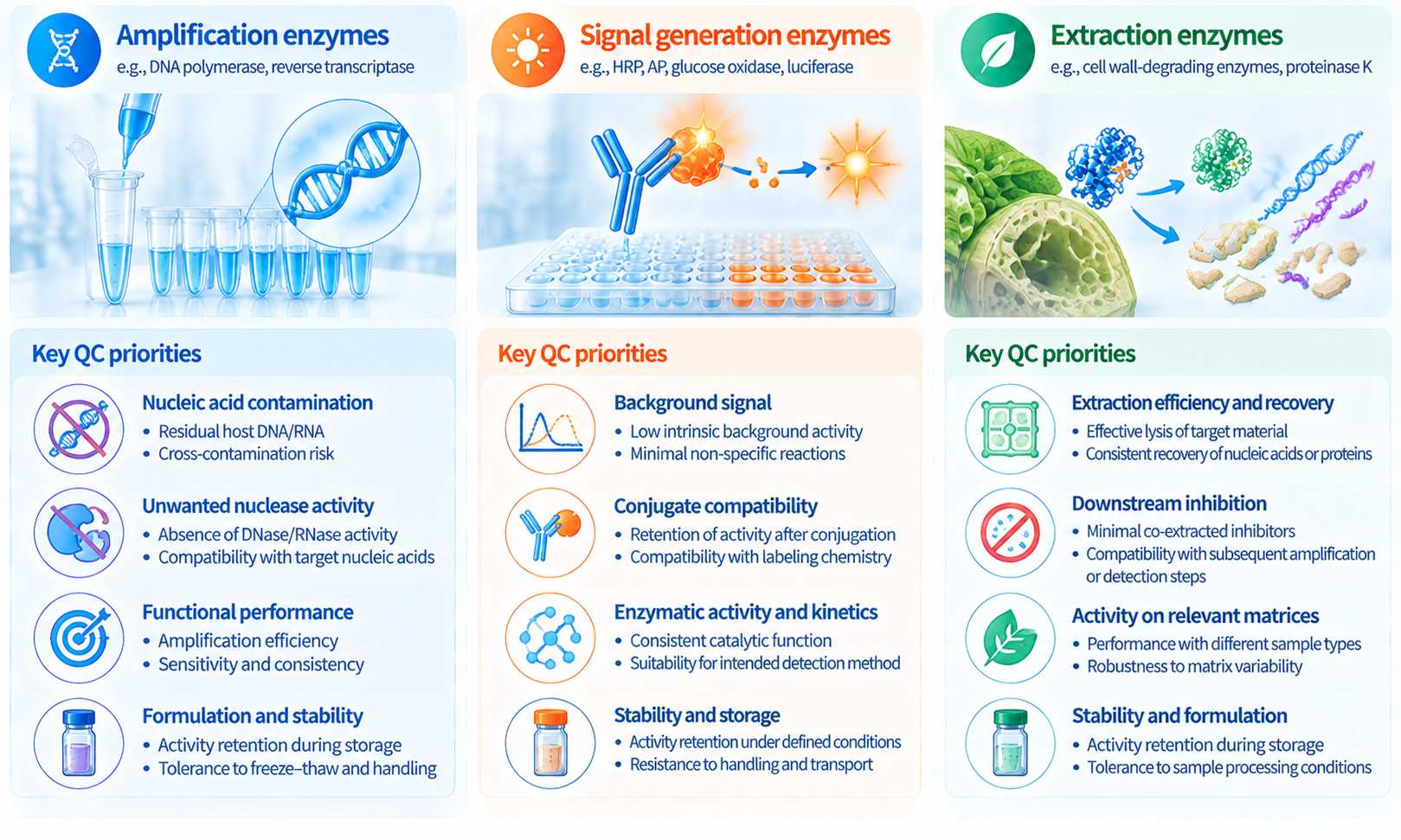
Start with the enzyme's role in the intended reagent. A polymerase, an immunoassay signal enzyme and an extraction protease encounter different substrates and failure modes. Document the reaction system, expected enzyme input and the conditions the material will experience before use.
Separate qualification of a new source from routine acceptance of a familiar lot. New-source qualification may require exploratory characterization and application comparisons. Once that relationship is understood, routine controls can focus on attributes that detect relevant variation. A shorter release panel needs a scientific rationale, not simply a lower testing cost.
Write each specification as an attribute, an identified method and an acceptance criterion. Include the result basis and units. Statements such as high purity or strong activity cannot support a reproducible decision unless the measurement and acceptable outcome are defined.
Eurachem describes analytical fitness for purpose in relation to the measurement task. Apply that logic to the checklist: a method must be capable of resolving the decision being made. An assay with poor precision near a release boundary may create apparent lot differences that are actually measurement variation.
| Checklist item | Record or evidence | Reason to investigate |
|---|---|---|
| Intended application | Reaction role, formulation and relevant use conditions. | Use differs from the qualified application. |
| Specification version | Approved attributes, methods, limits and units. | Result is judged against an obsolete or undefined limit. |
| Testing responsibility | Which results are supplier-tested, independently confirmed or periodically checked. | A critical attribute has no clear evidence owner. |
| Sampling plan | Representative units, sample handling and retained material. | Tested aliquot may not represent the received lot. |
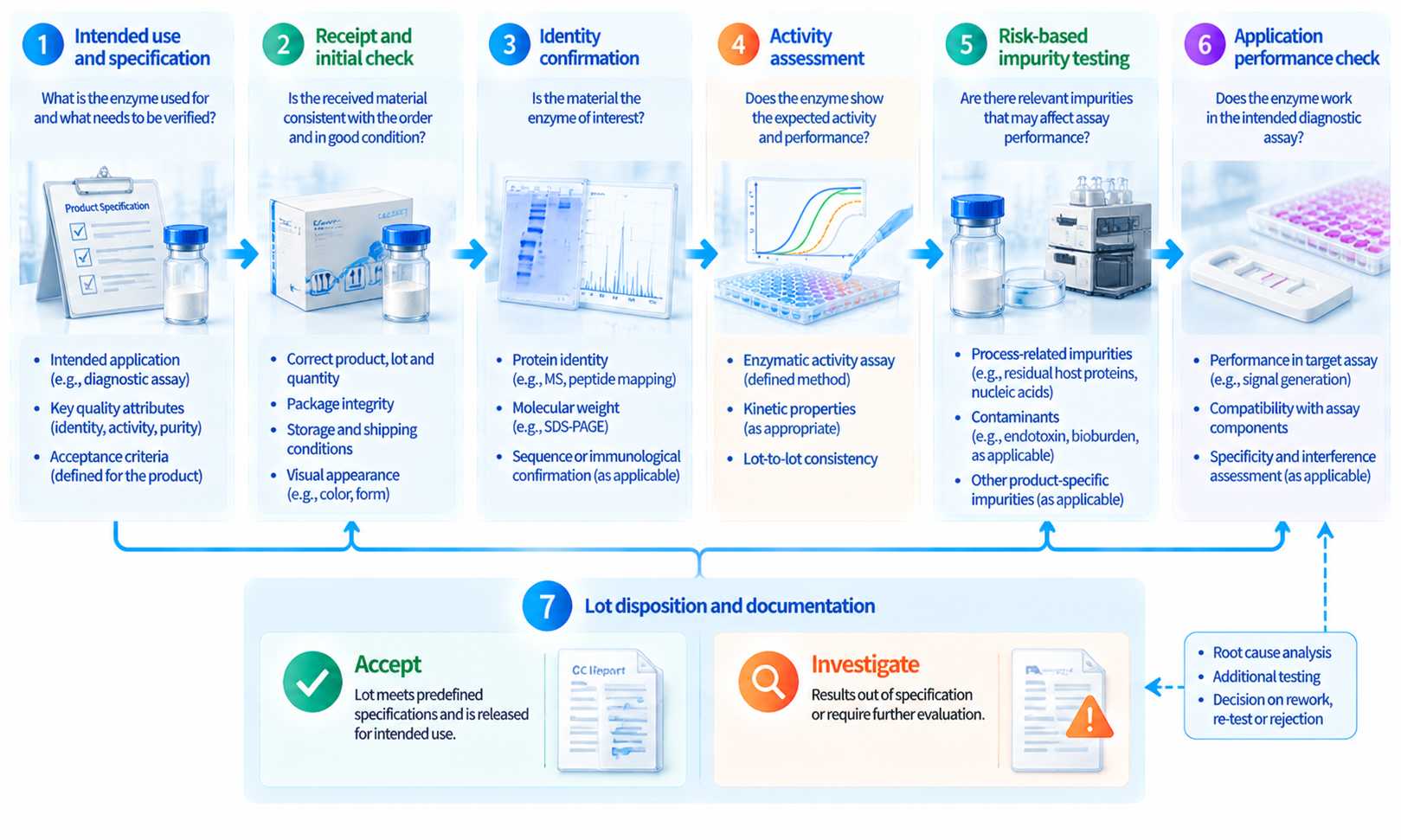
Confirm what arrived and whether its identity is supported
Reconcile the container label, order, certificate of analysis and internal receipt record. Check lot identity, quantity, concentration basis and formulation. Record discrepancies before combining containers or consuming the only available sample, so an investigation can remain traceable.
Review the source and construct description when relevant: native or recombinant origin, sequence variant, purification tag and tag-removal status. A familiar enzyme name may cover preparations with different molecular forms. Those differences can matter even when both preparations catalyze the same nominal reaction.
Identity testing should discriminate the intended enzyme from plausible alternatives. An electrophoretic band at the expected apparent mass is supporting information, but another protein can migrate similarly. The protein-QC guidance by de Marco and colleagues emphasizes identity and integrity as separate elements of sample quality.
Record the condition on receipt, including any relevant shipping information and signs of container damage or unusual appearance. A temperature excursion is a reason to assess the applicable evidence, not automatic proof of failure or suitability. Preserve the material under the specified conditions while that assessment is made.
For a changed source or construct, ask whether existing identity criteria remain meaningful. A method designed around an old tag or molecular form may need revision. Update the comparison deliberately rather than treating a changed pattern as acceptable because activity remains detectable.
Read activity results together with their definition
An activity value is inseparable from the assay conditions used to assign it. Check the substrate, temperature, pH, cofactors, reaction interval and calculation. STRENDA provides a useful reporting framework for these details. Results measured under different conditions should not be treated as directly equivalent merely because both use the symbol U.
Distinguish activity concentration from specific activity. Activity per milliliter describes the usable catalytic amount in a volume of stock. Activity per milligram depends additionally on the protein-mass measurement and what protein that denominator includes. Carrier proteins or other protein components can change its interpretation.
Review whether the reported activity is within the method's working range and whether controls supported the run. Excessive enzyme input can produce an endpoint that is no longer proportional to the amount added. A result obtained outside the method's established range should not be rescued by a favorable numerical value.
Where an internal reference lot is used, control its identity, handling and stability too. Comparing every new lot with an aging reference can mask a downward trend. A relative result is useful only when the comparator and the comparison conditions remain meaningful.
Evaluate activity and concentration together when a result is unexpected. Low activity per volume may reflect dilution, loss of active enzyme or a measurement problem. The Activity Assay Method Validation for Diagnostic Enzymes explains the method checks needed before assigning the cause to the material.
| Check | Evidence to retain | Interpretation boundary |
|---|---|---|
| Unit definition | Exact method and calculation basis. | Same unit label does not guarantee equivalent methods. |
| Protein concentration | Measurement method and formulation blank. | Total protein is not automatically active-enzyme concentration. |
| Assay controls | Blank, reference and run-suitability results. | A passing sample result does not override a failed analytical run. |
| Application dose | Actual volume or activity input used in the reagent. | More stock also introduces more formulation components. |
Select impurity checks that address the application
A generic purity test cannot cover every material risk. Oliveira and Domingues distinguish purity, homogeneity and structural conformity in recombinant-protein quality. Use those categories to ask what is present, whether the enzyme forms a consistent preparation and whether its state is compatible with function.
For molecular amplification enzymes, consider relevant nucleic-acid contamination and unwanted nuclease activity. A trace contaminant may be functionally important even if it contributes too little mass to appear in a routine protein profile. A contamination result must be interpreted with the sensitivity and controls of the test used.
For an immunoassay signal enzyme, include the behaviors that affect the signal system: background, substrate response and, where applicable, compatibility with the conjugation process. A free-enzyme activity assay may not predict how the enzyme behaves after it is attached to an antibody.
For an extraction enzyme, the relevant outcome can include adequate target recovery and compatibility with downstream detection after the intended removal or inactivation step. Residual activity, salts or other preparation components may need investigation if the final amplification is affected.
Choose additional tests such as residual host-cell proteins, residual DNA, bioburden or endotoxin only where the process and intended use justify them. Do not copy a therapeutic-protein release panel wholesale into a diagnostic raw-material specification. Different products can require different controls.
Document the detection capability for absence claims. Prefer a result tied to the stated method and its limit over an unqualified contaminant-free statement. Use the Purity Characterization Methods for Diagnostic Enzymes when the question requires complementary structural, separation or impurity-specific measurements.
Check whether the tested material represents the material in use
QC results are often obtained soon after manufacture or receipt, while the enzyme is used after storage, dilution or several handling steps. Identify which of those states the existing evidence covers. A freshly prepared stock result does not establish performance after the maximum permitted preparation hold.
Review the stated storage conditions, container and opening history. Include freeze-thaw or dilution studies where those actions are part of the actual workflow. A blanket instruction to avoid every exposure is less useful than a handling specification supported by an appropriate comparison.
WHO TGS–2 separates storage, transport and in-use stability for IVDs. The distinction is useful when reviewing enzyme handling evidence, although the document's regulatory context is the complete IVD. Match the raw-material question to the relevant exposure rather than borrowing a finished-kit shelf life.
For a diluted working preparation, confirm that the activity delivered remains consistent over the intended interval. Dilution changes the concentration of stabilizers as well as enzyme. Reusing stock-storage evidence without considering that change leaves a gap in the QC rationale.
Record the reference date and material state associated with each result. If a lot is retested after extended storage, preserve the earlier result rather than replacing it. The sequence can reveal a trend that a single current value hides.
Close the review with a documented decision
Compare the results with the predefined specification and verify that the analytical runs were valid. Resolve discrepancies between documents and measurements before disposition. A certificate and an internal result that disagree may reflect different methods or sample histories, so compare those details before concluding that either result is wrong.
An unexpected or out-of-specification result should lead to a documented investigation. Retesting can answer a defined question, but repeated testing until a passing number appears does not explain the original observation. Preserve the initial result and the rationale for any additional measurement.
Record whether the lot is accepted, held for investigation or rejected under the applicable procedure. Identify any approved restriction on use and who authorized the decision. Keep the underlying evidence accessible to the people who formulate or qualify the finished reagent.
Trend selected attributes across lots using consistent methods and conditions. A drift within broad acceptance limits may warrant attention before it creates an application failure. Separate analytical changes from material changes when interpreting that trend.
Define when qualification must be revisited: a new source, altered formulation, changed manufacturing process or revised application can make the existing panel incomplete. The checklist succeeds when it supports a traceable, scientifically justified decision and remains connected to the way the enzyme is actually used. Source guidance was checked September 24, 2026; review this framework when methods or requirements change.
Sources and further reading
- STRENDA Commission, Beilstein-Institut. STRENDA Guidelines: Enzyme Kinetics and Assay Conditions. Current public guidelines; accessed September 24, 2026.
- Eurachem. The Fitness for Purpose of Analytical Methods: A Laboratory Guide to Method Validation and Related Topics. Third edition, 2025.
- de Marco A and colleagues. Quality control of protein reagents for the improvement of research data reproducibility. Nature Communications. 2021. DOI: 10.1038/s41467-021-23167-z.
- Oliveira C, Domingues L. Guidelines to reach high-quality purified recombinant proteins. Applied Microbiology and Biotechnology. 2018;102:81–92. DOI: 10.1007/s00253-017-8623-8.
- World Health Organization. Establishing stability of in vitro diagnostic medical devices. Technical Guidance Series TGS–2, 2018.