

A second enzyme source is useful only when it can support the intended reagent reliably. Matching an enzyme name or a certificate value is a starting point; qualification must establish what changes when the candidate enters the actual assay, manufacturing process and storage configuration.
Define the replacement claim before ordering the study. An alternative that works after reformulation may be valuable, but it is a different outcome from a material that can be substituted under the existing process. The comparison must distinguish those decisions.
Define exactly what the second source must replace
Start with the approved baseline: the current enzyme configuration, incoming specification, use level, reagent formula, manufacturing steps and assay claims. Include the handling conditions that production actually uses. An incompletely defined baseline makes a successful comparison difficult to reproduce.
State whether the goal is direct substitution, an alternative with a permitted dose adjustment, or a separately controlled formulation. Specify which changes are allowed during screening and which require a new development decision. Otherwise, repeated optimization can conceal the fact that the original replacement objective was not met.
Separate continuity of supply from technical qualification. Two catalog suppliers may depend on the same upstream producer or manufacturing location. Where this matters to the continuity objective, clarify the relevant dependencies rather than assuming two purchase orders create independent supply.
Use a risk assessment to prioritize the work. Identify plausible effects on signal generation, background, analyte recovery, inhibition, contamination and stored performance. The GHTF supplier-control framework supports linking the extent of evaluation and subsequent controls to the supplied product's risk; it does not supply an enzyme-specific universal test panel.
| Replacement objective | What must be controlled | Possible conclusion |
|---|---|---|
| Direct substitution | Existing formula, use level and production conditions. | Candidate is supported within the tested configuration. |
| Defined dose adjustment | An approved adjustment rule and its effects on stock additions. | Alternative is supported under a distinct controlled instruction. |
| Reformulated alternative | Revised formula and relevant development requirements. | A new reagent configuration needs its own supporting evidence. |
Resolve differences in identity, formulation and measurement
Compare the preparations before interpreting their assay results. Relevant differences may include sequence or enzyme form, expression source, purification process, concentration, stabilizers and preservatives. A difference is a question to investigate, not automatic evidence of an unacceptable material.
Activity values need a common basis. As emphasized by STRENDA reporting guidance, enzyme identity and experimental conditions are part of an interpretable activity result. Supplier units measured with different substrates, temperatures or endpoint conventions should not be treated as interchangeable solely because they carry the same unit symbol.
Where needed, test both sources using a suitable common method. Record dilution, assay range and uncertainty or precision relevant to the comparison. If this method is not fit for either preparation, resolve that problem before using it to normalize the final reaction.
Distinguish an equal-volume comparison from an equal-activity comparison. Changing the stock volume to match activity also changes the amount of buffer and additives introduced. Use controls or defined formulation adjustments to understand this effect, and retain the original replacement condition as a separate question.
Select impurity tests by the potential consequence. For example, residual nuclease activity may matter to a nucleic-acid workflow even when a protein purity result appears satisfactory. A clear electrophoretic profile and a functional contamination assay answer different questions. Use the material risk assessment to decide which evidence is necessary.
Build a comparison that can reveal source and lot effects
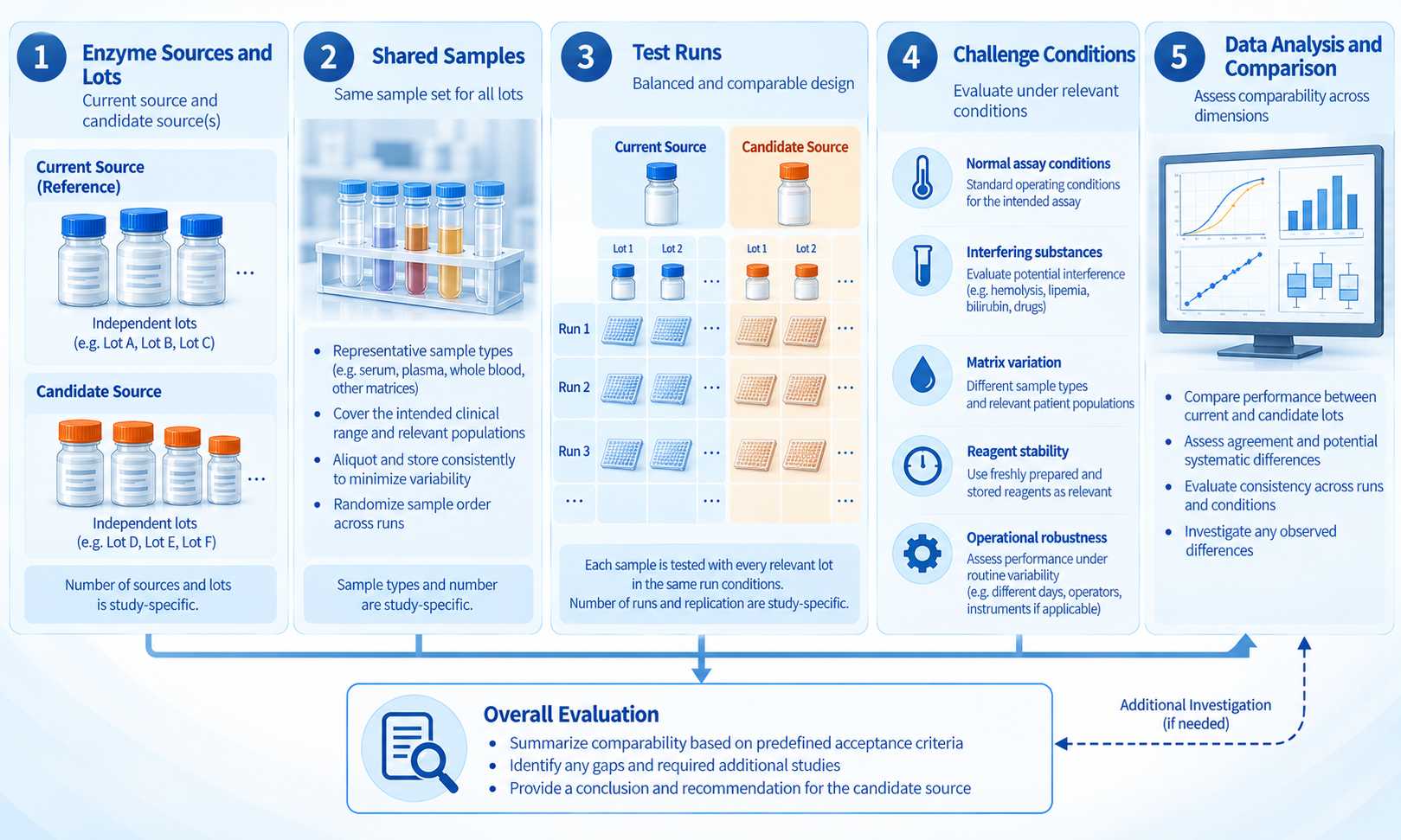
A single candidate lot compared with a single current lot cannot establish the range of either supply process. Include independent, representative production lots as justified by risk, expected variability and the intended inference. Repeated measurements from one vial improve knowledge of repeatability; they do not create additional manufacturing lots.
Define the study size from the decision to be made. Consider the largest acceptable shift, expected variability, relevant sample strata and uncertainty required for a useful conclusion. There is no universal lot count or sample count that makes every enzyme replacement qualified.
Use paired aliquots or otherwise comparable specimens when assessing the complete assay. Balance sources across runs, days, operators or instruments that could affect the result. If every candidate measurement occurs on one day and every baseline measurement on another, a day effect can be mistaken for a supplier effect.
Include the conditions most likely to expose a meaningful loss of performance. Depending on the assay, these may be low-positive samples, concentrations near a decision threshold, difficult sample matrices, high analyte concentrations or relevant interferents. Strong positive controls alone provide a narrow view of substitution performance.
Document sample handling and the order of testing. Randomization or a balanced sequence can reduce systematic effects from plate position, drift or specimen aging. Masking source identity during result review may be useful where interpretation involves judgment.
CLSI EP26 addresses laboratory evaluation of a new reagent lot using a pre-established protocol and patient samples. That scope is useful to distinguish from a manufacturer's raw-material supplier change, which can require broader material, production and stability evidence. Do not present a routine lot screen as complete second-source qualification.
Test the enzyme within the product life cycle
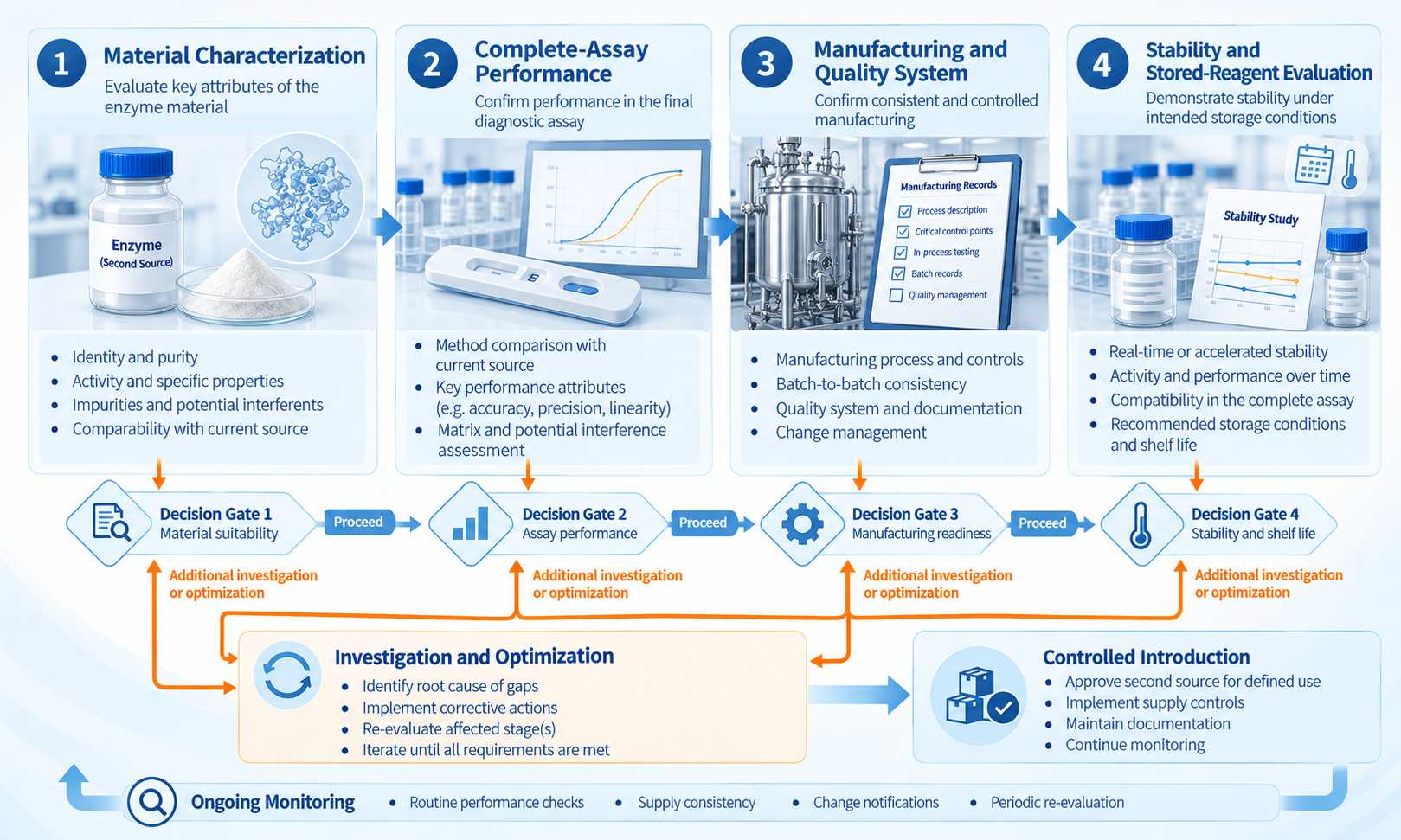
Use staged work so that each stage resolves a different uncertainty. Initial characterization can identify major incompatibilities before expensive complete-assay studies. Passing that stage permits further evaluation; it does not establish final-product suitability.
Compare the assembled reagent under the intended assay conditions. Select endpoints that match the claim and failure mechanism: quantitative bias and imprecision, signal and background, detection behavior or classification near a cutoff. Review individual samples and relevant strata as well as pooled summaries.
Move beyond bench preparation when manufacturing could alter performance. Assess relevant mixing, hold, dispensing, concentration or drying steps using an appropriate scale and configuration. A candidate that performs in a fresh hand-mixed reaction may behave differently after processing.
Evaluate the stored reagent as well as the incoming enzyme. CLSI EP25 covers design and evaluation of shelf-life and in-use stability studies and also addresses transport conditions. Its scope supports considering these separate states; it does not establish a shelf life for a particular candidate enzyme.
Use justified stress studies to investigate vulnerabilities, while preserving the distinction between development evidence and support for the claimed storage period. Similar initial performance does not demonstrate similar rates or mechanisms of deterioration. Identify any remaining real-time evidence needed before an unrestricted introduction.
| Stage | Question | Common blind spot |
|---|---|---|
| Incoming material | Is the preparation characterized and measurable on an interpretable basis? | Assuming matching nominal units establish identity or performance. |
| Complete assay | Are relevant performance endpoints supported across intended conditions? | Testing only strong positive controls. |
| Production process | Does the alternative tolerate the controlled manufacturing sequence? | Extrapolating directly from a fresh bench mixture. |
| Product life cycle | Is performance maintained in relevant stored, transported and in-use states? | Treating incoming enzyme shelf life as final reagent shelf life. |
Interpret differences against criteria established in advance
Set acceptance criteria before reviewing candidate results. Tie each margin to the effect the assay can tolerate and the intended use of the evidence. Avoid defining success as whatever difference happens to emerge from the study.
Inspect magnitude and uncertainty rather than relying on a statement that a difference is not statistically significant. An underpowered comparison can miss a material shift. For an equivalence claim, use an appropriate analysis with predefined margins and a design capable of supporting that inference.
Investigate discordant findings without erasing them from the record. Check sample integrity, handling, common-method suitability, lot identity and formulation effects. Repeat work according to a documented investigation plan; retain the original result and explain why additional evidence changes or does not change the conclusion.
Make the disposition specific. Possible outcomes include acceptance under the original configuration, acceptance only under a separately controlled configuration, further work for an identified gap, or rejection. A favorable average result should not override a relevant failure in a vulnerable sample group or exposure state.
Introduce the approved source with traceable limits
Record the qualified supplier, material version, specification, permitted use level and supported reagent configuration. Connect the decision to the underlying lots, protocols, deviations and reports. Production and receiving teams need an unambiguous way to identify the approved alternative.
Agree incoming controls, relevant change notifications and escalation responsibilities. Monitor early production lots for the attributes that drove qualification, then review the monitoring plan using accumulated evidence. Define what triggers investigation, temporary restriction or renewed qualification.
For a marketed device, complete the applicable regulatory change assessment before implementation. FDA's guidance on changes to existing devices includes an IVD-specific assessment of risk and verification or validation outcomes. It does not mean every supplier change requires a new 510(k), or that satisfactory bench results automatically eliminate that possibility. Apply its stated scope and current QMSR context.
Keep the backup usable. Review prolonged inactivity, expired supporting material, changes at either source and changes to the assay itself. The qualification remains meaningful only while its defined material and product conditions remain applicable.
For comparison-study interpretation, see CLSI EP Method Comparison Guide for Assay Developers. For supplier evidence, see ISO 13485 and Raw Material Documentation for IVD Enzyme Suppliers. The broader resource collection is Diagnostic Enzyme QC, Validation and Regulatory Resources.
Source and regulatory context reviewed September 24, 2026. Review within six months or when relevant requirements change. The study framework is an editorial synthesis; it is not a prescribed regulatory protocol or a universal equivalence specification.
Sources and further reading
- Global Harmonization Task Force, Study Group 3. Guidance on the Control of Products and Services Obtained from Suppliers. GHTF/SG3/N17R9:2008, December 11, 2008.
- STRENDA Commission, Beilstein-Institut. STRENDA Guidelines: Enzyme Kinetics and Assay Conditions. Current public guidelines; accessed September 24, 2026.
- Eurachem. The Fitness for Purpose of Analytical Methods: A Laboratory Guide to Method Validation and Related Topics. Third edition, 2025.
- Clinical and Laboratory Standards Institute. EP26: User Evaluation of Acceptability of a Reagent Lot Change. Second edition, 2022.
- Clinical and Laboratory Standards Institute. EP25: Evaluation of Stability of In Vitro Medical Laboratory Test Reagents. Second edition, 2023.
- U.S. Food and Drug Administration. Deciding When to Submit a 510(k) for a Change to an Existing Device. October 25, 2017; current PDF includes QMSR notice.