

An enzyme activity method is valid for a defined measurement task when its results are sufficiently reliable to support that task. Producing a strong signal or a repeatable number is not enough if the reaction conditions, calculation or sample matrix make the result misleading.
For diagnostic enzyme raw materials, validation should connect the assigned activity to the decision it supports, such as lot acceptance, formulation input or stability comparison. Keep that objective separate from validating the analytical and clinical performance of a finished diagnostic test.
Define the activity result before designing experiments
State what the method measures, in which material and for which decision. Is the output catalytic activity per volume of stock, specific activity per protein mass, or relative activity against an assigned reference? These outputs require different supporting measurements and should not share an ambiguous label.
Record the enzyme identity, substrate, buffer, pH, temperature, cofactors, reaction volume and timing. STRENDA provides reporting guidance for enzyme data and experimental conditions. Its role is to make the measurement interpretable; completing a reporting checklist does not establish analytical fitness by itself.
Where one unit is defined through conversion of a specified amount of substrate per unit time, include the conditions and conversion basis. Some enzyme assays instead use operational endpoint units. Do not convert an endpoint assignment into a conventional catalytic unit unless the relationship has been established experimentally.
Define the material range that the method must cover, including formulation variants and expected sample dilutions. Write acceptance criteria for the method before testing, based on the effect of analytical error on the intended decision. A method suitable for broad formulation screening may be inadequate for distinguishing small lot differences near a release boundary.
Establish the reaction window and detector response
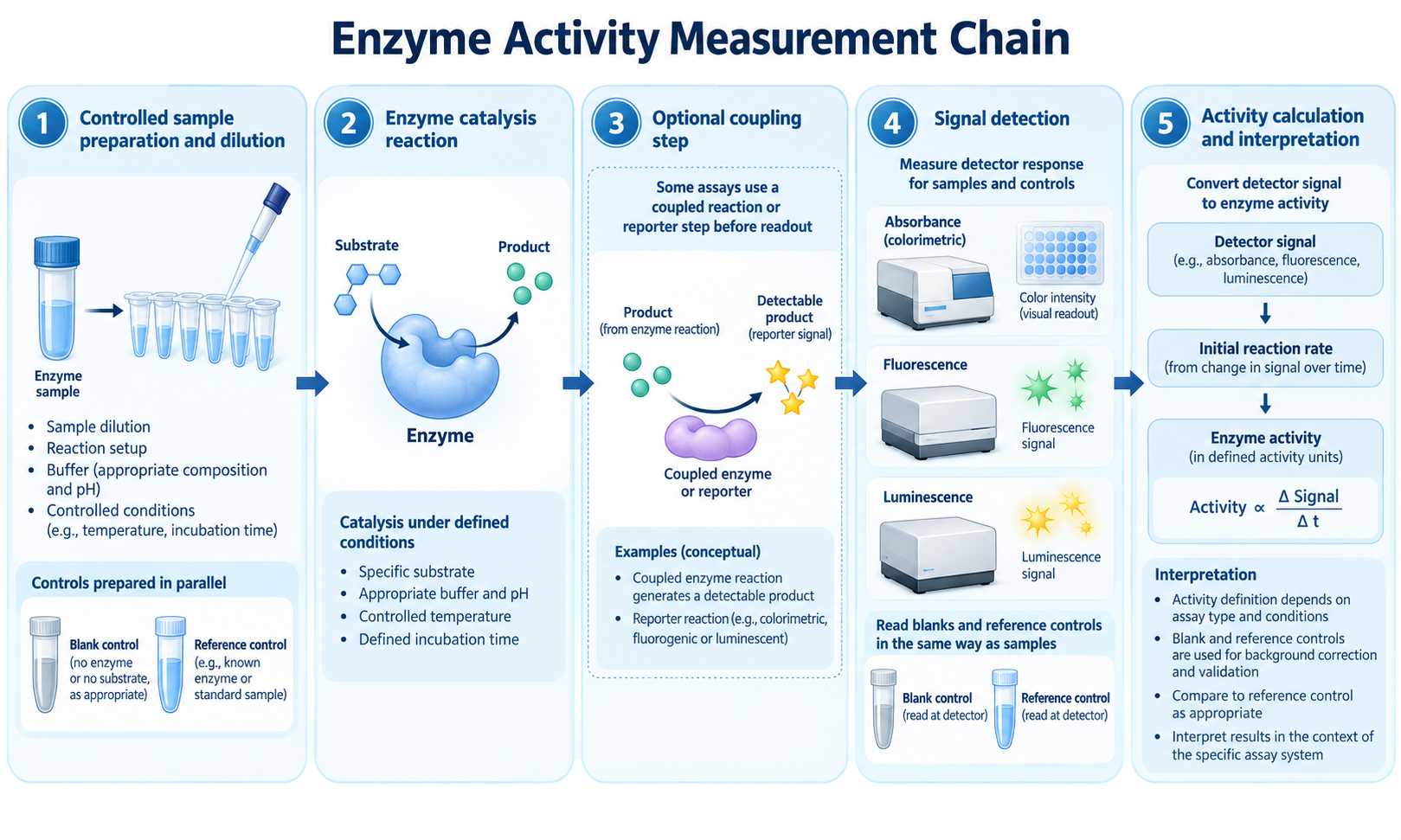
For a rate assay, collect progress curves at relevant enzyme inputs and examine where the measured rate remains suitably stable. The usable interval is an observed property of the reaction system, not a fixed number of minutes that can be transferred from another enzyme. Mixing delays and the start of data acquisition need explicit treatment.
Test whether changing enzyme input produces the expected change in measured rate within that interval. This enzyme-input relationship is distinct from the rate response to changing substrate concentration. Michaelis–Menten saturation behavior should not be mistaken for a failure of an activity method's working range.
Assess the detector separately where possible, using appropriate signal-generating material or a suitable calibration approach. A stable reaction can still exceed the reader's usable signal range. Conversely, a well-behaved optical calibration does not show that the catalytic reaction remains proportional to enzyme amount.
An endpoint assay can be useful when its timing, stop step and calibration support the intended result. Check reaction duration, stopping efficiency and signal stability after stopping. An endpoint near complete substrate consumption may distinguish neither high enzyme inputs nor modest activity differences reliably.
For coupled assays, evaluate whether the indicator reaction tracks the target reaction without becoming limiting over the intended range. Include its lag behavior in the timing assessment. Scott and Williams also highlight impurity activities introduced through coupling enzymes; increasing their concentration may address one limitation while increasing another source of background.
| Stage | Question to test | Possible misleading result |
|---|---|---|
| Sample dilution | Does handling preserve activity and a compatible matrix? | Dilution changes activity recovery or formulation effects. |
| Target reaction | Is the selected interval appropriate across enzyme inputs? | A late endpoint masks differences between samples. |
| Coupling step | Does the reporting reaction keep pace with the target reaction? | Signal reflects coupling capacity rather than target activity. |
| Detection and calculation | Are signal conversion, blank correction and dilution factors valid? | An apparently precise result carries a systematic calculation error. |
Show that the result reflects the intended activity
Design blanks to answer specific questions. A reagent blank can reveal spontaneous signal development; a sample or formulation blank can reveal background introduced with the material. Their composition should support the correction being made. Removing the enzyme may also remove buffer components, so a nominal blank is not always a matched blank.
Use relevant challenges to investigate plausible alternative sources of signal. Depending on the system, these might include substrate-independent fluorescence, a contaminating catalytic activity or a component that affects the detection chemistry. Choose controls that distinguish the alternatives instead of treating every unexpected signal as low enzyme purity.
Compare sample dilution behavior across the intended range. Nonparallel behavior against a reference can suggest matrix effects, different reaction behavior or an unsuitable comparison model. It does not identify the cause by itself. Review the formulation and dilution process before adopting an empirical correction factor.
Assess the final formulation that the method will routinely encounter. Glycerol, salts, detergents and stabilizers may enter the reaction at different concentrations when stock activities differ. A method developed with a simple buffer must demonstrate suitability for these intended samples before it is used to assign comparable lot values.
Build a validation study around the decision
Eurachem's fitness-for-purpose framework connects analytical performance to intended use. Translate that principle into a protocol with sample levels, sources of variation, calculations and acceptance rules. Allocate enough independent preparations and runs to address the variability that the routine method will actually encounter.
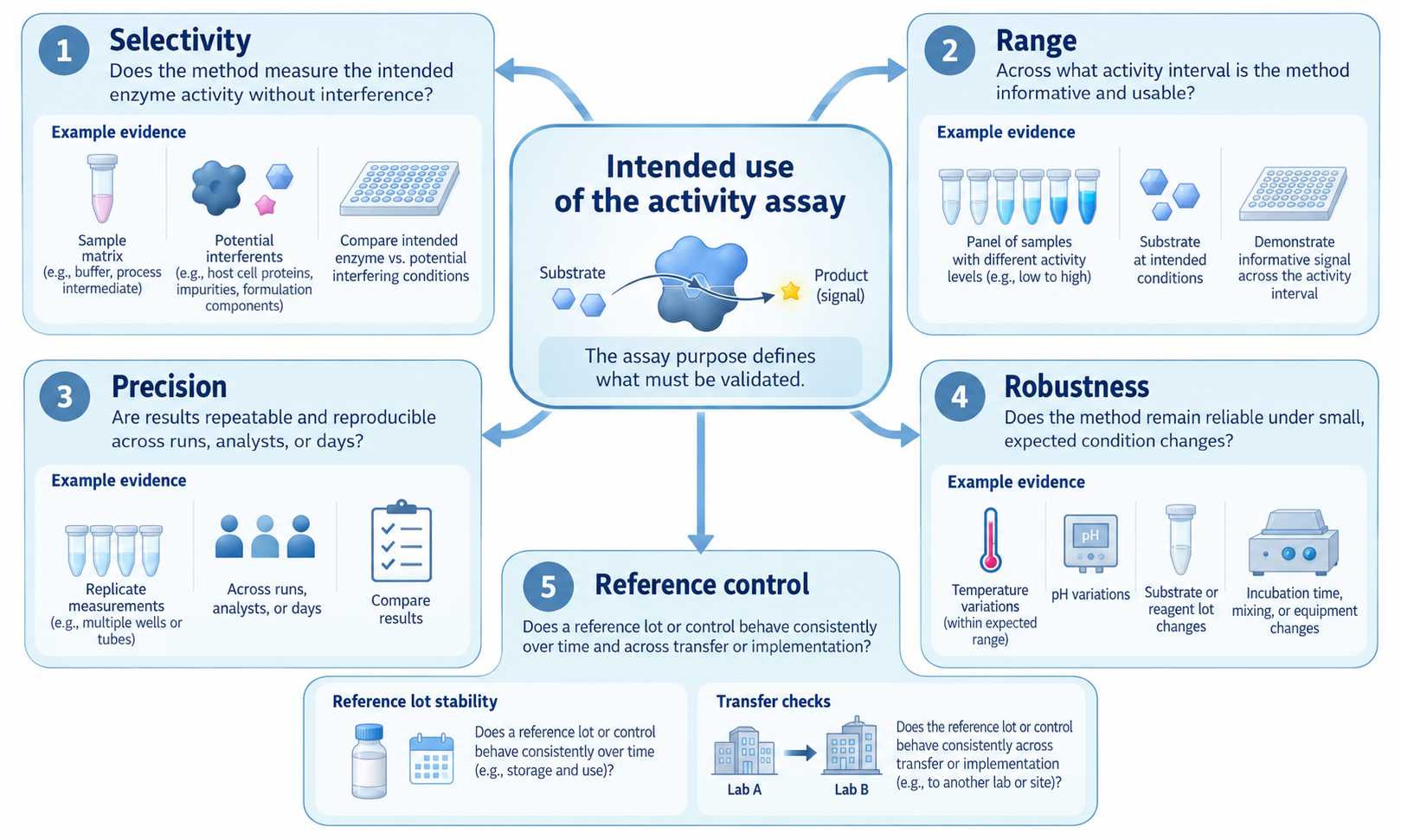
Repeatability describes variation under tightly controlled conditions. Intermediate precision adds relevant within-laboratory changes such as days, operators or instruments. Repeated reads of one reaction well mainly test reading behavior; they do not replace independent sample preparation and reaction setup when those steps contribute to routine uncertainty.
For the working range, examine the complete reported result after dilution and calculation, not just raw signal. Include levels near the boundaries where the method must support decisions. If low residual activity is a stated use, establish suitable low-end capability; a lot-potency method does not automatically need every detection-limit study used for trace analysis.
Accuracy evidence depends on what references exist. A product standard can support signal calibration without validating all catalytic steps. A reference enzyme with an assigned activity can support comparisons, but its assignment, stability and suitability must be understood. Agreement between two methods is informative only after their measurands and conditions are aligned.
Where no suitable reference procedure or material is available, state that limitation and combine justified evidence rather than claiming absolute accuracy from repeatability alone. ICH Q2(R2) provides an additional analytical-validation framework within its pharmaceutical scope; the relevant characteristics still need adaptation to the enzyme method and intended decision.
| Characteristic | Useful study question | Reporting requirement |
|---|---|---|
| Precision | How much variation comes from routine preparation and measurement? | State levels, run structure and the conditions varied. |
| Range and response | Where does the calculated activity remain suitable for use? | State the enzyme-input and dilution limits. |
| Accuracy or comparison | What independent evidence supports the assigned result? | Identify the reference basis and unresolved limitations. |
| Selectivity | Could another component generate or suppress the measured signal? | Record the challenges and matched controls. |
| Robustness | Which small procedural changes alter the reported activity? | Define the tested changes and resulting control requirements. |
Use robustness studies to make the procedure executable
Select deliberate variations that could occur during normal operation: reaction temperature, pH adjustment, reagent equilibration, mixing, read delay or substrate preparation. The purpose is to identify which conditions need tight control and which tolerances are acceptable. It is not to expose the method to arbitrary extremes and call survival proof of robustness.
Pay attention to interactions. A longer setup delay may matter only at a particular temperature or sample dilution. If early experiments indicate coupled effects, choose a study design that can distinguish them instead of changing several conditions together without attribution.
Separate sample stability from method robustness. An enzyme aliquot that loses activity while waiting to be tested may make the method appear imprecise. Define allowable preparation and holding conditions, and evaluate the stability of working reagents and references over the period in which they are used.
During transfer, compare the complete procedure at the receiving laboratory or instrument setup. Optical path length, mixing behavior, timing and data-processing settings can change the relationship between signal and assigned activity. Use representative samples and predefined comparison criteria; matching the written wavelength alone is not enough.
Maintain the validated state in routine use
The controlled method should specify sample preparation, equipment settings, reagent acceptance, calculation rules and run-suitability checks. Include how invalid runs, unexpected dilution behavior and out-of-range samples are handled. These rules should be established before a difficult sample appears, so results are not selected according to whether they pass a material specification.
Maintain a reference strategy that includes storage, aliquoting, monitoring and replacement. Bridge a new reference to the existing system while suitable material remains available. Otherwise, a gradual decline in the comparator can make stable samples appear increasingly active or hide a parallel decline in the test material.
Trend appropriate control results and investigate changes in level or variability. A change in substrate source, coupling reagent, formulation or calculation software may warrant targeted verification or broader revalidation, depending on its effect on the measurement. Record the rationale for that scope rather than applying one automatic response to every change.
The validation report should connect the original objective, performed studies, deviations and conclusion. State what samples and decisions are covered and what remains outside the established use. This boundary makes the result usable by both the material reviewer and the assay-development team.
Apply the validated method within the Diagnostic Enzyme QC Checklist. For analytical performance of the finished diagnostic system, see Precision, Linearity, LoD, LoQ and Interference in Diagnostic Assays. The Diagnostic Enzyme QC, Validation and Regulatory Resources connects these separate evidence levels.
Source review date: September 24, 2026. Validation criteria must be justified for the specific method and use; no universal enzyme-release limits are implied.
Sources and further reading
- STRENDA Commission, Beilstein-Institut. STRENDA Guidelines: Enzyme Kinetics and Assay Conditions. Current public guidelines; accessed September 24, 2026.
- Eurachem. The Fitness for Purpose of Analytical Methods: A Laboratory Guide to Method Validation and Related Topics. Third edition, 2025.
- International Council for Harmonisation; U.S. Food and Drug Administration. Q2(R2): Validation of Analytical Procedures. Final guidance, March 2024.
- Assay Guidance Manual. Basics of Enzymatic Assays for HTS. NCBI Bookshelf, chapter NBK92007.
- Scott JE, Williams KP. Validating Identity, Mass Purity and Enzymatic Purity of Enzyme Preparations. Assay Guidance Manual, updated October 1, 2012.