

A second supplier reduces risk only when it provides an independently available material that can be used in the intended assay through a controlled process. Two purchase orders can still depend on the same manufacturing site, critical input or delivery route.
This guide uses official quality, procurement, stability and supply-continuity material reviewed through October 20, 2026. It focuses on planning a usable alternative before a disruption. Detailed qualification methods remain assay-specific, and no enzyme is assumed interchangeable because its name or activity unit matches.
Map what must remain available for production to continue
Start with the enzyme's role in the finished reagent and the consequence of losing supply. A low-cost component can stop release of a high-value assay if there is no acceptable substitute. Purchasing spend alone is therefore a poor proxy for continuity risk.
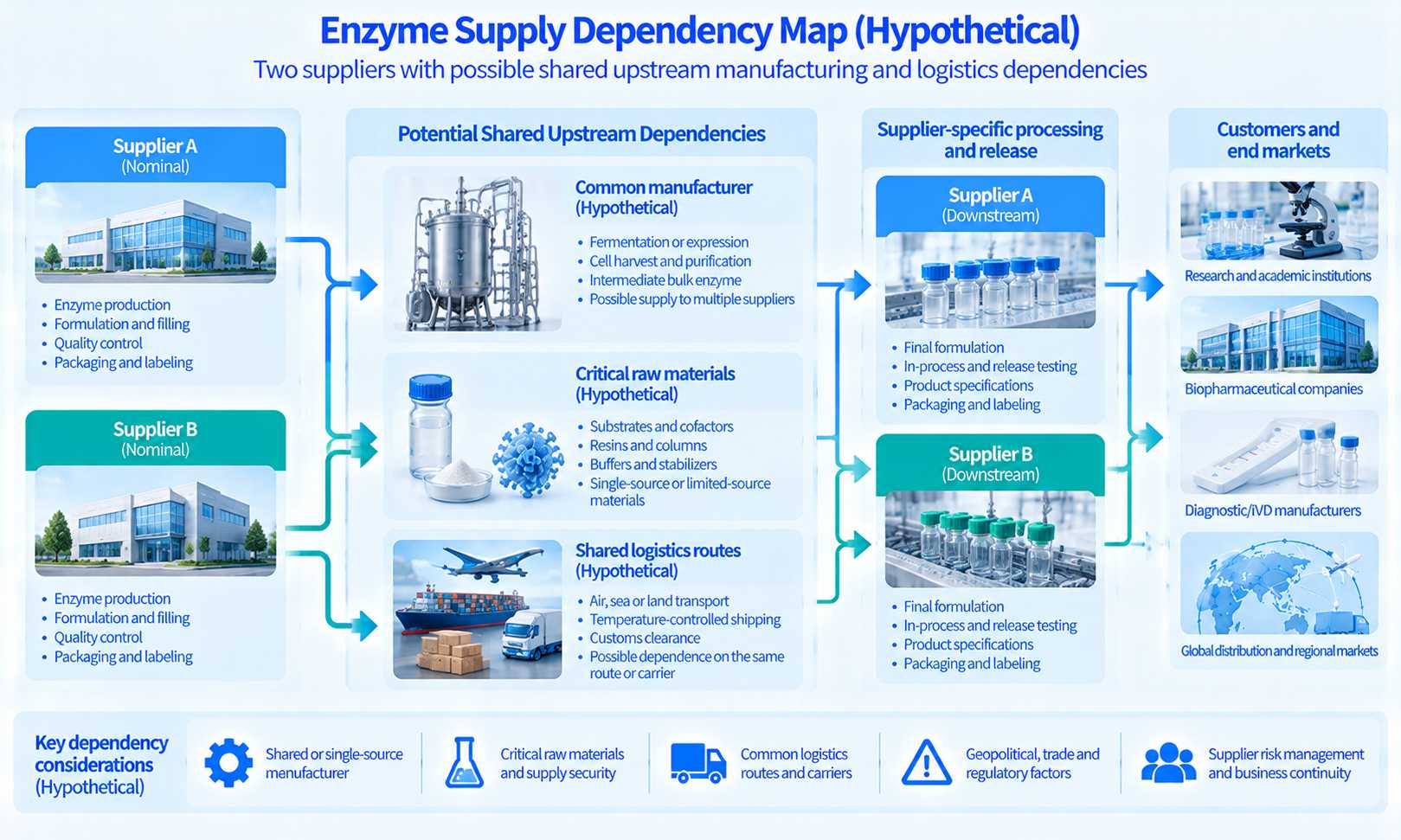
Identify the actual manufacturer, manufacturing location, formulation site, distributor and transport route where the information is available. A distributor can provide valuable service, but a second distributor does not necessarily provide a second manufacturing source.
Ask about critical upstream dependencies at an appropriate level of disclosure. Two sources may use the same specialized starting material or external service. The objective is not to obtain proprietary process details; it is to understand whether a plausible disruption would affect both options.
FDA's supply-chain recommendations include alternate material sources, additional capacity and alternative delivery methods. Applied to diagnostic enzymes, that supports a broader continuity discussion than simply maintaining a list of approved vendors.
Record unknown dependencies explicitly. An unverified assumption of independence should not be reported as a confirmed risk reduction. Where the origin cannot be established, consider whether inventory or another mitigation is needed while the information gap remains.
Define recovery as usable released output
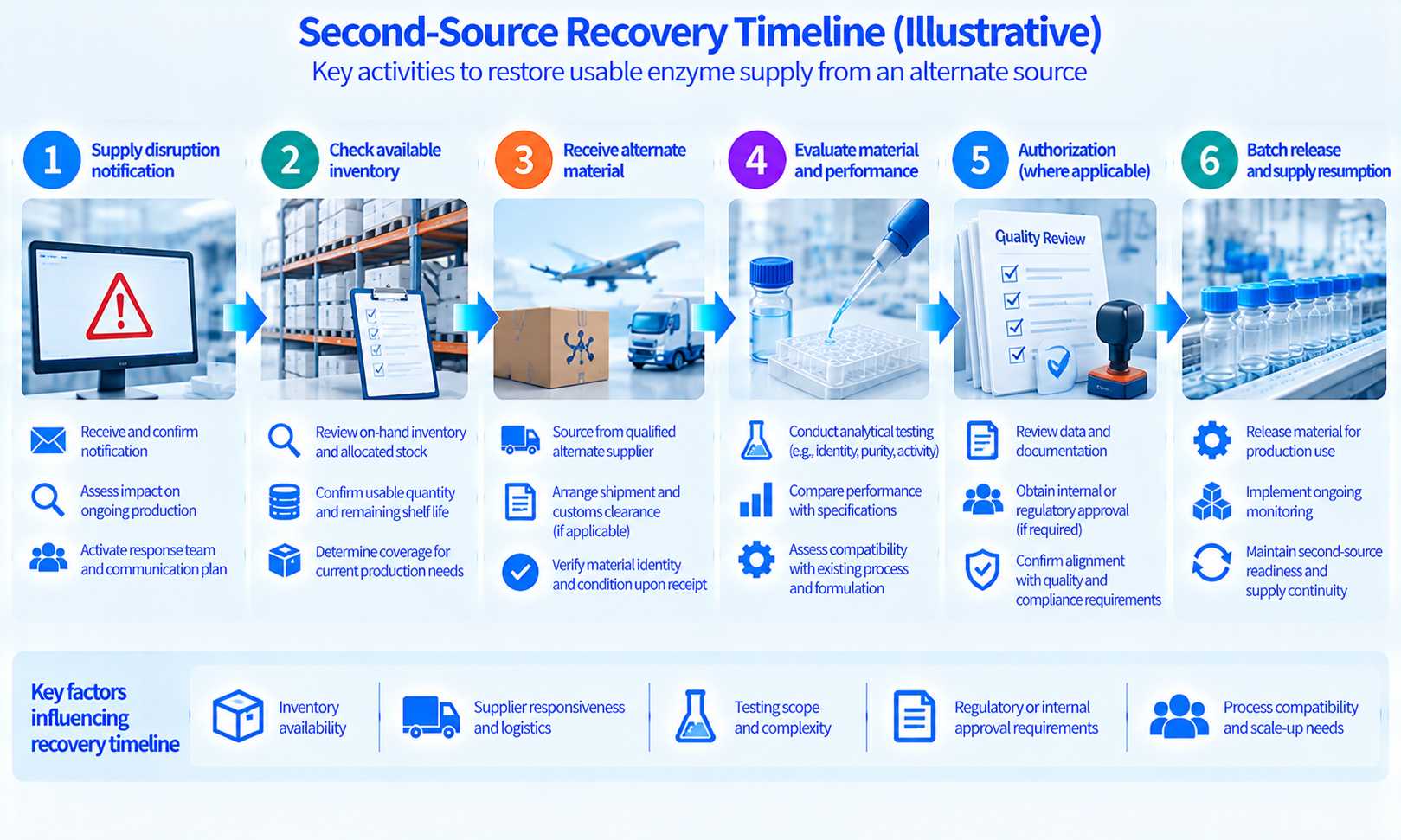
Supplier lead time is only one part of recovery. After an alternative arrives, the organization may need incoming evaluation, formulation work, assay comparison, manufacturing scheduling and release. Regulatory assessment may also be relevant depending on the change and product.
Build a realistic sequence from disruption notification to usable output. Identify which activities can proceed in parallel and which require a prior result. An alternative that is available quickly may still leave a long interruption if the supporting evaluation has not been prepared.
Inventory should be compared with this recovery sequence. Count usable stock, not simply the quantity on a ledger. Expiry, quarantine status, allocated production and packaging losses can reduce what is actually available.
Use scenarios that represent plausible failures: delayed transport, a rejected incoming lot, a temporary manufacturing interruption or discontinuation. Each scenario may require a different response. A transport workaround does not resolve a quality failure at the source.
The proposed strategy should state who can trigger the response and what evidence is required. If every decision waits for an emergency meeting, a nominally prepared second source may not shorten the interruption as expected.
Choose the level of redundancy that fits the risk
| Option | Potential benefit | Remaining obligation |
|---|---|---|
| Additional distributor | Another commercial or logistics route. | Confirm whether the manufacturing source is shared. |
| Qualified alternate enzyme | A technically assessed material option. | Maintain supply availability and a controlled switching process. |
| Split routine sourcing | Ongoing experience with both materials. | Control differences, scheduling and lot traceability. |
| Reserved capacity | Access to production under an agreed arrangement. | Verify what capacity and timing are actually committed. |
| Strategic inventory | Time to respond without immediate substitution. | Control expiry, storage and replenishment. |
No option is universally best. Routine split sourcing can keep both materials familiar but adds planning and evaluation work. A standby source can simplify normal production while requiring deliberate maintenance to remain usable.
Compare the full cost of resilience. Qualification work, minimum orders, reserved capacity and inventory carrying costs should be weighed against the consequences of interruption. This is a decision framework, not a formula for assigning a universal safety-stock percentage.
WHO procurement guidance reinforces the importance of the complete supply and use arrangement. For raw materials, translate that principle into clear delivery, documentation and support expectations rather than assuming a catalogue listing guarantees future availability.
Treat technical comparability as a separate workstream
An enzyme name does not define a complete material specification. Source, preparation, concentration, formulation and accompanying impurities can differ. Activity values also depend on the measurement method, so equal stated units do not prove equal behavior in the diagnostic assay.
Define which material attributes could affect the intended method. Then assess performance in the complete reagent system, including relevant difficult specimens or conditions. The evaluation should address the reason the source is being changed and the properties that might be altered.
ISO 13485 describes a medical-device quality-management framework, while FDA's QMSR provides the current US regulatory quality-system context for applicable manufacturers. Neither source establishes that a particular alternate enzyme is suitable. Product and process evidence remain necessary.
Keep qualification status separate from permission to use the material in a released product. Internal approval, change assessment and any applicable external requirements need to be resolved through the organization's process.
The Second-Source Qualification Guide for Diagnostic Enzymes addresses the technical comparison in more detail. The strategic task here is to complete enough of that work before disruption so that the alternative is more than a procurement contact.
Protect the time buffer that inventory is meant to provide
Storage and transport conditions determine whether stock remains useful. WHO stability guidance distinguishes storage, transport and in-use questions for IVD products. For an enzyme inventory, apply the same distinction carefully using the supplier's supported conditions and the user's own material controls.
Do not extend a material's use period merely because replacement supply is delayed. A continuity plan should define how questionable stock is assessed and who decides its disposition. Supply pressure does not establish retained performance.
Consider the size of each receipt and the time needed to consume it. Large purchases may reduce ordering frequency while increasing exposure to expiry or a single-lot problem. Smaller deliveries can reduce some risks while increasing dependence on transport frequency.
Traceability is especially important when introducing an alternate. Production records should identify which material and lot were used so that later performance observations can be interpreted. Avoid pooling sources in a way that obscures the origin of a problem.
A practical inventory review therefore includes quantity, status, remaining supported life, storage history and intended allocation. These fields explain how much recovery time the stock actually buys.
A second-source plan needs periodic evidence of readiness
Revisit the plan after relevant supplier changes, assay changes or shifts in demand. An alternate qualified against an earlier formulation may no longer represent the current product. Likewise, a supplier that once had capacity may not retain the same delivery capability.
Keep change-notification arrangements and contact routes current. Define the events that should prompt an assessment, including manufacturing location, formulation or critical process changes where relevant. The Change Control for IVD Raw Materials and Diagnostic Enzymes guide covers the assessment process.
Exercise the recovery plan using a documented scenario. Check whether required records can be found, whether inventory assumptions are accurate and whether the alternate source can respond. A tabletop exercise can reveal decision and communication gaps without claiming that a full production transfer has been validated.
Measure readiness through evidence rather than the number of listed suppliers. The useful questions are whether dependencies differ, the material remains suitable, supply is available and the organization can release production within its required window.
Further industry and development discussions appear in Technical Articles, Literature Reviews and Industry Insights. A defensible second-source strategy connects technical compatibility with an executable continuity plan.
Sources and further reading
- US Food and Drug Administration. Emergency Preparedness and Medical Devices: Supply Chain Recommendations. Accessed October 20, 2026..
- International Organization for Standardization. ISO 13485:2016 — Medical devices: Quality management systems. Accessed October 20, 2026..
- US Food and Drug Administration. Quality Management System Regulation (QMSR). Accessed October 20, 2026..
- World Health Organization. Guidance for procurement of in vitro diagnostics and related laboratory items and equipment. Accessed October 20, 2026..
- World Health Organization. TGS 2: Establishing stability of in vitro diagnostic medical devices. Accessed October 20, 2026..