

The IVD raw-material landscape is best understood by what a supplier makes, controls and supports. Specialist producers, formulation partners and distributors contribute different capabilities. Compare them against the same assay requirements while making manufacturing responsibility, technical support and delivery arrangements explicit.
This qualitative landscape reviews official material available through October 20, 2026. It maps supplier roles and evidence requirements rather than publishing a vendor ranking or market-share table. It does not claim a complete census of suppliers, production capacity or import dependence.
Separate the material markets before comparing suppliers
IVD raw materials include more than enzymes. Depending on the assay, important inputs may include antibodies, antigens, nucleic-acid reagents, substrates, calibrator materials, particles and formulation ingredients. The relevant supplier population changes with the material and its role.
Even within enzymes, molecular amplification, clinical chemistry and immunoassay signal systems create different requirements. A broad catalogue does not demonstrate equal capability across all these applications. A narrow specialist may have deep expertise in one function but limited support elsewhere.
Define the unit of comparison: an isolated enzyme, a formulated component, a conjugate or a complete mix. Comparing prices across these categories without adjusting the specification can produce a misleading impression of supplier competitiveness.
The landscape should therefore begin with a material-function map. Identify what the assay needs, what must be controlled and where the supplier's responsibility ends. This is an analytical framework for organizing candidates, not a claim about the size of each segment.
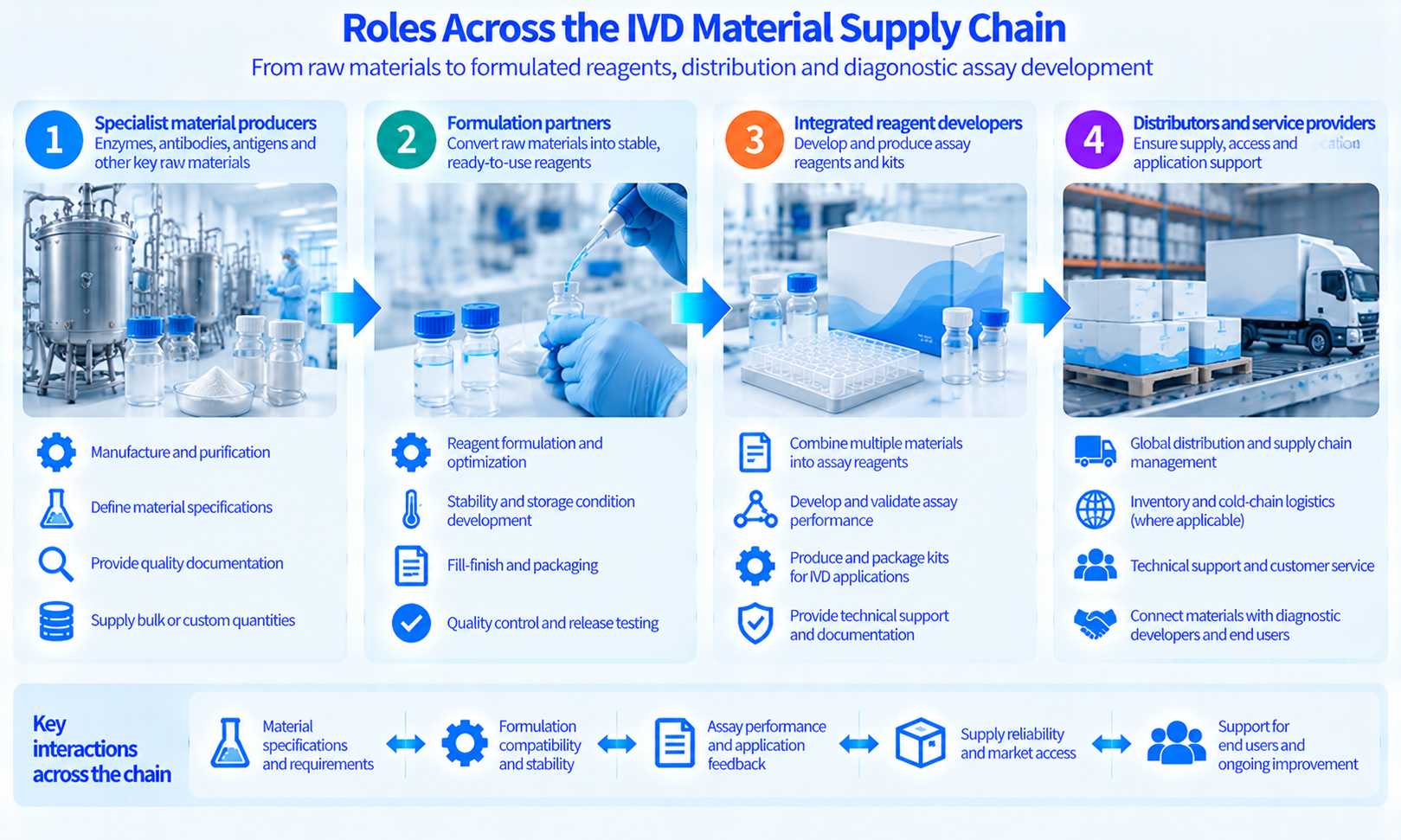
Supplier roles overlap, but their responsibilities differ
| Role | Potential contribution | Question to verify |
|---|---|---|
| Specialist manufacturer | Production and characterization of defined materials. | Which production stages and sites are controlled directly? |
| Formulation or conjugation partner | Conversion of materials into application-specific components. | Who controls incoming inputs and final functional testing? |
| Integrated reagent developer | Experience with complete assay systems. | What material and support are actually available to external customers? |
| Distributor or regional representative | Local ordering, stock and communication. | Who is the manufacturer and who handles quality decisions? |
| Custom development partner | Adaptation to a specific technical requirement. | What evidence, ownership and ongoing supply arrangements are agreed? |
A single organization can occupy several roles. The useful distinction is operational responsibility, not a marketing label. Clarify which entity manufactures, releases, stores and sells the material.
This matters when comparing domestic and imported routes. A local commercial presence does not prove local manufacture, and a foreign brand does not reveal every production location. Trace the relevant material rather than treating the corporate address as its origin.
Likewise, an established distribution network can be valuable without making the distributor an independent second source. The supply-chain guide addresses that continuity question separately; this landscape focuses on identifying the role accurately.
Distinguish material supply from application support
A supplier landscape becomes more useful when it identifies the level of integration available to an assay developer. A purified enzyme, a formulated reagent and a finished reaction mix solve different portions of the development problem. They also leave different responsibilities with the buyer. Define the expected output before comparing suppliers on price or catalogue breadth.
For a standard enzyme preparation, the central questions concern identity, formulation, activity measurement and reproducibility. For a formulated component, compatibility and handling become more prominent. For a custom project, the comparison expands to include development milestones, access to results, acceptance criteria and the transition to routine manufacture.
Technical support should be assessed through the information it can provide. A useful response explains test conditions, identifies the preparation under discussion and separates measured evidence from proposed experiments. General assurances of suitability do not resolve an application-specific uncertainty. Ask who can interpret unexpected results and how that person works with the manufacturing and quality teams.
WHO procurement guidance emphasizes suitability for the intended setting of use. Although that guidance addresses diagnostic procurement rather than an enzyme supplier ranking, it reinforces a useful distinction: purchasing an available product is not the same as obtaining a component that works in the intended testing system.
For example, an enzyme with a well-characterized activity value may still require formulation development before it can be used in a dried assay. The supplier assessment should identify who owns that work, which evidence closes the gap and whether the resulting preparation can be supplied consistently. Do not treat a proposed development pathway as a demonstrated product capability.
Keep the scope of support explicit in the shortlist. Document what is available with a catalogue purchase, what requires a separate project and what remains the assay developer's responsibility. This makes comparisons meaningful even when candidates have different business models.
Common quality concepts coexist with distinct market requirements
ISO 13485 provides an internationally recognized medical-device quality-management framework. Its relevance does not eliminate the need to verify the scope of an individual supplier's system or the suitability of a material. Quality-system certification and assay performance answer different questions.
In the United States, FDA's QMSR became effective on February 2, 2026. This is relevant context for applicable device manufacturers and their quality arrangements. It should not be described as an FDA approval of raw-material suppliers or an automatic requirement with identical application to every upstream business.
IMDRF's 2024 essential-principles document provides another international reference point for device safety and performance. Harmonized principles do not create a single worldwide market-authorization route. Developers still need to assess the requirements applicable to their finished product and market.
For global sourcing, organize documentation by intended use. Some records support material characterization, others support supplier oversight, and others relate to a finished diagnostic device. Keeping those purposes separate makes it easier to identify a genuine gap.
The practical comparison is therefore evidence-based: can the supplier provide the material, records and ongoing support needed for this programme? A global footprint is not sufficient evidence of suitability, just as a local footprint is not sufficient evidence of limitation.
Compare the complete supply route on equal terms
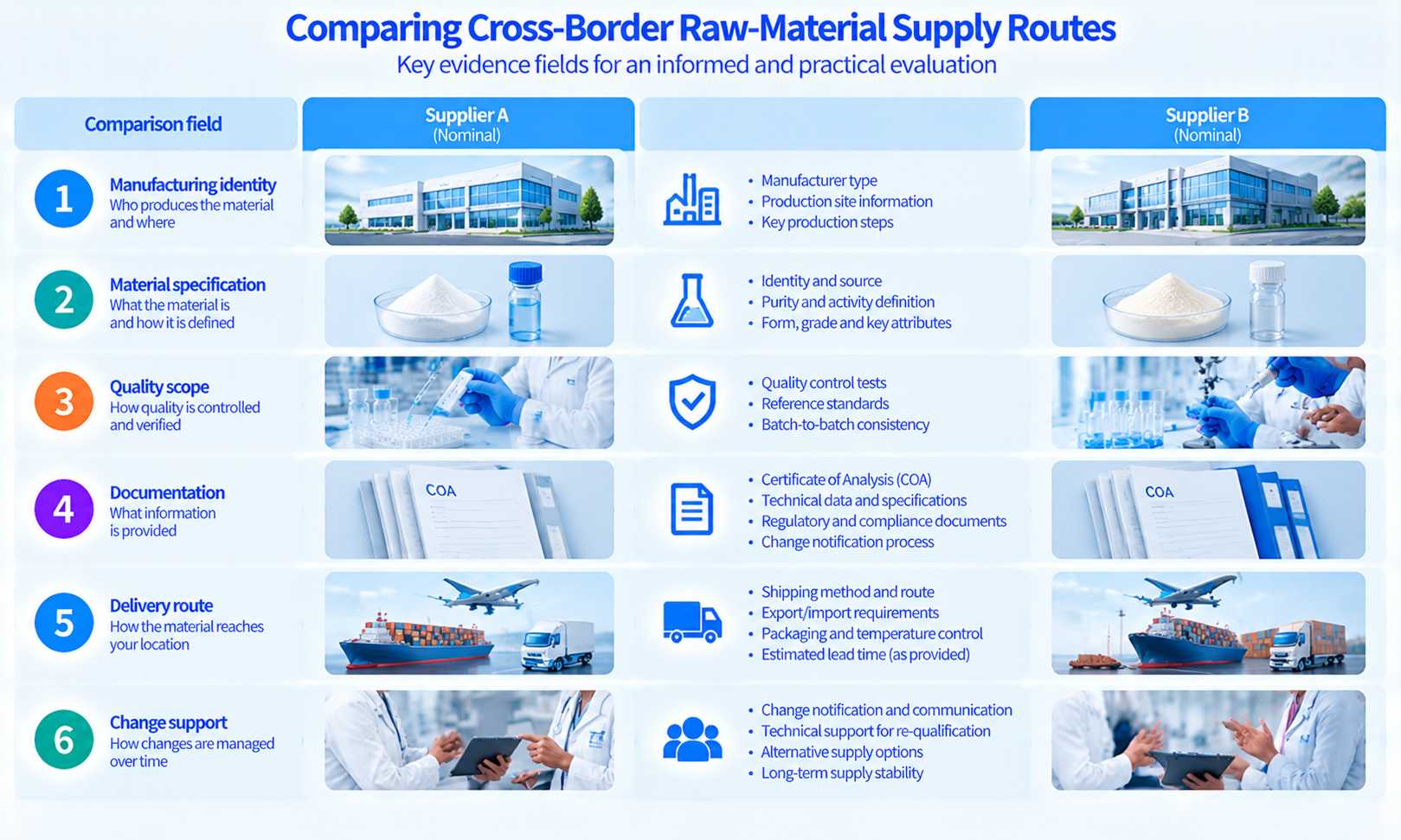
Use the same specification and application test when comparing candidates. Account for differences in formulation, activity methods, concentration and packaging. A lower quoted price may reflect a different product boundary rather than greater efficiency.
Then compare the commercial route: ordering entity, shipping conditions, delivery reliability, minimum order, stock location and response to quality questions. Cross-border transport can add steps, but the actual risk depends on the route and controls rather than a general domestic-versus-imported label.
FDA's continuity recommendations support examining alternate sources and delivery methods. For landscape analysis, this means recording dependencies and available options without assuming that two different company names provide independent production.
Communication quality also needs evidence. Ask a technical question that requires a traceable answer, such as how a reported activity value is measured or how a relevant change is communicated. The response can be more informative than the length of a catalogue.
The Diagnostic Enzyme Supply Chain and Second-Source Strategy article develops the continuity implications. Here, the goal is a comparison that is fair across supplier roles and regions.
Turn the landscape into a documented candidate assessment
Build a shortlist by material fit first, then evidence and supply support. Record the specific product, manufacturing identity where known, available documentation and unresolved questions. Avoid assigning scores to unknowns as though they were confirmed weaknesses or strengths.
Separate publicly verifiable information from claims that require supplier confirmation or testing. A website can identify a potential candidate, but it cannot establish performance in the buyer's assay. Qualification requires the relevant material and a defined evaluation.
For a balanced review, apply identical questions to every candidate. Separate demonstrated capability, supplier-reported information and unresolved questions. Where evidence differs, describe the missing test or record and its importance to the application. Do not turn unavailable information into an unsupported quality ranking.
The ISO 13485 and Raw Material Documentation for IVD Enzyme Suppliers guide explains documentation boundaries. Related industry analyses are collected in Technical Articles, Literature Reviews and Industry Insights.
A useful supplier landscape is a map of capabilities, responsibilities and information gaps. It becomes actionable when those gaps are converted into verification work, rather than concealed by an unsupported league table.
Sources and further reading
- World Health Organization. Guidance for procurement of in vitro diagnostics and related laboratory items and equipment. Accessed October 20, 2026..
- International Medical Device Regulators Forum. Essential Principles of Safety and Performance of Medical Devices and IVD Medical Devices. Accessed October 20, 2026..
- International Organization for Standardization. ISO 13485:2016 — Medical devices: Quality management systems. Accessed October 20, 2026..
- US Food and Drug Administration. Quality Management System Regulation (QMSR). Accessed October 20, 2026..
- US Food and Drug Administration. Emergency Preparedness and Medical Devices: Supply Chain Recommendations. Accessed October 20, 2026..