

ISO 13485 can provide a framework for controlling the processes behind an enzyme supply relationship. It does not replace the specification, analytical evidence or application qualification needed for a particular raw material. A useful supplier file connects all of these elements while keeping their scopes distinct.
For an IVD enzyme supplier and its customer, the practical question is which records demonstrate control of the agreed material, who maintains those records and how changes are communicated. The appropriate package depends on the enzyme, its role in the assay and the responsibilities of each organization.
Separate the quality system from the material and the device
ISO describes ISO 13485:2016 as a medical-device quality management system standard that can also be used by suppliers and external parties. The relevant organization, activities and supplied products must therefore be identified before a certification claim can be interpreted. The words ISO 13485 alone do not describe an enzyme's purity, activity or application suitability.
Material evidence addresses a different level. A specification states what the supplied enzyme must meet; methods define how attributes are measured; lot records connect results to a delivered batch. The complete diagnostic system then requires its own evidence for the intended specimen, workflow and result.
As of September 24, 2026, FDA's Quality Management System Regulation, or QMSR, has been effective since February 2, 2026 and incorporates ISO 13485:2016 by reference. This does not make every supplier certificate equivalent to FDA authorization, nor does it remove FDA-specific requirements. Applicability depends on the organization's regulated role and activities.
Treat these distinctions as the opening questions in supplier review. Identify the legal manufacturer of the final IVD and the role of the enzyme provider. Avoid assuming that a quality agreement transfers the manufacturer's responsibility for the finished device to the supplier.
Read the certificate as a statement with boundaries
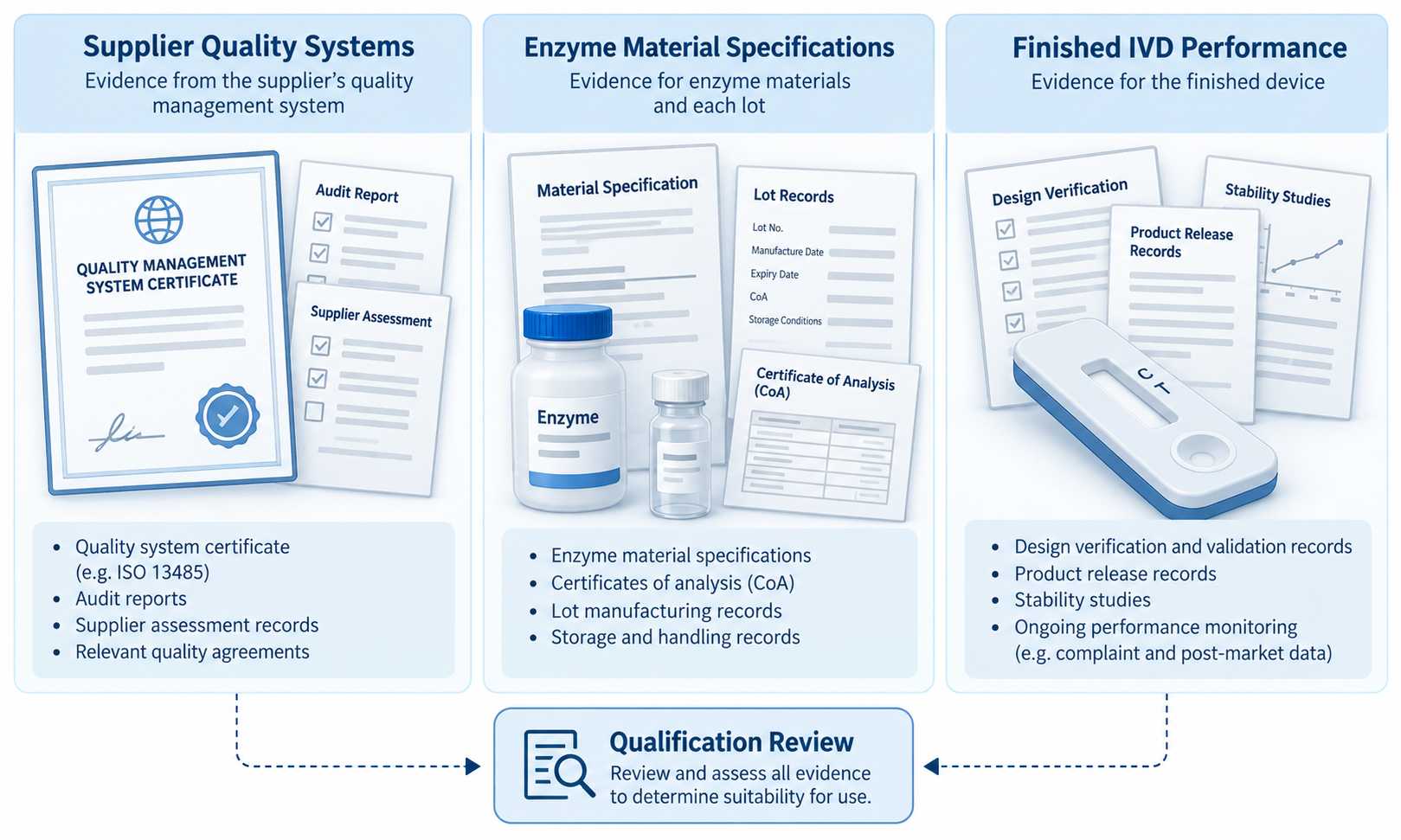
When a certificate is supplied, check the named legal entity, covered sites, stated activities, standard edition, issuing body and validity information. Compare those details with the location and operation that will actually make or release the enzyme. A corporate certificate may not cover every subsidiary, site or activity.
ISO explains that certification is performed by external certification bodies; ISO does not issue certificates to organizations. Keep the issuer's identity clear in your records. Verify a certificate through an appropriate issuing or accreditation channel when its authenticity or current status matters to the purchasing decision.
Read the scope literally. Certification for distribution, for example, should not be interpreted as proof that a separate manufacturing operation was evaluated within the same scope. If wording is broad or ambiguous, document the clarification and the evidence used to connect the supplied material to the certified activities.
The practical outcome is a documented assessment of relevance, not simply a checked certificate-present box. Additional product-specific evidence may still be needed even when the certificate is valid. Conversely, the absence of a particular certificate requires evaluation against applicable requirements and purchasing policy, rather than an unsupported conclusion about catalytic quality.
| Review item | What to establish | What it does not establish |
|---|---|---|
| Entity and site | The document covers the relevant organization and operation. | All affiliated organizations share the same scope. |
| Activities | The stated scope is relevant to the supplied product or service. | Every enzyme application has been validated. |
| Issuer and status | The certificate is authentic and current where required. | ISO itself approved the supplier or product. |
| Product relationship | The supplied enzyme is connected to the covered activities. | The enzyme is an authorized finished IVD. |
Build the material file around interpretable evidence
Start with the agreed material identity and specification. Include the enzyme form, formulation, concentration basis and the attributes that matter to the intended reaction. Record the current document version so the same lot is not judged against different requirements by purchasing, quality and assay-development teams.
Link the certificate of analysis to the specification and analytical method versions. An activity result is only useful when its unit definition and measurement conditions are understood. STRENDA's reporting guidance supports recording the enzyme preparation and assay conditions needed to interpret catalytic data.
Use the technical data sheet for controlled product-level information such as formulation, handling and general method context. Keep lot-specific observations distinguishable from typical values or development findings. If a technical statement is used as an acceptance criterion, place it in the agreed specification with a defined method and decision rule.
Retain the evidence supporting storage and transport conditions, including the material state to which it applies. Bulk liquid, filled containers and material after reconstitution may have different support. A temperature statement without its exposure context can leave receiving staff unable to assess an excursion.
Assess the measurement methods as well as the reported numbers. Eurachem's fitness-for-purpose approach asks whether a method can support the intended decision. For a critical attribute, identify the available method-performance evidence and any customer verification needed before relying on supplier results.
| Record group | Purpose in the purchasing decision |
|---|---|
| System and organization | Identify the supplier, relevant sites, responsibilities and applicable system evidence. |
| Product definition | Control identity, formulation, specification and intended supply configuration. |
| Analytical support | Explain units, methods, result interpretation and important method limitations. |
| Lot and delivery records | Connect the shipment to batch results, dates, quantity and handling history. |
| Lifecycle records | Preserve changes, deviations, investigations, complaints and re-evaluation decisions. |
Agree who supplies, reviews and acts on each record
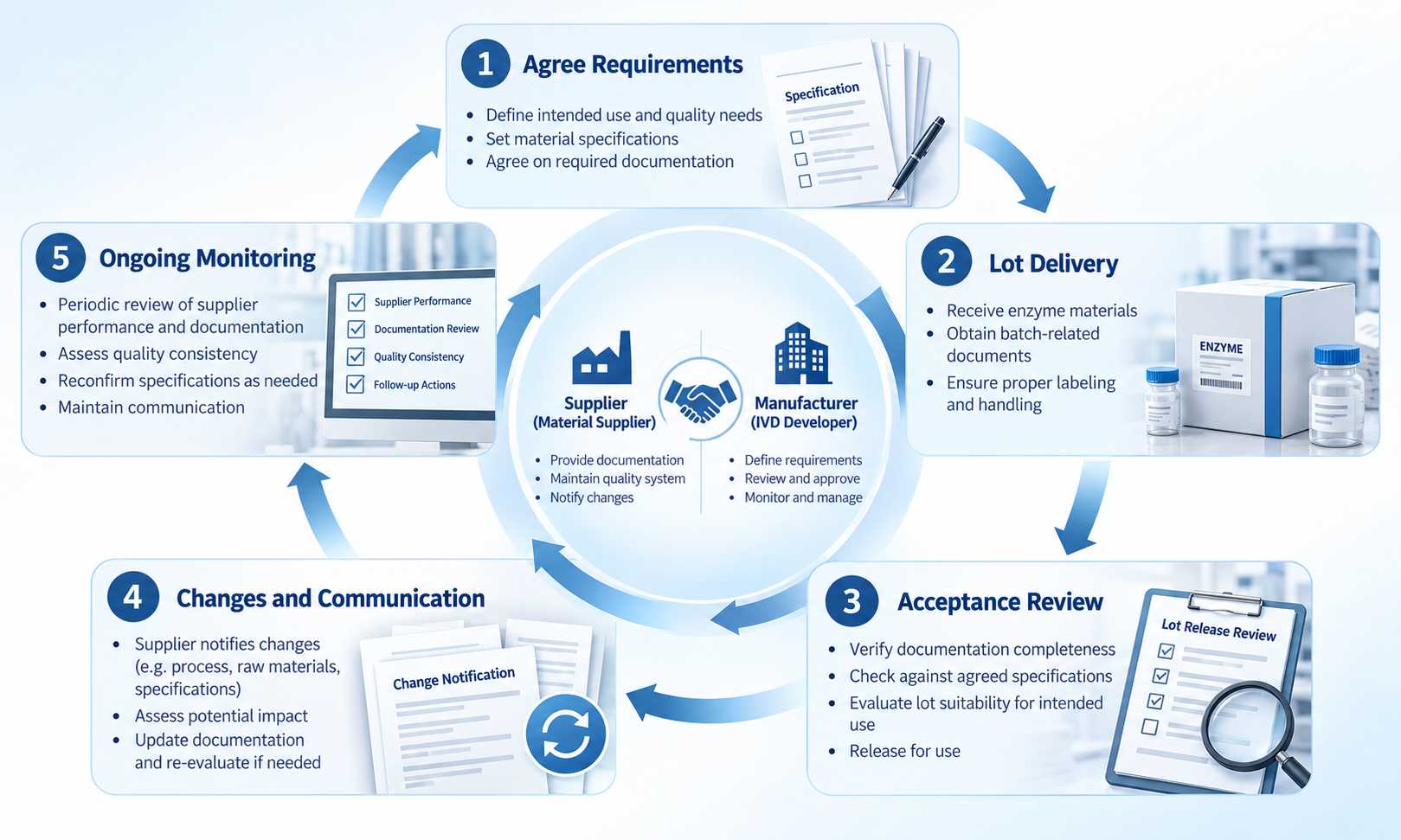
The GHTF supplier-control guidance describes a sequence of evaluation, agreed controls and continued monitoring linked to the risk of the supplied product. Although the document is historical guidance rather than current law, its distinction between supplier evidence and manufacturer responsibility remains useful for planning a supply interface.
Define which tests are performed by the supplier, which are confirmed by the customer and which are reviewed periodically. The allocation should address the relevant material risks and the reliability of available evidence. Duplicate testing is not automatically more informative if both parties use an unsuitable method.
For each required document, identify an owner, delivery point and reviewer. Some information is needed before qualification; other information must accompany each lot or be available during an investigation. A list without timing can leave a shipment physically received but impossible to accept for use.
Specify how confidential process information will be handled. The customer may need evidence that a risk is controlled without receiving every proprietary manufacturing detail. Agree on an appropriate combination of summaries, controlled access or other verifiable records, while documenting any residual information gap.
Ensure the arrangement is practical for both sides. A promise to provide advance notice is incomplete unless the types of change, notification route and required response are understood. The agreement should support a timely technical decision rather than depend on an individual contact remembering an informal discussion.
Make change and exception records actionable
Changes in enzyme source, construct, production site, purification, formulation or analytical method can affect different parts of the evidence package. Ask which changes require notification and what supporting comparison will be available. Do not assume that an unchanged catalog number means the qualified material has remained unchanged.
Define how the customer identifies affected lots and determines the implementation point. During a transition, old and new versions may coexist in inventory. Traceability should allow a reagent batch or development result to be connected to the correct raw-material version.
For a nonconforming or questionable lot, retain the original result, investigation and disposition. Distinguish a documented deviation decision from an ordinary conforming release. If additional testing is performed, explain what uncertainty it addresses rather than selecting only the favorable results for the final record.
Set an investigation pathway for problems discovered after use. Useful exchanges may include affected lot identifiers, sample handling, relevant assay observations and retained-sample findings. Preserve confidentiality and avoid sending unrelated patient information when a material investigation can be conducted without it.
Changes in system certification status can also warrant review, but the response should follow their relevance to the supplied material and agreed requirements. A certificate issue and a product defect are different observations; each needs evidence and an appropriate disposition.
Keep the supplier file current and usable
Review the file against the current product and supply arrangement. Confirm that active specifications, technical sheets and agreements are easy to identify, while superseded versions remain traceable where required. A folder containing every historical document without a clear current version can create avoidable acceptance errors.
Use delivery experience to update the review. Trends in lot results, recurring document gaps, unresolved investigations or notification failures may indicate that existing controls are insufficient. Re-evaluation should address the demonstrated issue and the material's role in the finished assay.
Before closing qualification, identify any open gap and its consequence. An administrative omission may be resolved through document correction; an unexplained method difference or missing critical stability evidence may require technical work before use. Record who can approve the conclusion and what use conditions it covers.
The resulting file should let a new reviewer answer three questions without relying on personal memory: what material was agreed, why the available evidence supports acceptance, and what will happen if that evidence changes. This is the practical value of documentation within a controlled supply relationship.
Use COA, TDS and Quality Documentation Template for Diagnostic Enzymes for reusable document fields. The separate RUO vs IVD-Grade Raw Materials: Practical Differences addresses intended-use terminology. Related topics are collected in Diagnostic Enzyme QC, Validation and Regulatory Resources.
Regulatory and standards context reviewed September 24, 2026; review again within six months. The guidance does not establish any supplier certification or determine the regulatory status of a particular product.
Sources and further reading
- International Organization for Standardization. ISO 13485:2016—Medical devices: Quality management systems—Requirements for regulatory purposes. Third edition, 2016; current listing checked September 24, 2026.
- International Organization for Standardization. Certification. Current public guidance; accessed September 24, 2026.
- U.S. Food and Drug Administration. Quality Management System Regulation (QMSR). Current official page; accessed September 24, 2026.
- Global Harmonization Task Force, Study Group 3. Guidance on the Control of Products and Services Obtained from Suppliers. GHTF/SG3/N17R9:2008, December 11, 2008.
- STRENDA Commission, Beilstein-Institut. STRENDA Guidelines: Enzyme Kinetics and Assay Conditions. Current public guidelines; accessed September 24, 2026.
- Eurachem. The Fitness for Purpose of Analytical Methods: A Laboratory Guide to Method Validation and Related Topics. Third edition, 2025.