

Precision, linearity, detection capability and interference describe different properties of a diagnostic assay. A favorable result for one property cannot establish the others: a test may be highly repeatable yet biased, or detect a low concentration without quantifying it reliably.
Build the evaluation around the intended specimen, workflow, output and decision. This guide explains the purpose and interpretation of each study, including where quantitative and qualitative assays need different evidence.
Define the claim before selecting a study
Start with the complete measurement procedure. Identify the specimen type, preparation steps, instrument, reagent configuration, calibration and reporting rule. Performance established for purified material in buffer does not automatically describe a workflow that includes extraction from patient specimens.
Specify whether the output is a concentration, a qualitative classification or an intermediate signal used to make a classification. That distinction determines which performance characteristics are meaningful. A binary test may have a continuous internal signal, but its user-facing result still requires evaluation around the positive/negative decision.
Choose acceptance criteria from the intended use and the consequences of error. Define how study uncertainty, invalid results and deviations will be handled before collecting data. A result should not become acceptable merely because a more favorable threshold was chosen after reviewing it.
Analytical performance is also separate from clinical performance. CLSI terminology distinguishes detection-related concepts from the proportion of affected subjects who test positive. A lower LoD may improve one part of a testing system, but does not by itself establish clinical sensitivity in the intended population.
| Characteristic | Primary question | What a passing study does not establish |
|---|---|---|
| Precision | How variable are results under specified conditions? | Absence of systematic bias. |
| Linearity | Are reported values sufficiently proportional over the proposed interval? | Reliable detection or quantitation at its lower end. |
| LoD | At what low concentration is detection sufficiently reliable under the defined rule? | Acceptable numerical error at that concentration. |
| LoQ | Where are predefined quantitative error goals met? | Clinical usefulness in every population. |
| Interference | How do particular substances or sample conditions affect results? | Resistance to every possible interferent. |
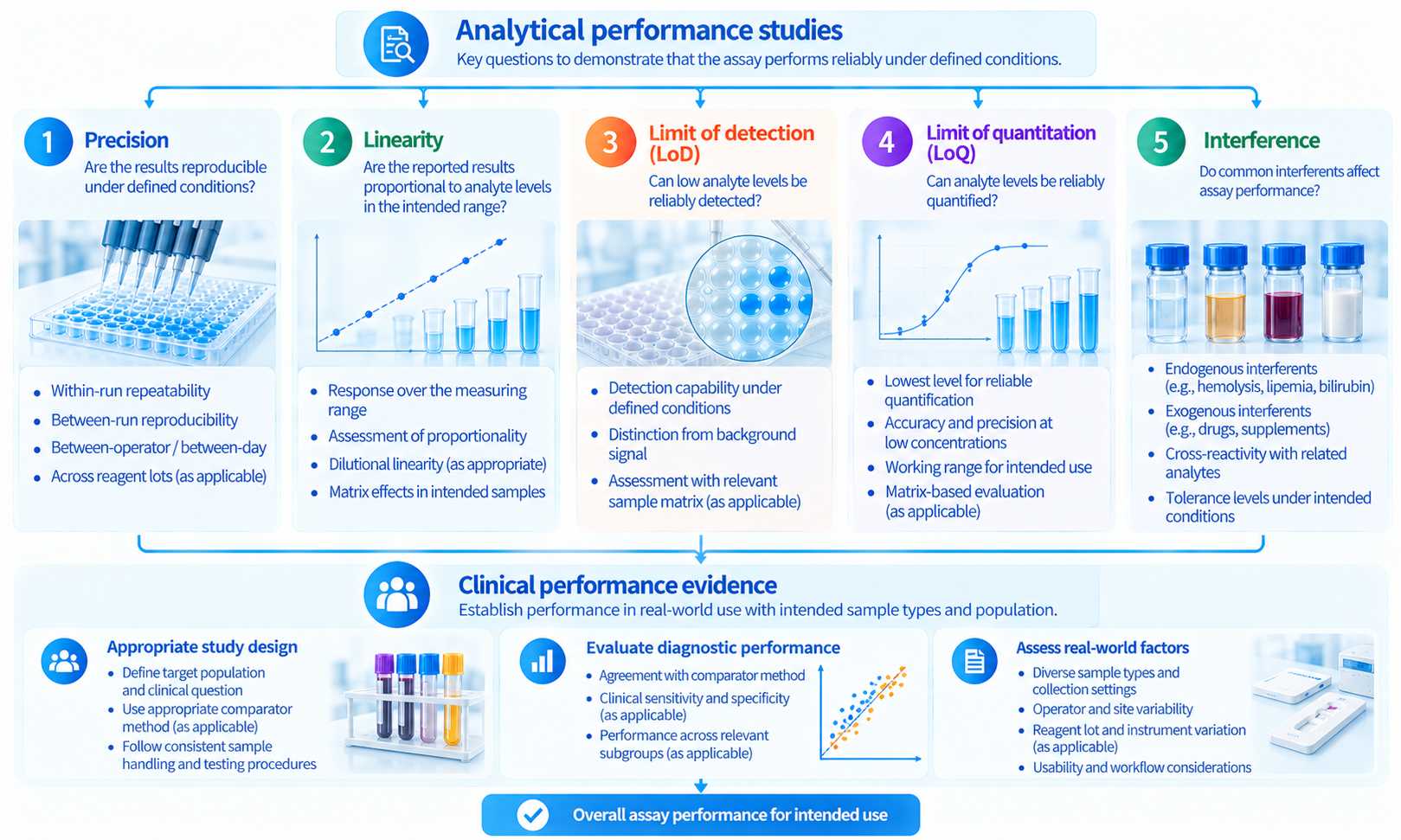
Measure variation under conditions that match the claim
Precision concerns the agreement among repeated measurements under specified conditions. The VIM definition is useful because it makes those conditions part of the result. A precision claim without a description of what varied leaves the reader unable to judge its relevance.
Distinguish repeatability from broader within-laboratory variation and, where relevant, reproducibility across sites. Design the study so that the sources being estimated can be separated. If day, operator and instrument always change together, their effects cannot simply be assigned to one factor afterward.
Choose materials at concentrations that matter to the assay, including relevant decision levels and difficult regions of the measuring interval. High-level control material alone can give a reassuring view while missing low-end variability. Keep sample and reagent stability under control so deterioration is not misinterpreted as random measurement variation.
Report an appropriate measure of imprecision at each level, with uncertainty where applicable. Coefficient of variation can be informative when a meaningful nonzero mean supports it; close to zero, standard deviation or another justified approach may be more interpretable. Do not compress all levels into one percentage if performance changes with concentration.
The current CLSI EP05 fourth edition addresses quantitative precision studies, including within-site and site-to-site designs. Its public scope directs verification of a manufacturer's precision claim to EP15 and fully qualitative binary performance to EP12. These are different tasks, so a small verification exercise should not be presented as full development evidence.
Evaluate reported results across the proposed interval
Linearity asks whether measured values behave proportionally over the interval being claimed, within an acceptable deviation. It is not established by a high correlation coefficient or R-squared value alone. A broad concentration span can produce an impressive association while hiding meaningful local departures.
Use a concentration series with justified assigned or relative values and a matrix appropriate to the intended samples. Document preparation uncertainty and examine whether dilution changes the matrix or the behavior of the measurand. Apparent nonlinearity may come from the test procedure, the prepared series or both.
Inspect deviations across the interval and relate them to predefined acceptable error. Include sufficient attention to the boundaries rather than relying only on central concentrations. When a restricted interval performs acceptably, report that interval instead of averaging away an unacceptable region.
Distinguish the shape of the calibration signal from the behavior of the reported concentration. An assay can use a nonlinear calibration function and still produce appropriately proportional concentration results. Likewise, a straight signal-response segment does not establish the full reportable interval after dilution and calculation.
CLSI EP06 provides the relevant linearity framework. Treat dilution extension as an additional claim requiring evidence, including acceptable recovery and matrix behavior. A result beyond the directly evaluated interval should not be called validated simply because a dilution factor can be entered into the software.
Keep blank, detection and quantitation limits distinct
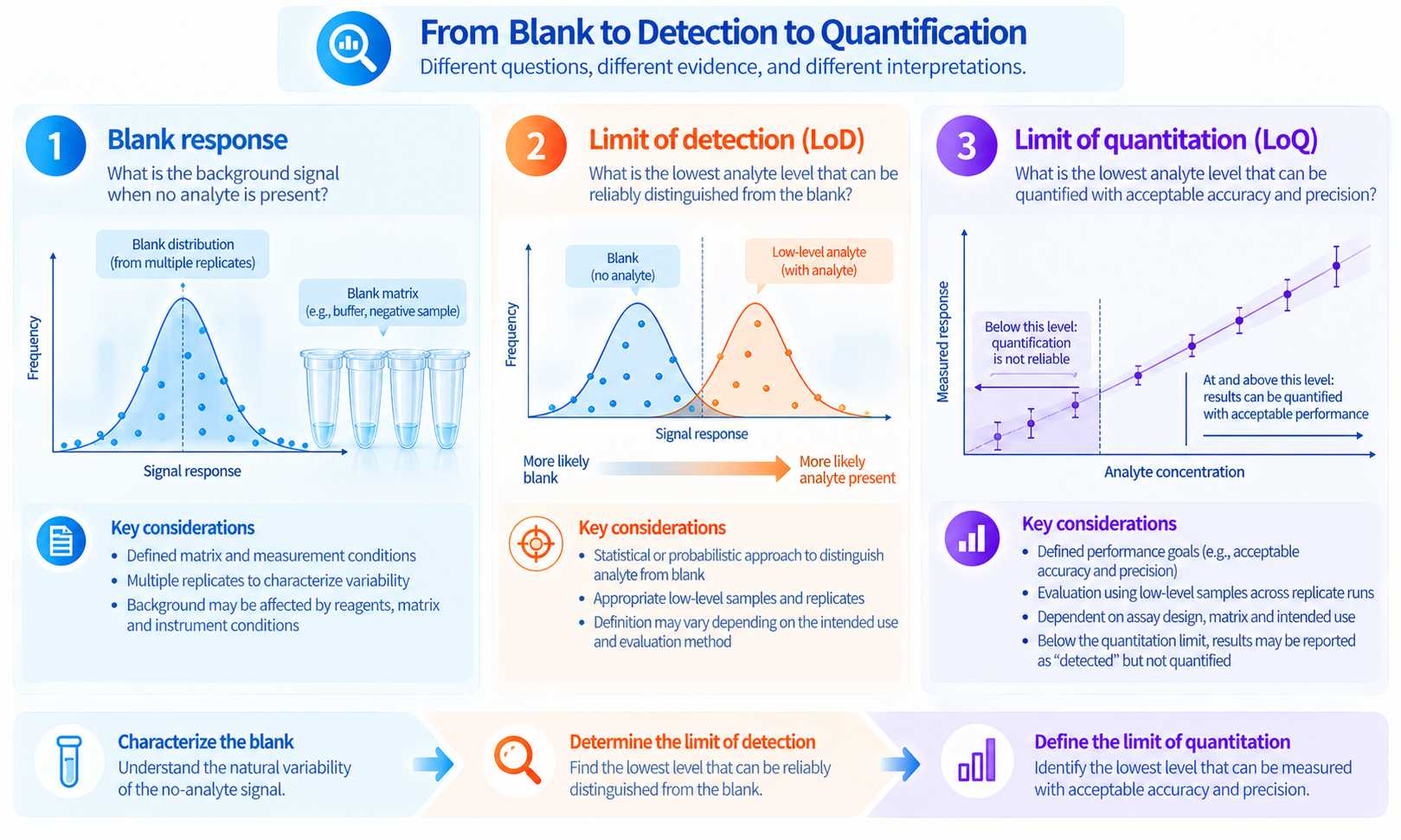
The limit of blank, or LoB, characterizes the upper region of apparent results from suitable blank material under a stated false-positive framework. It describes blank behavior. It does not alone show how consistently a low concentration containing analyte can be detected.
The limit of detection, or LoD, addresses reliable distinction of low-level analyte from blank under the specified detection rule and probability criterion. Evaluate low-level samples as well as appropriate blanks. A single positive result at the lowest tested dilution is not enough to characterize a probabilistic detection limit.
The limit of quantitation, or LoQ, concerns the lowest concentration meeting predefined quantitative performance goals. Detection may be possible where numerical results remain too variable or biased for their intended interpretation. Depending on the method and criteria, LoQ can coincide with LoD or be higher; there is no universal spacing between them.
CLSI EP17 covers these detection-capability concepts and their evaluation. Define whether the claimed limit belongs to the detection reaction alone or the complete specimen-processing workflow. Losses, inhibition and sampling effects introduced before the measurement can change the practical low-end performance.
For a qualitative assay, focus on the probability of a positive result and relevant classification behavior at concentrations around the detection region. State the concentration basis, specimen matrix, replicate structure and uncertainty. A quantitative LoQ is not automatically required for a test that does not report a numerical quantity; EP12 provides the binary-output context.
Use matched comparisons to identify meaningful effects
Interference evaluation asks whether a specified substance changes the result sufficiently to matter for the intended use. Select challenges from the sample type, assay chemistry, specimen collection and plausible exposures. A generic list is a starting point, not evidence that every listed substance must be tested or that the list covers all relevant risks.
Compare challenged and control samples that are otherwise appropriately matched. Control the added volume and solvent, and consider whether preparing the challenge changes pH, matrix composition or analyte concentration. Without that control, a difference may be attributed to the interferent when it actually results from sample preparation.
Assess relevant analyte levels, especially where a shift could affect interpretation. A challenge may be inconsequential at a high concentration but change classification near a cutoff. For quantitative methods, evaluate the magnitude and direction of the effect against the predefined allowable difference; statistical significance alone does not determine practical acceptability.
Use an initial screen to identify concerns, then characterize the relevant concentration-response behavior or investigate affected samples as needed. A negative result supports a bounded statement about the tested conditions. It does not justify describing the method as interference-free.
CLSI EP07 addresses screening, effect characterization and investigation of patient-sample discrepancies. Its current Plus listing includes a companion guide published in March 2026; the underlying standard remains the third edition. Biological cross-reactivity, specimen effects and unexplained patient-result discrepancies may require additional assay-specific studies beyond a chemical challenge panel.
| Record | Why it matters |
|---|---|
| Interferent and preparation | Identifies the actual challenge, including its form and added solvent. |
| Challenge concentration | Bounds the condition for which the result applies. |
| Analyte levels and matrix | Shows whether clinically relevant interpretation regions were examined. |
| Matched control and replication | Supports attribution of the effect and assessment of variability. |
| Acceptance rule and observed effect | Separates the measured difference from the judgment about its significance. |
Combine the evidence without blending the conclusions
Create a claim-to-study summary that preserves the output of each evaluation. For each claim, record the procedure version, specimens, interval or challenge conditions, acceptance criteria and supporting results. Where studies used different reagent lots or configurations, explain why their conclusions can be combined.
Pay particular attention to the lower reporting boundary. An interval may be linear while its lowest concentrations fail the quantitative error goal. Reliable detection at those levels does not resolve that problem. The reporting rule must reflect what the combined evidence supports, including any distinction between detected and quantifiable results.
Keep method comparison and bias assessment visible as separate evidence. Precision demonstrates consistency, while a comparison can reveal systematic differences whose interpretation depends on the comparator. Neither should be replaced by a general statement that the assay was validated.
When an enzyme source, formulation, instrument setting or sample workflow changes, assess which claims could be affected and choose corresponding studies. This gives change evaluation a reasoned scope. It also prevents a successful raw-material activity check from being used to dismiss a possible effect on the finished assay.
For detailed comparison planning, continue to CLSI EP Method Comparison Guide for Assay Developers. Raw-material measurements are covered separately in Activity Assay Method Validation for Diagnostic Enzymes, with the broader resource map in Diagnostic Enzyme QC, Validation and Regulatory Resources.
Source review date: September 24, 2026. This overview uses public standards descriptions and analytical guidance. Study execution requires the applicable full procedure and a justified assay-specific protocol; the page does not supply universal acceptance thresholds.
Sources and further reading
- Clinical and Laboratory Standards Institute. EP05: Evaluation of Precision of Quantitative Measurement Procedures. Fourth edition, December 11, 2025; current EP05 Plus listing.
- Clinical and Laboratory Standards Institute. EP06: Evaluation of Linearity of Quantitative Measurement Procedures. Second edition, 2020.
- Clinical and Laboratory Standards Institute. EP17: Evaluation of Detection Capability for Clinical Laboratory Measurement Procedures. Second edition, 2012; reaffirmed June 2017.
- Clinical and Laboratory Standards Institute. EP07: Interference Testing in Clinical Chemistry. Third edition, 2018; reaffirmed 2022; EP07 Guide added March 17, 2026.
- Clinical and Laboratory Standards Institute. CLSI Publishes the Third Edition of EP12—Evaluation of Qualitative, Binary Output Examination Performance. March 13, 2023.
- Joint Committee for Guides in Metrology. VIM3: Measurement precision, entry 2.15. JCGM 200:2012; online annotated entry.
- Clinical and Laboratory Standards Institute. Harmonized Terminology Database. Public database accessed September 24, 2026.
- Eurachem. The Fitness for Purpose of Analytical Methods: A Laboratory Guide to Method Validation and Related Topics. Third edition, 2025.