

AI-assisted thermostability engineering is useful when it helps select enzyme variants that retain the required function after a defined temperature exposure. A higher predicted stability score or measured unfolding temperature is supporting evidence, not a substitute for that functional result.
Start with the thermal history that limits the diagnostic workflow. Then choose a measurable endpoint, preserve activity and specificity constraints, and verify the candidate in the formulation and assay where the improvement matters.
Define the temperature problem in the intended workflow
Thermal demands differ across diagnostic applications. An enzyme may need to remain active during a reaction, survive a brief processing step or retain performance after a distribution excursion. These are different design problems. Record the temperature profile, exposure duration, material state and point at which function is measured before describing a candidate as more thermostable.
For a molecular assay, distinguish the time spent at the operating temperature from earlier heating steps and later thermal cycles. For an immunoassay conjugate, consider whether the relevant stress occurs before labeling, during storage or in use. An isolated enzyme can encounter a different environment from the same enzyme attached to another molecule or incorporated into a reagent mixture.
Choose a reference preparation and reproduce the observed limitation. If activity loss is inconsistent, investigate handling, formulation and measurement variation first. The engineering program needs a response that can discriminate variants reliably. A more severe challenge is not automatically a better screen if it removes all useful differences or creates a failure mechanism unrelated to the intended use.
Define the properties that must be retained alongside the thermal objective. These may include initial activity, substrate selectivity, useful signal range or compatibility with another enzyme. State the acceptance logic before candidate selection so that a thermal gain cannot conceal a loss in a required function.
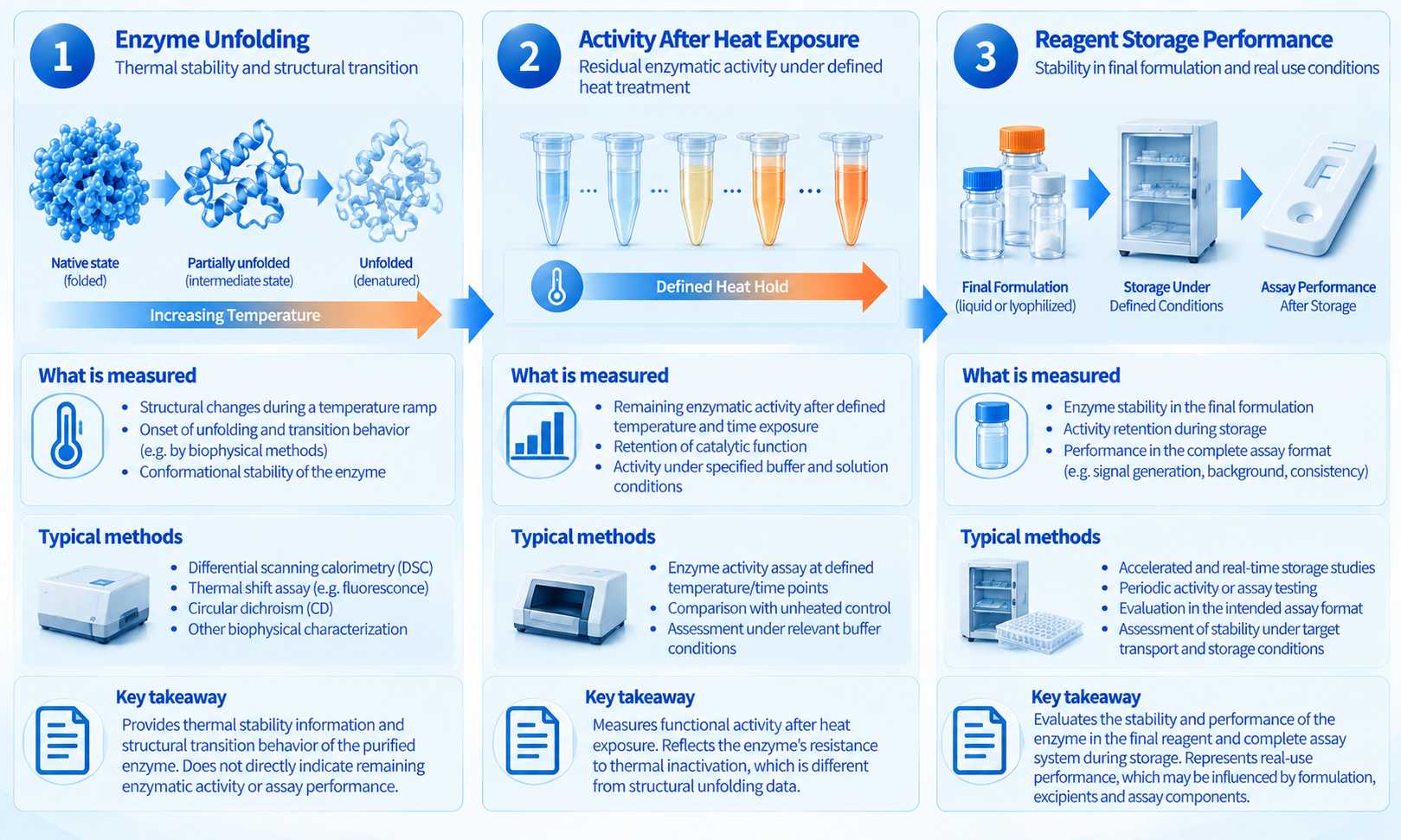
Keep unfolding, inactivation and shelf life separate
| Endpoint | What it describes | Interpretation boundary |
|---|---|---|
| Apparent melting temperature, Tm | A transition observed during a specified thermal scan. | Depends on the method and conditions; it does not directly report useful activity after a heat hold. |
| Residual activity | Activity measured after a defined exposure, relative to a specified baseline. | Requires exposure time, assay conditions and an unstressed comparator. |
| Inactivation time course | How functional response changes during exposure at a selected temperature. | A fitted half-life is conditional on the model and the tested conditions. |
| Operating-temperature performance | Useful reaction output while the enzyme works at a chosen temperature. | Combines reaction kinetics and stability over the measurement interval. |
| Formulated-reagent storage performance | Function retained during storage of the actual reagent. | Requires storage, packaging and assay evidence; cannot be inferred from Tm alone. |
Differential scanning fluorimetry, described by Niesen and colleagues, follows a fluorescence change associated with protein unfolding. Ligands and solution conditions can affect the observed transition. This makes the method useful for comparing conditions, while also explaining why a reported Tm should remain attached to its measurement method and formulation.
For screening, report an apparent transition when the measurement does not establish reversible equilibrium unfolding. Avoid treating a dye-based signal as direct evidence of catalytic survival. If the readout is ambiguous, use an appropriate complementary measurement rather than assigning a precise stability interpretation to an unsuitable trace.
Residual activity also needs a clear denominator. Comparing a heated sample with its own unheated control describes fractional retention. Comparing both heated preparations at equal protein amount describes remaining useful output on a different basis. A variant can retain a larger fraction of a low starting activity and still provide less final activity than the reference. Preserve both the initial and post-exposure observations.
Use predictions to prioritize plausible changes
AI methods can rank substitutions or propose sequence variants for a stability-related objective. Their relevance depends on what the model learned. A predictor trained on unfolding free-energy changes, a model trained on thermal transitions and a model fitted to residual activity are not interchangeable. Check the label, sign convention, reference state and range of proteins represented in the training evidence.
Use structural information to interpret proposals and set constraints where the mechanism is known. Changes near substrate-binding regions, catalytic residues or interfaces may need particular scrutiny. A predicted structural improvement is a reason to investigate a candidate, not proof that the relevant conformational changes or interactions will remain functional.
Include a suitable computational or experimental baseline. PROSS, introduced by Goldenzweig and colleagues, combines sequence and structure information for expression and stability design. FRESCO studies illustrate another computational stabilization approach. These methods help frame useful comparisons, but should not all be relabeled as machine learning merely because they use computation.
Zheng and colleagues' iCASE work combined computational analysis and machine learning to study stability and activity in industrial enzymes. Its relevance here is the joint consideration of those properties. The tested examples do not establish a diagnostic-enzyme success rate or remove the need to measure the intended reaction.
When combining candidate substitutions, evaluate the combination as a new design. Effects inferred for individual changes may not add together in the combined protein. Retain interpretable intermediate variants when they can help explain an unexpected loss of activity or a failure to reproduce the anticipated thermal benefit.
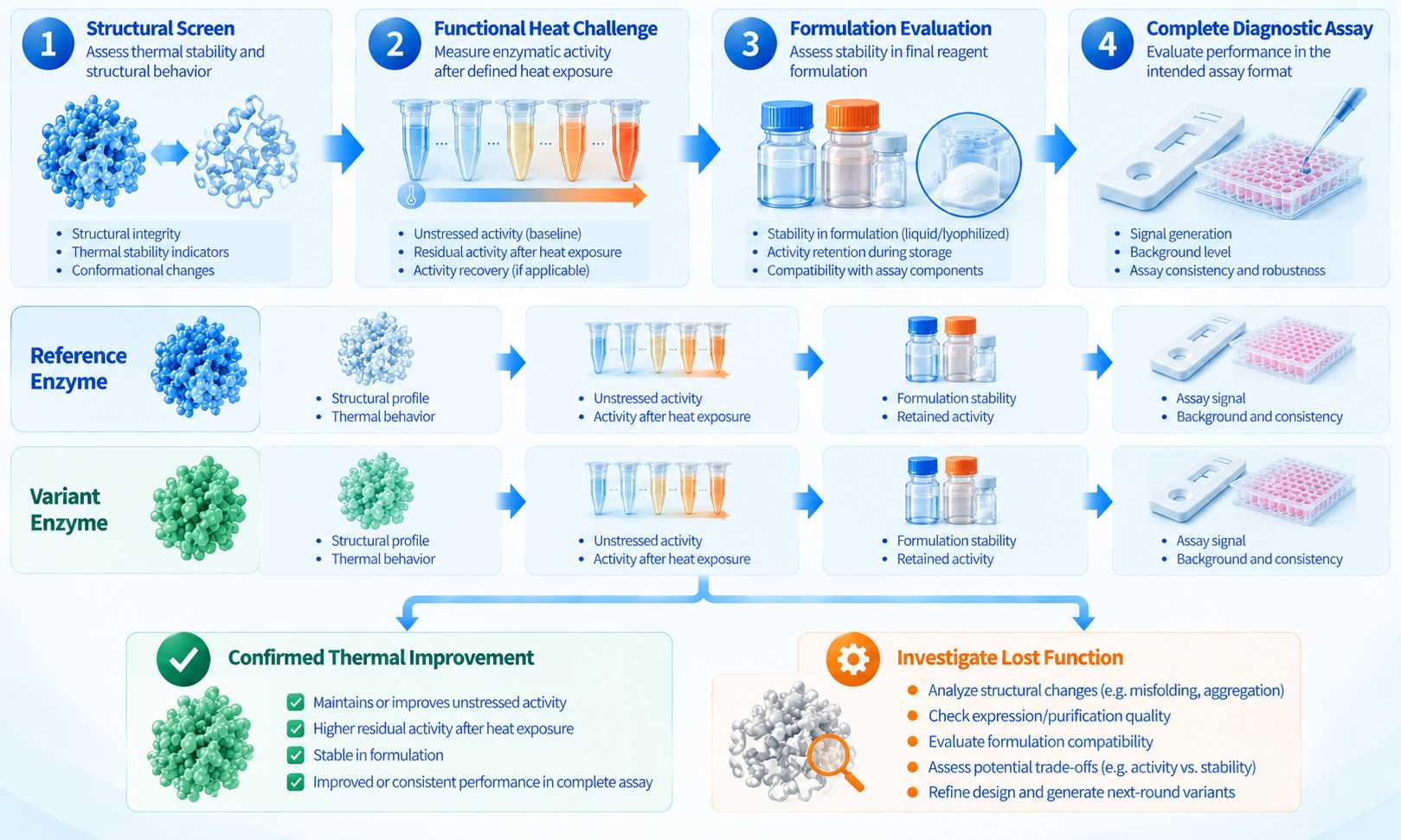
Confirm the thermal benefit with matched functional tests
Compare reference and candidate using material of known identity and a preparation quality suitable for the measurement. Keep the concentration basis, solution composition and exposure history aligned. If the claim concerns sequence, avoid changing the buffer at the same time unless the experiment can separate the two effects.
Measure baseline function before stressing the material. Then apply the planned exposure and assess remaining function under a defined assay. Keep the distinction between activity during the exposure and activity measured after cooling. A post-exposure assay can address retained function without establishing how fast the enzyme operated at the higher temperature.
Build a temperature or time comparison that can reveal the relevant boundary, rather than relying only on a single favorable point. Choose the range from the application and the reference behavior. Report uncertainty and independent preparation results where they affect the conclusion. No universal number of variants or exposure points can replace that experimental rationale.
If a structural screen and a functional test disagree, preserve the disagreement. A thermal transition may move while catalytic output does not improve. Conversely, useful activity may persist without a large shift in the chosen structural readout. Decide which endpoint governs advancement from the project objective, then investigate whether the secondary result explains or limits the candidate.
Finally, repeat the important comparison with independently prepared material. This helps distinguish a sequence-associated effect from a particular expression, purification or handling event. Record the exact method and reference lot so that the next development team can reproduce the comparison.
Resolve activity losses rather than averaging them away
Stability and useful activity can improve together, but they must be measured separately. In the alcohol dehydrogenase study by Aalbers and colleagues, computational stabilization produced a variant containing an activity-impairing change. Reverting that change recovered activity while retaining a substantial stabilization benefit. The example shows why a follow-up investigation can be more informative than selecting the highest thermal endpoint alone.
Recent reverse-transcriptase work by Tao and colleagues also illustrates constrained redesign of an evolved protein. The study examined stability and expression in a prime-editing context. It is relevant to the engineering strategy, but does not establish RT-qPCR performance or diagnostic reagent storage life.
For a candidate with reduced activity, ask whether the result reflects intrinsic function, the amount of active material or the preparation. Compare the evidence before assigning a mechanism. A thermal design score cannot resolve this distinction. If the required function falls below an agreed limit, treat that as a failed constraint rather than hiding it inside a weighted average.
Retain the smallest useful set of changes when it improves interpretability and meets the objective. Extensive redesign may be justified in some programs, but additional substitutions create additional questions about behavior and transfer. The decision should follow the measured benefit and the development burden, not the novelty of the sequence.
Test the formulated reagent before extending the claim
A sequence selected in one buffer still needs evaluation in the intended formulation. Consider the final concentration, excipients, substrates, other proteins and the material state. Use a comparison that can distinguish a formulation effect from a variant effect. If a new formulation benefits both materials equally, describe that finding accurately rather than attributing the entire gain to the sequence.
For a dried reagent, evaluate the relevant processing and reconstitution steps as well as storage. For an enzyme conjugate, assess useful performance after conjugation. The practical target is the reagent at its point of use, and that target may differ from the isolated-protein screen that helped select the sequence.
Define the final claim narrowly enough to match the evidence: for example, improved residual activity after the tested exposure in the named formulation. A shelf-life or transport claim needs its own study in the relevant package and assay. Thermal engineering can contribute to that program without predicting its outcome in advance.
For the broader candidate-selection process, see AI Models for Diagnostic Enzyme Variant Design. For documenting exposure conditions and measurements, use AI-Ready Experimental Dataset Design for Enzyme Optimization. Return to the AI-Driven Enzyme Engineering Resource Center for related application guides.
Sources and further reading
- Niesen FH, Berglund H, Vedadi M. The use of differential scanning fluorimetry to detect ligand interactions that promote protein stability. Nature Protocols. 2007;2:2212-2221. DOI: 10.1038/nprot.2007.321.
- Aalbers FS and colleagues. Approaching boiling point stability of an alcohol dehydrogenase through computationally-guided enzyme engineering. eLife. 2020;9:e54639. DOI: 10.7554/eLife.54639.
- Goldenzweig A and colleagues. Automated Structure- and Sequence-Based Design of Proteins for High Bacterial Expression and Stability. Molecular Cell. 2016;63:337-346. DOI: 10.1016/j.molcel.2016.06.012.
- Zheng N and colleagues. Tailoring industrial enzymes for thermostability and activity evolution by the machine learning-based iCASE strategy. Nature Communications. 2025;16:604. DOI: 10.1038/s41467-025-55944-5.
- Tao YA and colleagues. AI-guided redesign of laboratory-evolved reverse transcriptases enhances prime editing. Nature Biotechnology. 2026. DOI: 10.1038/s41587-026-03149-6.