

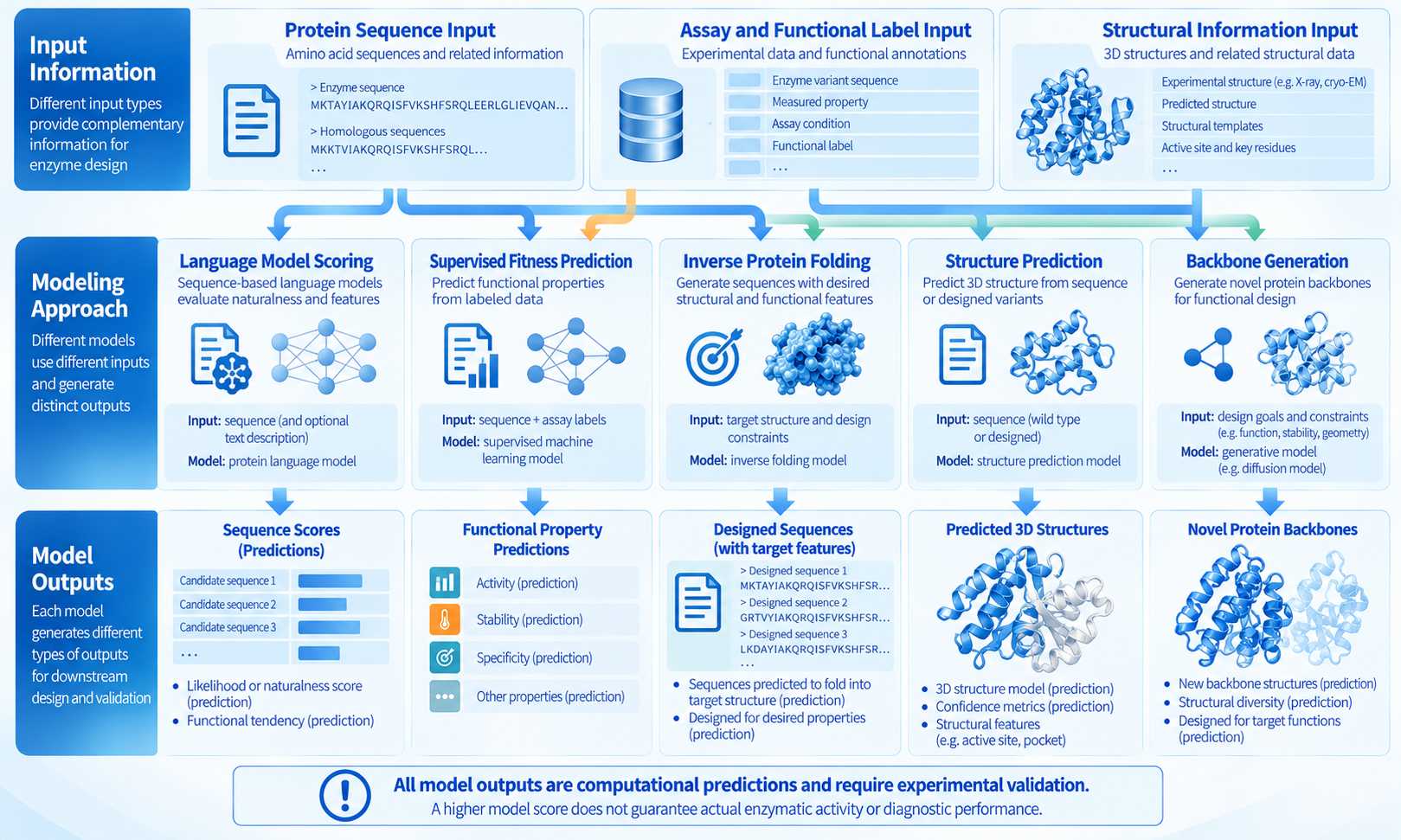
Choose an AI model for enzyme variant design by matching its input data and output to the experimental decision. A model that ranks sequence plausibility, predicts an assay label or proposes a backbone performs a different task in each case.
For diagnostic development, the useful comparison is whether a method helps select testable candidates that meet a defined assay objective. Model size, structural confidence and performance on an unrelated benchmark cannot establish that result by themselves.
Define the task before selecting an architecture
Specify whether the project needs to rank single substitutions, combine known changes, redesign selected regions of an existing scaffold or explore a different protein architecture. These decisions differ in how far candidates depart from the available evidence. A model evaluated on nearby substitutions has not automatically been evaluated for an extensively redesigned sequence.
Next identify the output that would actually guide selection. It might be a predicted assay response, a probability of satisfying a threshold, a structural proposal or a ranking used to allocate experiments. Define the response and its conditions explicitly. A label called fitness is incomplete unless the underlying measurement and comparison are known.
Inventory the available evidence before choosing the method. Relevant information may include a reference sequence, homologous sequences, experimental or predicted structures, consistent activity measurements and results from unsuccessful variants. Check whether the sequences and measurements can be joined unambiguously. If the labels mix incompatible assays, adding model complexity will not resolve their meaning.
Keep the first modeling question narrow enough to evaluate. For example, predicting an endpoint for variants measured in the same assay is a different problem from transferring that prediction across formulations. Treat a change in matrix, temperature or preparation method as a potential change in the prediction task, and plan the corresponding evidence.
Compare model families by their inputs and outputs
| Model family | Typical input and output | Useful role and limitation |
|---|---|---|
| Protein language model | Sequence input produces representations or sequence-based variant scores. | Prioritization without local labels; sequence statistics do not directly specify the diagnostic endpoint. |
| Assay-trained predictor | Variant features and measured labels support predictions of the recorded response. | Local ranking or estimation; reliability depends on label quality and the candidate distribution. |
| Inverse-folding model | A backbone conditions candidate amino acid sequences. | Constrained sequence redesign; backbone compatibility does not establish catalysis. |
| Structure predictor | A sequence, and model-dependent context, produces structural hypotheses and confidence estimates. | Inspection of structural plausibility; confidence is not measured activity. |
| Backbone generator | Design conditions guide structural proposals. | Exploration of architectures; functional enzyme development still requires sequence design and experiments. |
Meier and colleagues demonstrated zero-shot prediction of mutation effects using protein language models. Zero-shot means the prediction does not use task-specific experimental supervision in that setting. It does not mean the model has no training history, nor does it make the output independent of the sequence distribution used during training.
For labeled datasets, start with an understandable baseline as well as a more elaborate candidate model. Hsu and colleagues found that simple combinations of evolutionary information and assay labels could compete with more complex approaches. The practical implication is to measure local benefit before committing to a computationally expensive method.
ProteinMPNN, described by Dauparas and colleagues, addresses sequence design conditioned on structure. RFdiffusion, described by Watson and colleagues, addresses generation of protein structures under design conditions. These tools can occupy different stages of a design pipeline. Treating them as interchangeable predictors of an enzyme activity label obscures what each model was trained to do.
An established diagnostic enzyme scaffold often carries knowledge about expression, reaction chemistry and formulation compatibility. A broader redesign should justify why that additional distance from the reference is useful. Novelty is not itself a performance objective, and a more conservative candidate may be easier to interpret and transfer.
Ask what each score measures
Read the definition of the score before setting a cutoff. A sequence likelihood describes the model's treatment of a sequence. A supervised prediction estimates a label under the fitted relationship. A structure-confidence metric estimates confidence in structural features. None should be renamed as an experimentally measured property.
EMBL-EBI explains pLDDT as a measure of local confidence in a predicted structure. It does not measure confidence in every relationship between domains. More generally, a confident structural prediction does not establish a variant's catalytic rate, inhibitor tolerance or storage life. Those endpoints require their own evidence.
Avoid comparing raw scores from unrelated model families as if the scales were shared. Even within one family, a software version, preprocessing change or scoring convention can alter the values. Record directionality, units where applicable and the reference used for a relative score. If scores are combined, state why the combination is meaningful and examine the underlying components separately.
Uncertainty needs the same care. Ensemble disagreement can be a useful warning, but agreement among similar models is not a guarantee of accuracy. If a prediction interval is reported, check its behavior on held-out measurements representative of the intended candidates. In unfamiliar sequence or assay conditions, communicate the lack of supporting data rather than turning a narrow-looking interval into unwarranted confidence.
For designs involving multiple substitutions, do not assume that favorable single-mutation estimates will add together. Interactions between changes can alter the outcome. Treat a combination as a new candidate requiring appropriate prediction and measurement, especially when it moves outside the combinations represented in the data.
Evaluate the generalization the project actually needs
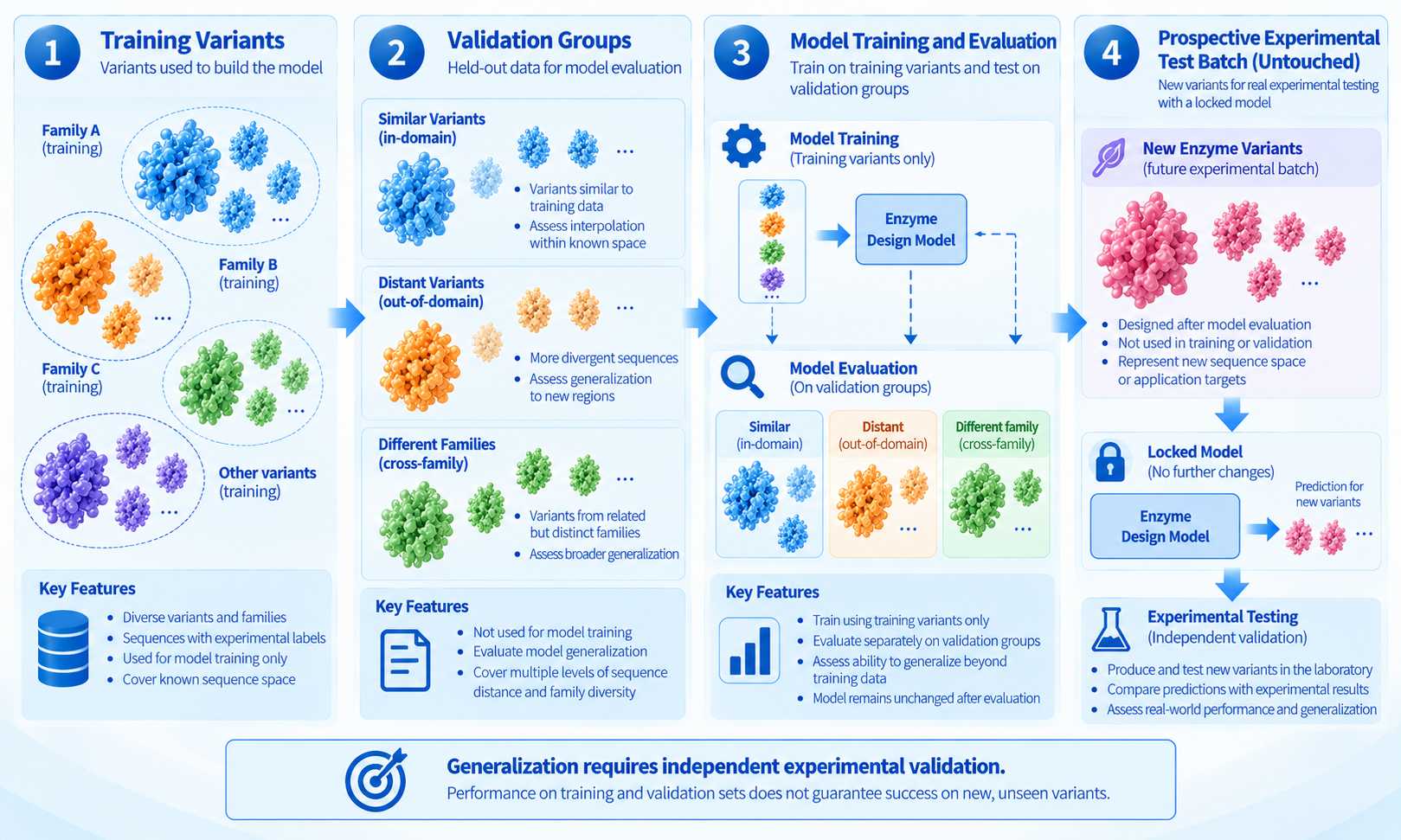
A random train-test split answers a limited question when closely related variants appear on both sides. It may be appropriate for a narrow interpolation task, but it can overstate usefulness for a different scaffold or a larger mutational step. DataSAIL research highlights the importance of reducing similarity-driven leakage when evaluating biological models under distribution shifts.
Choose the split from the intended use. Keep replicate measurements of the same variant together. Consider grouping by sequence neighborhood when the goal is extrapolation, and by experimental round when evaluating prediction of future candidates. If batches or laboratories differ, examine whether their separation changes the conclusion. No single split captures every deployment scenario.
Fit preprocessing, feature selection and hyperparameters using the development data only. Keep the final test set outside those decisions. Repeatedly checking the final test set while modifying the model turns it into another development set, even if its labels are never directly used in gradient training.
Use evaluation measures that reflect the decision. Rank correlation can describe ordering across a dataset, while the fraction of useful candidates among a selected batch addresses experimental yield. A predictor of numerical response also needs an error assessment on the relevant scale. Report the comparator and experimental budget so that a claimed selection advantage has a clear meaning.
A prospective batch is particularly informative: freeze the method and candidate-selection rule before obtaining the new measurements. Compare predictions with the measured outcomes and record failed or unmeasurable candidates separately. This tests the design decision closer to the way it will be used than another random split of an already familiar dataset.
Turn model output into an informative candidate batch
Start by applying constraints that represent the engineering objective. Preserve required sequence regions or functions when the design rationale calls for them, and record exceptions explicitly. Computational filters should remove candidates for a stated reason, not simply because a convenient score is available.
Among the feasible designs, select candidates that test more than one hypothesis. Taking only near-identical top-ranked sequences may give little information if they share the same failure mode. A practical batch can include promising candidates, alternatives that challenge model assumptions and suitable reference comparisons. The proportions should follow the assay cost and stage of the project, rather than a universal exploration rule.
Retain the distinction between predicted merit and build feasibility. A sequence that cannot be produced or characterized under the available process has not been shown to have poor intrinsic catalytic activity. Track that outcome because it matters to development, while avoiding an incorrect activity label that could mislead the next model.
When models disagree, identify what each one is responding to before choosing a winner. A sequence-based score may favor a familiar pattern while an assay-trained predictor favors a change associated with a local response. Testing a small, interpretable set can be more useful than averaging away the disagreement. The purpose of the batch is to support the next decision, not to make every computational score agree.
Record the selection so it can be evaluated later
The modeling handoff should include the exact candidate sequences, reference numbering, model checkpoint, software version, inputs, constraints and selection rule. Preserve the split definition and the results of the baseline comparison. If stochastic sampling was used, retain the settings needed to understand how the candidates were generated.
State what would count as a useful prediction and what result would trigger a change in approach. If the selected candidates do not outperform a reasonable baseline, investigate the label, distribution and experimental noise before escalating model complexity. If the predicted gain disappears in the intended reagent system, revisit the target measurement.
Use Design-Build-Test-Learn Workflow for Enzyme Evolution to organize the resulting experimental rounds. For deeper treatment of structural tools, see AlphaFold, RFdiffusion and ProteinMPNN for Enzyme Design: Practical Limits. The AI-Driven Enzyme Engineering Resource Center connects these decisions to application, data and project-planning resources.
Sources and further reading
- Meier J and colleagues. Language models enable zero-shot prediction of the effects of mutations on protein function. NeurIPS. 2021;34.
- Hsu C and colleagues. Learning protein fitness models from evolutionary and assay-labeled data. Nature Biotechnology. 2022;40:1114-1122. DOI: 10.1038/s41587-021-01146-5.
- Dauparas J and colleagues. Robust deep learning-based protein sequence design using ProteinMPNN. Science. 2022;378:49-56. DOI: 10.1126/science.add2187.
- Watson JL and colleagues. De novo design of protein structure and function with RFdiffusion. Nature. 2023;620:1089-1100. DOI: 10.1038/s41586-023-06415-8.
- EMBL-EBI. pLDDT: Understanding local confidence. AlphaFold training materials; accessed October 2026.
- Joeres R, Blumenthal DB, Kalinina OV. Data splitting to avoid information leakage with DataSAIL. Nature Communications. 2025;16:3337. DOI: 10.1038/s41467-025-58606-8.