

AI-driven enzyme engineering can help prioritize variants for a diagnostic assay when the limiting enzyme property is defined and measurable. The development goal is a reproducible improvement under the intended reaction conditions, with the other required properties retained.
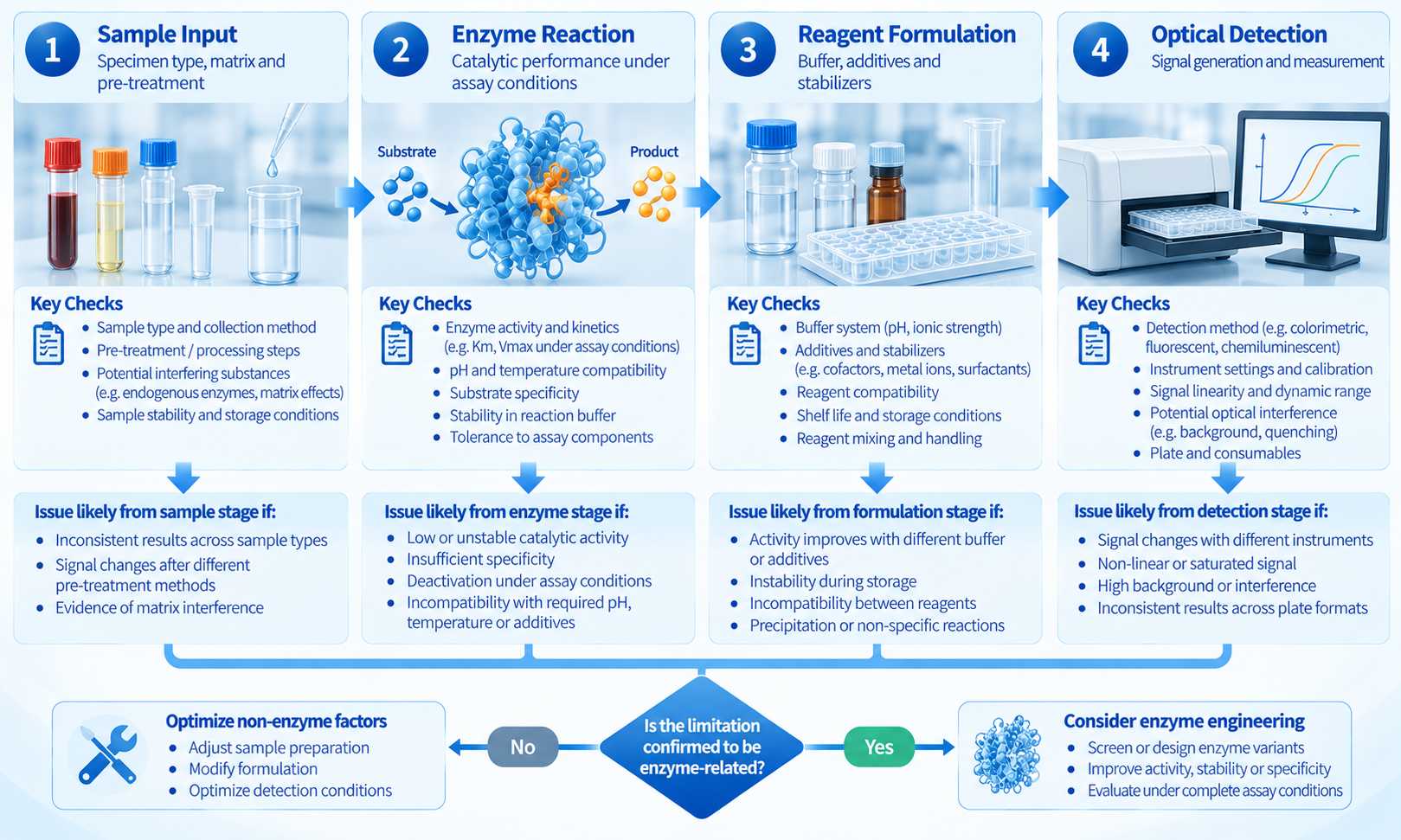
Begin by identifying the assay bottleneck. Then decide whether sequence changes, formulation changes or another part of the workflow offers the most direct route to improvement. This guide explains how to frame that decision and evaluate a candidate in context.
Confirm that the enzyme is limiting performance
A weak or variable assay result is an observation, not a diagnosis of an enzyme defect. Before commissioning sequence design, ask whether the same enzyme preparation performs consistently in a simple reference reaction. Compare that result with behavior in the complete assay. The difference helps locate conditions that deserve investigation, although it does not by itself establish the mechanism.
For an amplification assay, a delayed signal could involve template recovery, an inhibitor, primer behavior, reporter detection or enzyme function. Changing the enzyme before separating these possibilities may improve one test condition while leaving the original failure unresolved. A controlled comparison of sample input, reaction components and detection behavior is more informative than a single endpoint.
For an enzyme immunoassay, low signal can arise from the amount of bound conjugate as well as its catalytic behavior. Assess the recognition and labeling steps alongside the enzyme-substrate reaction. If background originates from nonspecific binding, increasing catalytic output may amplify that background too. A sequence-engineering target should therefore emerge from the mechanism investigation, rather than from the signal amplitude alone.
Kermekchiev and colleagues showed that mutations in Taq polymerase altered tolerance to particular PCR inhibitors. This establishes that sequence can matter for that property. The study was not an AI engineering campaign and does not make every sample-associated failure a polymerase-design problem. Use it as a mechanistic example, then test the cause in your own system.
Translate the application into an objective and constraints
Write the objective as a comparison against a named reference under specified conditions. Describe the material, reaction and endpoint well enough that a second team could understand the test. Add properties that must not deteriorate. This prevents a candidate from being called improved solely because one favorable measurement was selected after the experiment.
The following matrix is a planning framework, not a list of demonstrated AI improvements. The proposed checks should be adapted to the assay mechanism and intended use. There is no universal acceptance threshold for these enzyme classes.
| Application | Possible engineering objective | Companion checks |
|---|---|---|
| PCR or qPCR polymerase | Retain useful synthesis in a defined matrix or cycling program. | Specificity, low-input behavior, negative reactions and compatibility with reporter chemistry. |
| Reverse transcription | Produce usable cDNA under the selected temperature, time and template conditions. | Template-dependent bias, downstream amplification compatibility and negative controls. |
| Immunoassay signal enzyme | Improve useful substrate conversion in the working conjugate. | Binding retention, blank signal, read window and conjugate stability. |
| Coupled clinical chemistry system | Improve the limiting reaction within the coupled method. | Other reaction steps, endogenous interferents and the measurement range. |
| Dried diagnostic reagent | Retain functional performance after the defined drying and reconstitution process. | Initial activity, reconstitution behavior, packaging and storage evidence. |
Separate an objective from a convenient surrogate. Soluble expression is useful when production limits testing, but it does not establish improved catalytic efficiency. Activity after heating may help compare variants, but it does not alone establish storage life. Record why the surrogate is expected to matter and when that relationship will be checked in the intended system.
When several properties matter, identify the non-negotiable limits first. A candidate that fails a required specificity condition should not advance because its activity gain raises an averaged score. Among candidates that meet the constraints, compare the remaining benefits against the effort needed for formulation, manufacturing and assay requalification.
Use AI to support a defined experimental choice
Models can help rank substitutions, propose combinations or identify sequences for testing. The useful output is a reasoned candidate set with stated assumptions. Whether that set improves the project depends on what is built, what the experiment measures and how the result compares with a reasonable selection baseline.
Biswas and colleagues demonstrated data-efficient engineering using pretrained sequence representations and experimental labels in selected proteins. Hsu and colleagues showed the value of combining evolutionary information with assay measurements and comparing against simple methods. These findings motivate testing an appropriate model locally. They do not establish that a larger model or a smaller training set will work for every enzyme.
Two application-adjacent examples illustrate how evidence should be transferred carefully. Tao and colleagues redesigned reverse transcriptase domains for prime editing, including attention to folding and expression. Their results support the feasibility of constrained redesign in that setting. They do not report diagnostic RT-qPCR validation.
Yeh and colleagues designed and experimentally tested luciferases for selected synthetic substrates. The work shows that computational design can contribute to a functional light-producing enzyme system. It does not establish interchangeability with horseradish peroxidase or alkaline phosphatase conjugates. Substrate, labeling, assay format and measurement conditions would all require evaluation before such a substitution could be justified.
For model inputs, outputs and evaluation choices, continue to AI Models for Diagnostic Enzyme Variant Design. Keep the application specification available during that discussion so the computational task remains connected to the actual development need.
Evaluate the candidate at the level where it will be used
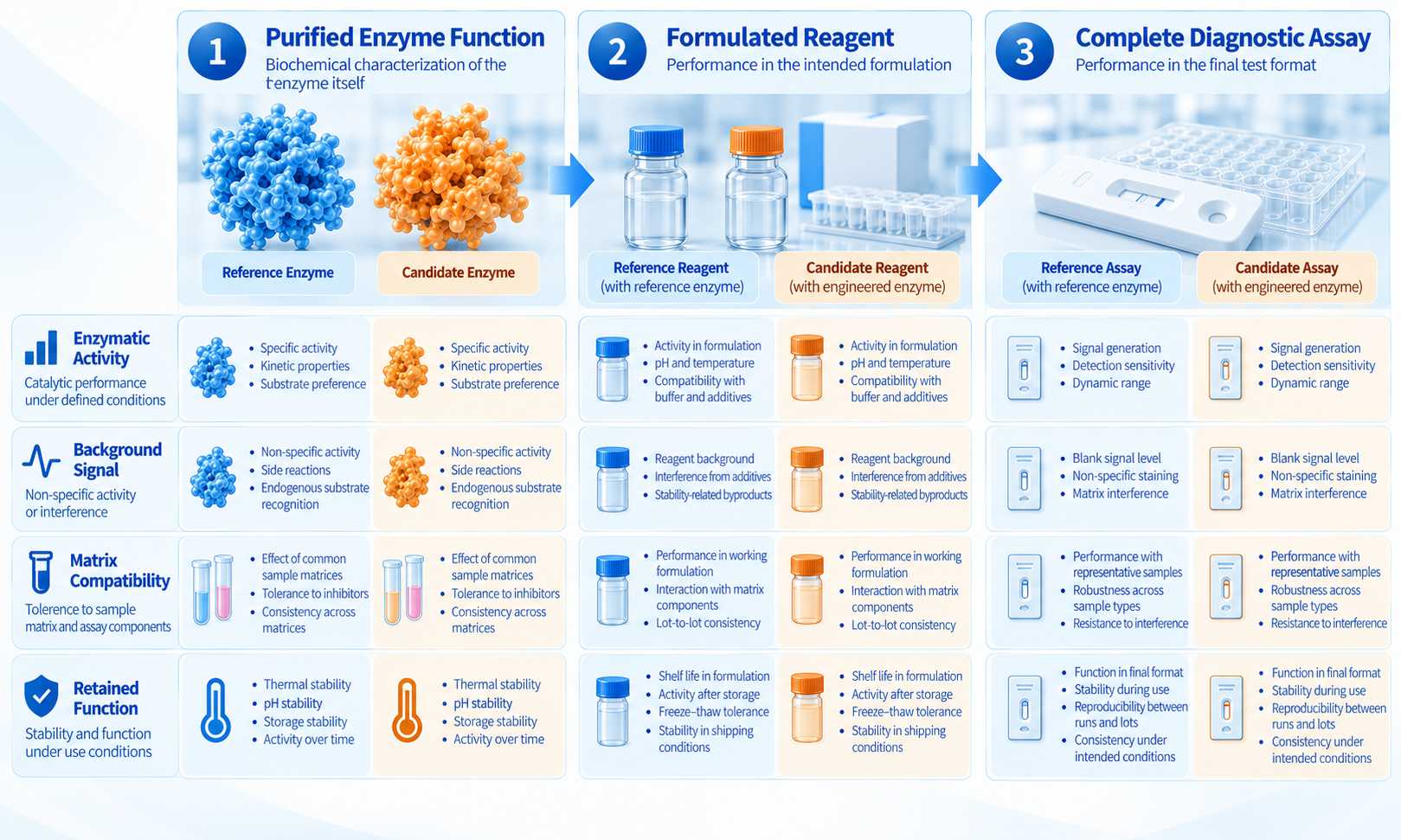
Use a staged evaluation to avoid spending full-assay resources on poorly characterized material. First establish that the tested preparation corresponds to the intended sequence and that its quality is suitable for a comparison. Then measure the target property under controlled conditions. Finally, assess the candidate in the reagent combination and sample conditions that motivated the work.
Choose the normalization deliberately. An equal-protein comparison and an equal-activity comparison answer different questions. Equal protein can reveal differences in useful output per amount of material, while equal activity can help compare performance after calibrating preparations to a reference method. Neither approach automatically corrects for impurities, inactive protein or incompatible activity-unit definitions. Record the rationale and retain the preparation information needed to interpret it.
Include the reference within the same experimental runs as the candidate. Independent preparations are particularly valuable when expression or purification could explain the apparent gain. A screen that compares a fresh candidate with an older reference stock risks attributing a material-handling difference to sequence design.
The complete assay evaluation should test the original failure condition and ordinary operating conditions. A stress-tolerant enzyme that behaves poorly in unstressed samples may not meet the project need. Use representative matrix variation, relevant negative samples and the actual signal interpretation method. The purpose is to determine where the benefit persists and where it stops.
Interpret a gain without hiding its costs
Consider a hypothetical reverse-transcriptase program whose objective is useful cDNA production during a shorter reaction. An earlier downstream qPCR signal is encouraging, but several explanations remain possible. The variant might produce more usable cDNA, or a change in carryover buffer might alter amplification. A comparison that controls the downstream reaction helps separate these explanations. This is an interpretation example, not an experimental result.
Now consider the other required properties. The same candidate may respond differently to template structure, concentration or sample carryover. Evaluate those conditions before describing the benefit broadly. If a gain is confined to a narrow template set, state that boundary and decide whether it still serves the intended assay.
For reporter enzymes, compare both useful signal and background over the intended read window. A faster reaction can create timing sensitivity even when a single endpoint looks favorable. For coupled reactions, a change to one enzyme can move the rate-limiting step elsewhere. These are reasons to inspect the system response rather than assume that a better isolated-enzyme measurement will improve the final readout.
Preserve separate results for activity, specificity, production yield and retained function. A compact comparison table usually communicates the trade-offs more clearly than a single composite score. If a composite objective is used for candidate selection, document its weights and retain the underlying measurements so the decision can be revisited.
Define what is ready for transfer
A candidate is ready for the next development stage when the evidence supports a specific decision. That might be a repeatable gain in the intended prototype, a narrowed hypothesis that needs another experiment, or a decision to stop sequence engineering and change the formulation. Each is more useful than a ranking with no corresponding application evidence.
The handoff should connect the exact sequence to its preparation history, assay methods, raw results, comparison material and remaining limitations. Record the model and selection rationale as provenance, while making the experimental evidence the basis for the performance conclusion. Preserve unsuccessful candidates when they inform future design choices.
For iteration planning, use Design-Build-Test-Learn Workflow for Enzyme Evolution. For the broader topic map, return to the AI-Driven Enzyme Engineering Resource Center. Candidate selection remains one stage of diagnostic development; complete analytical and intended-use evaluation must follow the requirements of the final assay.
Sources and further reading
- Kermekchiev MB and colleagues. Mutants of Taq DNA polymerase resistant to PCR inhibitors allow DNA amplification from whole blood and crude soil samples. Nucleic Acids Research. 2009;37:e40. DOI: 10.1093/nar/gkn1055.
- Tao YA and colleagues. AI-guided redesign of laboratory-evolved reverse transcriptases enhances prime editing. Nature Biotechnology. 2026. DOI: 10.1038/s41587-026-03149-6.
- Yeh AH-W and colleagues. De novo design of luciferases using deep learning. Nature. 2023;614:774-780. DOI: 10.1038/s41586-023-05696-3.
- Biswas S and colleagues. Low-N protein engineering with data-efficient deep learning. Nature Methods. 2021;18:389-396. DOI: 10.1038/s41592-021-01100-y.
- Hsu C and colleagues. Learning protein fitness models from evolutionary and assay-labeled data. Nature Biotechnology. 2022;40:1114-1122. DOI: 10.1038/s41587-021-01146-5.