

Artificial intelligence can help prioritize enzyme variants and organize the search for useful properties. Its value depends on a measurable objective, relevant data and an experimental test that reflects the intended application. A promising prediction is a reason to investigate a candidate, not evidence that a diagnostic reagent is ready.
These FAQs address project decisions rather than model operating instructions. They distinguish structure prediction, sequence design and function prediction, then explain the data and confirmation needed to move from a computational shortlist to an evaluated enzyme.
Define what improvement means
What does AI enzyme engineering actually involve?
It uses computational models to support decisions about enzyme design or variant selection. In machine learning-assisted directed evolution, measured results can guide which candidates are examined next. Wu and colleagues demonstrated this approach in defined experimental systems. The practical output is a prioritized experiment or candidate set, followed by testing and further learning.
What makes a useful optimization objective?
State the property, measurement conditions and minimum acceptable behavior. For a diagnostic enzyme, that might mean retaining function after a defined handling exposure while preserving performance in the assay. Also identify properties that must not deteriorate. A request for a better enzyme is too ambiguous to decide whether a predicted or measured change is useful.
Should a project optimize enzyme activity or complete assay performance?
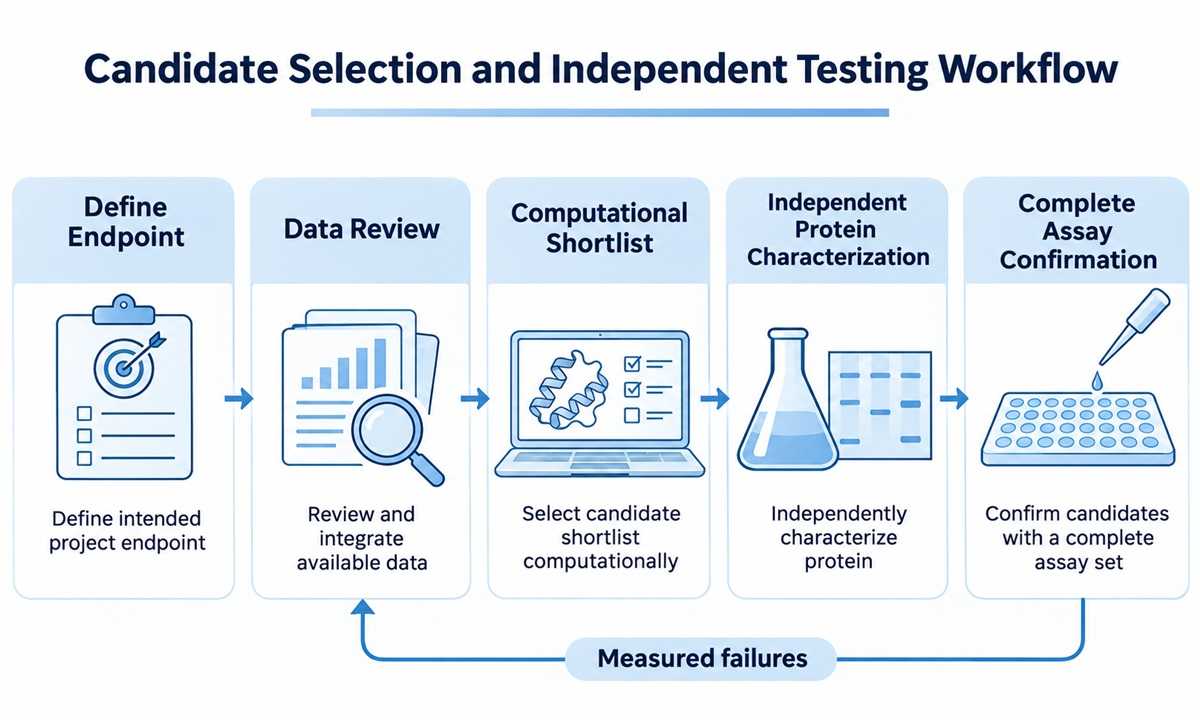
Use an endpoint that reflects the intended decision, with supporting measurements where needed. An isolated activity assay can help identify biochemical changes, but it may not capture specimen effects or interactions in a master mix. Define how candidates will move from the screening assay to the complete application. The relationship between those two tests should be examined.
Can AI guarantee a more thermostable or inhibitor-tolerant variant?
No. Such properties can be project objectives, but predictions require confirmation under specified conditions. Define the temperature exposure or inhibitor challenge before ranking candidates. Preserve comparison controls and other required functions. An improvement under one challenge does not establish improved storage, tolerance to every specimen, or superior performance across all assay formats.
Is sequence engineering always the right first intervention?
Not necessarily. A formulation, measurement or handling problem may be the limiting factor. Establish a reproducible baseline and investigate obvious process differences before starting a variant campaign. If the starting assay cannot reliably distinguish useful changes, a large computational shortlist may only generate more ambiguous measurements. The first investment may need to be in the test itself.
Can AI remove cross-reactivity from a diagnostic assay?
Only treat this as a bounded hypothesis. First identify whether the unwanted response arises from the enzyme, binding reagents, specimen or detection system. An enzyme-focused model cannot automatically correct a problem caused elsewhere. Define the intended substrate and relevant alternatives in the evaluation plan, while preserving the desired reaction and complete-assay behavior.
Understand what a model output represents
Does an AlphaFold structure prove that an enzyme is active?
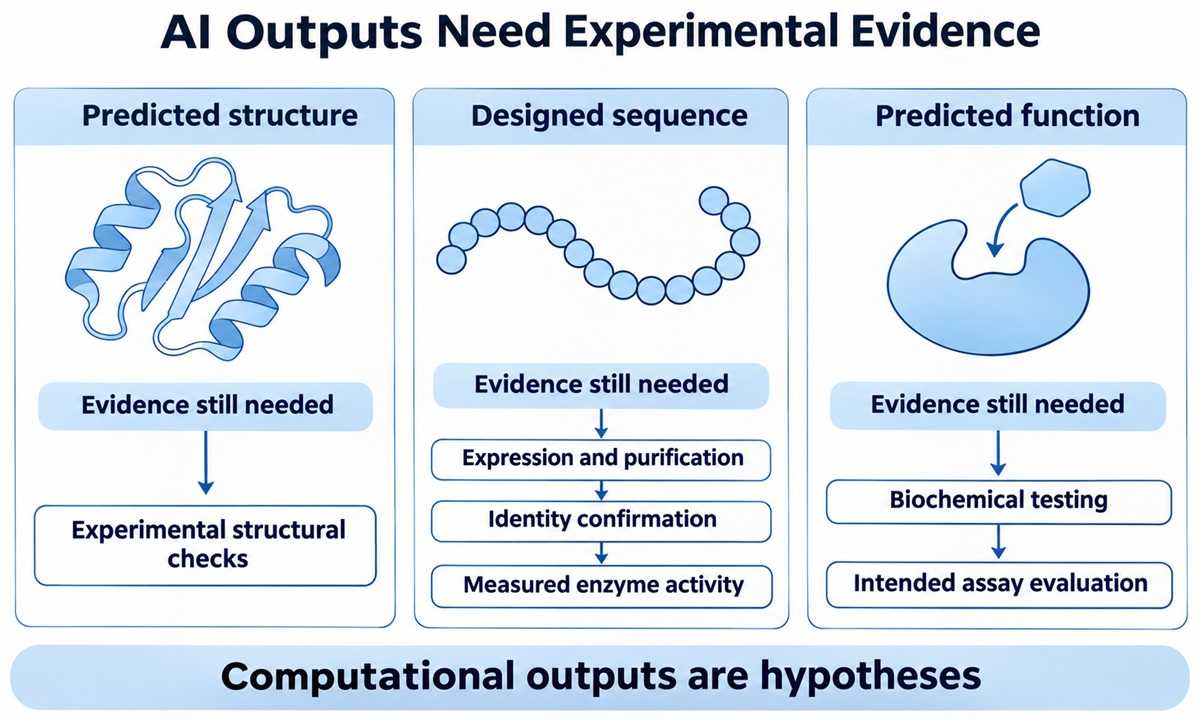
No. The foundational AlphaFold2 study concerns prediction of three-dimensional protein structure. Catalytic performance requires additional evidence about the actual preparation and reaction. A credible fold can support a structural hypothesis without establishing turnover, substrate selectivity or stability. Keep the predicted structure and measured functional result as separate entries in the project record.
Does high pLDDT mean high activity or stability?
No. Predicted local distance difference test, or pLDDT, is a structure-confidence measure used by AlphaFold. It is not an activity unit, melting temperature or shelf-life estimate. Interpret it according to the model and version that generated it. A high-confidence structural region still needs appropriate experiments before a functional claim is made.
What does ProteinMPNN contribute?
ProteinMPNN designs amino-acid sequences compatible with an input backbone, as described by Dauparas and colleagues. That helps address a sequence-design problem. It does not directly establish that a sequence will deliver the desired catalytic reaction in a diagnostic formulation. Preserve relevant design constraints and evaluate selected proteins experimentally rather than interpreting sequence scores as measured enzyme performance.
What does RFdiffusion contribute?
The foundational RFdiffusion method generates protein backbones under design constraints. This differs from predicting a structure for an existing sequence or measuring catalytic function. Its original study included active-site scaffolding applications, but a modeled site is not itself proof of effective catalysis. Record the exact method version and the question it was used to address.
Can a protein language model work without project-specific measurements?
Some models can propose or score sequences using information learned from other proteins. Those scores may be useful starting points, but they do not replace measurements for the intended application. Project data can reveal whether the ranking is informative in the relevant setting. Compare candidate selection with a reasonable baseline before claiming that the model improved the project.
Is the newest or largest model automatically the best choice?
No general ranking applies to every enzyme and objective. Choose a method whose inputs and outputs fit the decision, then evaluate it against a suitable baseline. Check data availability, reproducibility and practical testing capacity as well as computational performance. A published benchmark is useful context, but may address a different property or sequence distribution.
Make data and uncertainty interpretable
How many measured variants are needed?
There is no universal minimum. Biswas and colleagues demonstrated data-efficient engineering in specific proteins, but that result does not set a sample count for every project. The useful amount depends on assay noise, sequence diversity, the objective and the method. Begin with a justified pilot and assess whether predictions help select informative or improved candidates.
What should accompany each sequence and result?
Keep a stable sequence identifier, the measured endpoint, units, conditions and links to raw data. Include preparation, batch and replicate information that could explain variation. Distinguish a result from the analyst’s interpretation of it. A numerical label without the underlying test context is difficult to reuse, compare or investigate when a prediction fails.
Should unsuccessful variants be removed from the dataset?
Valid poor performers can be informative and should not be silently discarded. Separate confirmed low performance from failed expression, missing measurements and invalid assay runs. Those outcomes have different meanings. Define exclusion rules before model fitting and retain their reasons, so that cleaning the data does not erase the evidence needed to understand the experiment.
Can results from different assays be pooled?
Only after examining whether they measure comparable quantities under compatible conditions. Differences in substrate, temperature, preparation or analysis may change what a value represents. Keep provenance and assay identifiers rather than forcing unlike measurements onto one unexplained scale. Where comparability is uncertain, model or analyze the groups separately and document the limitation.
Why can a good test-set score be misleading?
Its relevance depends on how the test set differs from the training data. A split containing very similar sequences may answer an easier question than the next design round. Greenman and colleagues evaluated uncertainty under different degrees of distribution shift. For a project, choose evaluation splits that reflect the intended prediction task and keep final confirmation independent.
Can an uncertainty score be trusted as a probability of success?
Not automatically. Its meaning depends on the method and calibration against appropriate data. The Greenman benchmark found no uncertainty approach that was best across every setting it examined. Check what the score represents before using it to allocate experiments. A narrow predicted interval does not make an unfamiliar candidate experimentally confirmed.
Turn candidates into usable evidence
What does design-build-test-learn mean in practice?
Define a candidate-selection decision, prepare the selected material, measure it and use the results to revise the next decision. Keep the cycle traceable. Learning includes explaining failures and testing whether the selection strategy adds value. Repeating computational scoring without incorporating reliable experimental feedback is not the same as completing that cycle.
Why retest an apparent hit using an independent preparation?
It helps determine whether the initial result reflects the candidate or an incidental preparation or assay effect. Compare with the parent or other predefined reference under matched conditions. Preserve the original result and repeat measurements rather than replacing inconvenient data. The confirmation design should address the uncertainty that remains after the screening experiment.
How should trade-offs between properties be handled?
Define priorities and constraints before choosing the winner. A candidate with improved activity may be less suitable if another required property deteriorates. Present the separate measured endpoints rather than hiding them in an unexplained combined score. Where several candidates meet different needs, retain the comparison and make the application decision explicit.
Does improved biochemical performance establish diagnostic suitability?
No. It supports a biochemical claim under the tested conditions. A diagnostic application also needs evaluation of the complete reagent system, relevant matrices and intended performance requirements. Treat transfer into that system as a separate evidence step. An AI-selected enzyme is subject to the same need for application evidence as any other new material.
When should a campaign pause or change direction?
Use predefined decision points. Reconsider the approach when measurements are unreliable, proposed improvements do not reproduce, or the tested candidates do not address the application constraint. Review whether the problem is the objective, dataset, model or experimental test. A useful outcome can be a well-supported reason to change the strategy rather than another round of similar candidates.
What belongs in the final project handoff?
Include sequence and preparation identifiers, method versions, candidate-selection rationale, raw results, comparison controls and unresolved limitations. State which claims are measured and which remain predicted. Document data permissions and the applicable review arrangements before sharing or advancing work. A ranked sequence list alone is insufficient to reproduce the decision or evaluate the material in another laboratory.
Prepare a focused starting brief
| Project input | Question it should answer |
|---|---|
| Application endpoint | What measurable change would make the enzyme more useful? |
| Existing evidence | Can the current test reliably distinguish that change? |
| Constraints and confirmation | What must be preserved, and how will a selected candidate be verified? |
Use How to Prepare a Project Brief for AI Enzyme Optimization to define the project. AI-Ready Experimental Dataset Design for Enzyme Optimization expands the data requirements. The FAQ directory links the other enzyme topics.
Sources and further reading
- Jumper J and colleagues. Highly accurate protein structure prediction with AlphaFold. Nature. 2021;596:583–589. DOI: 10.1038/s41586-021-03819-2.
- Dauparas J and colleagues. Robust deep learning-based protein sequence design using ProteinMPNN. Science. 2022;378:49–56. DOI: 10.1126/science.add2187.
- Watson JL and colleagues. De novo design of protein structure and function with RFdiffusion. Nature. 2023;620:1089–1100. DOI: 10.1038/s41586-023-06415-8.
- Wu Z and colleagues. Machine learning-assisted directed protein evolution with combinatorial libraries. PNAS. 2019;116:8852–8858. DOI: 10.1073/pnas.1901979116.
- Biswas S and colleagues. Low-N protein engineering with data-efficient deep learning. Nature Methods. 2021;18:389–396. DOI: 10.1038/s41592-021-01100-y.
- Greenman KP, Amini AP, Yang KK. Benchmarking uncertainty quantification for protein engineering. PLOS Computational Biology. 2025;21:e1012639. DOI: 10.1371/journal.pcbi.1012639.