

A useful AI enzyme optimization brief defines the application problem, the reference enzyme, the improvement to be measured and the properties that must remain acceptable. It also identifies the data and experimental capacity available to test candidates. Naming a preferred model is secondary to making those decisions clear.
The brief should let another team distinguish a feasible pilot from an open-ended request. This guide provides a practical structure, examples of clearer objectives and the questions that should be resolved before design, testing or commercial commitments begin.
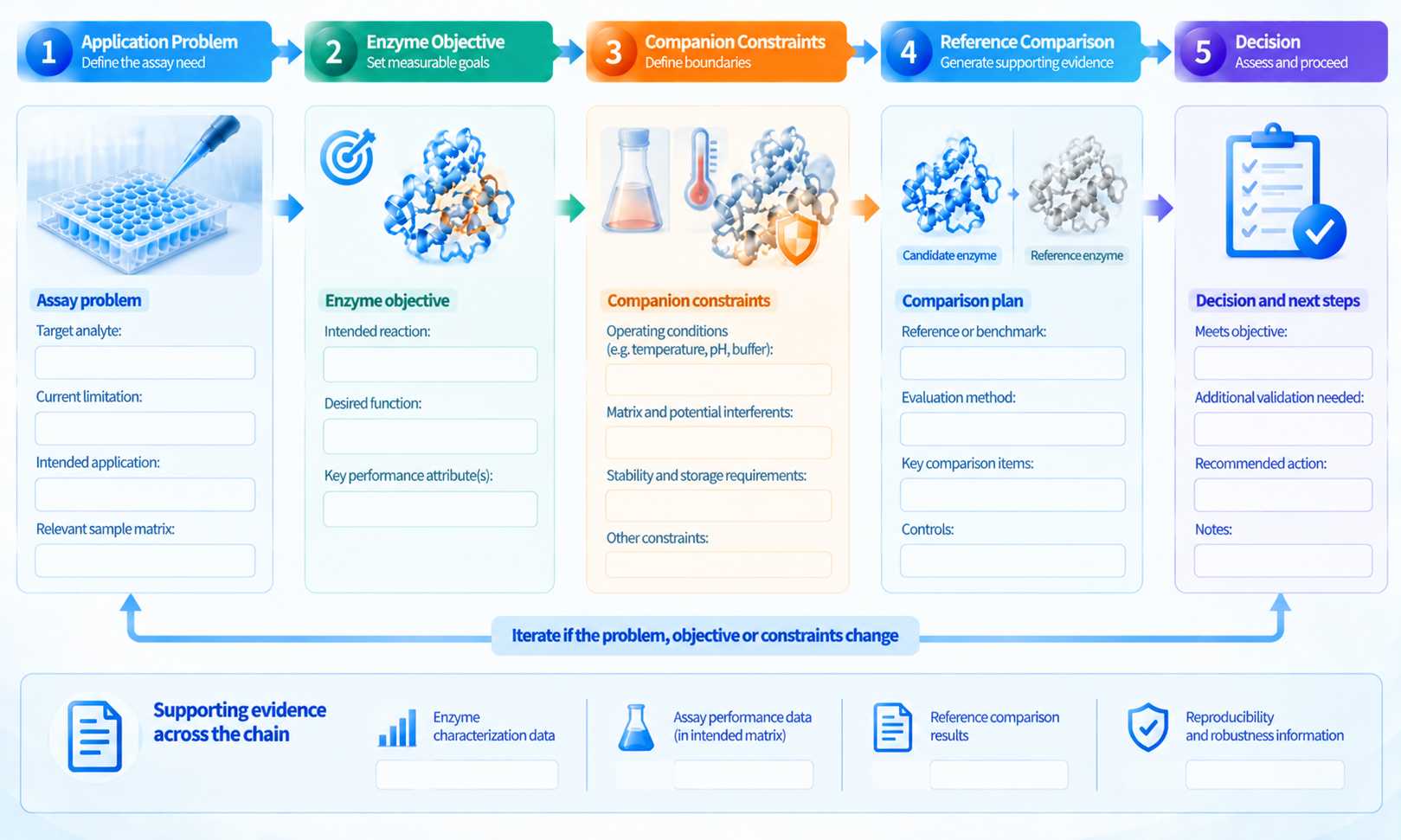
Describe the application failure before proposing a method
Begin with the workflow in which the enzyme is used. Identify the assay format, the step affected and the observable limitation. For example, useful activity may decline after a defined handling step, or an enzyme system may perform inconsistently with a particular sample preparation. Explain why that limitation matters to the intended application.
Separate observations from proposed causes. A change in assay signal is an observation; attributing it to an enzyme property is a hypothesis unless the comparison establishes that link. Include the evidence that points toward sequence engineering, together with plausible alternatives such as formulation, substrate quality or measurement conditions.
State what has already been tried and what was learned. A concise summary of unsuccessful formulation changes, reference comparisons or prior variants is more useful than a long project history. Link the underlying records so that the receiving team can inspect the evidence without reconstructing the entire development program.
Explain why AI assistance is being considered. The reason might be prioritizing combinations, using available sequence-function measurements or exploring a constrained design space. Wu and colleagues' work with combinatorial libraries demonstrates one way measured variants can support model-guided selection. It does not establish that every enzyme problem needs a learned model or that the same screening effort will suffice elsewhere.
Write a measurable objective with explicit constraints
| Initial wording | Information to add | Decision it enables |
|---|---|---|
| Improve stability | Specify the exposure, formulation, measurement time and retained function. | Distinguish the desired application benefit from a different stability metric. |
| Increase activity | Name the substrate, conditions, normalization basis and reference preparation. | Determine whether the comparison measures the intended enzyme property. |
| Reduce background | Identify the unwanted response and the target function that must be retained. | Separate improved discrimination from general loss of activity. |
| Use fewer experiments | Define the experimental budget and comparator selection strategy. | Evaluate whether prioritization adds value within the available resources. |
Use a sentence that links the reference, condition, endpoint and acceptance decision. A practical pattern is: improve the specified endpoint relative to the identified reference under the agreed conditions, while maintaining the listed companion properties. Populate the actual thresholds from application needs and measurement capability rather than borrowing an attractive number from a publication.
Rank objectives when trade-offs are possible. Identify the primary improvement, mandatory limits and optional preferences. An enzyme that improves one endpoint but fails a mandatory requirement should not be rescued by averaging all properties into a favorable composite score without prior agreement.
Keep enzyme-level and system-level criteria separate. The first can establish an intrinsic or preparation-specific property; the second asks whether it helps in the intended reagent. Both may belong in the plan, but they should have distinct methods and acceptance decisions.
Describe uncertainty in the reference measurement. A claimed gain that is smaller than routine measurement variation may not support a development decision. Agree how repeat measurements and confirmation will be interpreted before selecting candidates from the data.
Assemble the evidence needed to scope the work
Identify the starting enzyme and reference material precisely. Include the tested sequence or accession with version, construct boundaries, relevant tags, preparation information and the basis used to quantify enzyme amount or activity. If access to the sequence is restricted, state that limitation and establish an authorized way to review it.
Describe the assay sufficiently for another scientist to understand the label being optimized. STRENDA provides useful reporting principles for enzyme identity and experimental conditions. A brief can summarize the method and link a controlled protocol; it should not present an unexplained activity column as a complete experimental foundation.
For a quantitative PCR or reverse-transcription quantitative PCR application, include the assay and analysis context relevant to interpreting the result. MIQE 2.0 provides reporting guidance for those experiments. Use it to identify missing information, while recognizing that a reporting checklist does not itself validate the assay or isolate an enzyme effect.
Inventory available data by what was measured, on which variants and under which conditions. Include unfavorable results and known exclusions. State whether raw observations, replicate structure and method versions are available. Detailed data formatting belongs in the dataset plan; the initial brief must at least reveal whether the records are comparable and interpretable.
Do not convert a small dataset into an automatic rejection or a promise of success. Biswas and colleagues demonstrated data-efficient learning in tested proteins, but the study does not supply a universal minimum dataset size. The project question is whether the available evidence, prior information and feasible new experiments can support the proposed decision.
Mark each input as available, available with restrictions, to be generated or unknown. Assign an owner to important gaps. This allows the receiving team to distinguish a missing attachment from a scientific uncertainty that may change the scope.
Scope the pilot around decisions and experimental capacity
State how many candidates the laboratory can realistically produce and test per round, which measurements are rapid screens, and which require more intensive confirmation. Include preparation capacity, material needs, instrument access and expected turnaround. These constraints determine whether a proposed computational shortlist can actually be evaluated.
Separate exploratory screening from confirmation. A pilot may first ask whether the reference assay is sufficiently reproducible and whether candidate measurements are informative. A later decision may ask whether a selected candidate retains its benefit in independent material or a relevant application challenge. Each stage needs an output and a reason to continue.
Yang and colleagues' active-learning-assisted evolution study illustrates iterative feedback between experiments and model-guided selection. For briefing purposes, the implication is to budget for learning and revision, not only the first set of designs. It does not justify committing to a fixed number of successful rounds before the local assay and design space have been assessed.
Define a comparator appropriate to the goal. If the project is meant to evaluate AI prioritization, specify how its candidate choices will be compared with a relevant alternative under a fair experimental budget. If the sole goal is an application-ready improvement, the main comparator is the current reference reagent. These are different success questions.
Set review points for continuation, redirection or stopping. Examples include an assay that cannot resolve the intended improvement, unavailable reference material, or a candidate benefit that disappears during confirmation. A documented negative conclusion can be a useful pilot deliverable even when no improved enzyme is obtained.
Keep research uncertainty separate from scheduling commitments. The team may agree to deliver a defined analysis or test report by a date while leaving the biological outcome uncertain. Make that distinction explicit so that a promised deliverable is not mistaken for a guaranteed performance gain.
Use a concise brief with linked supporting records
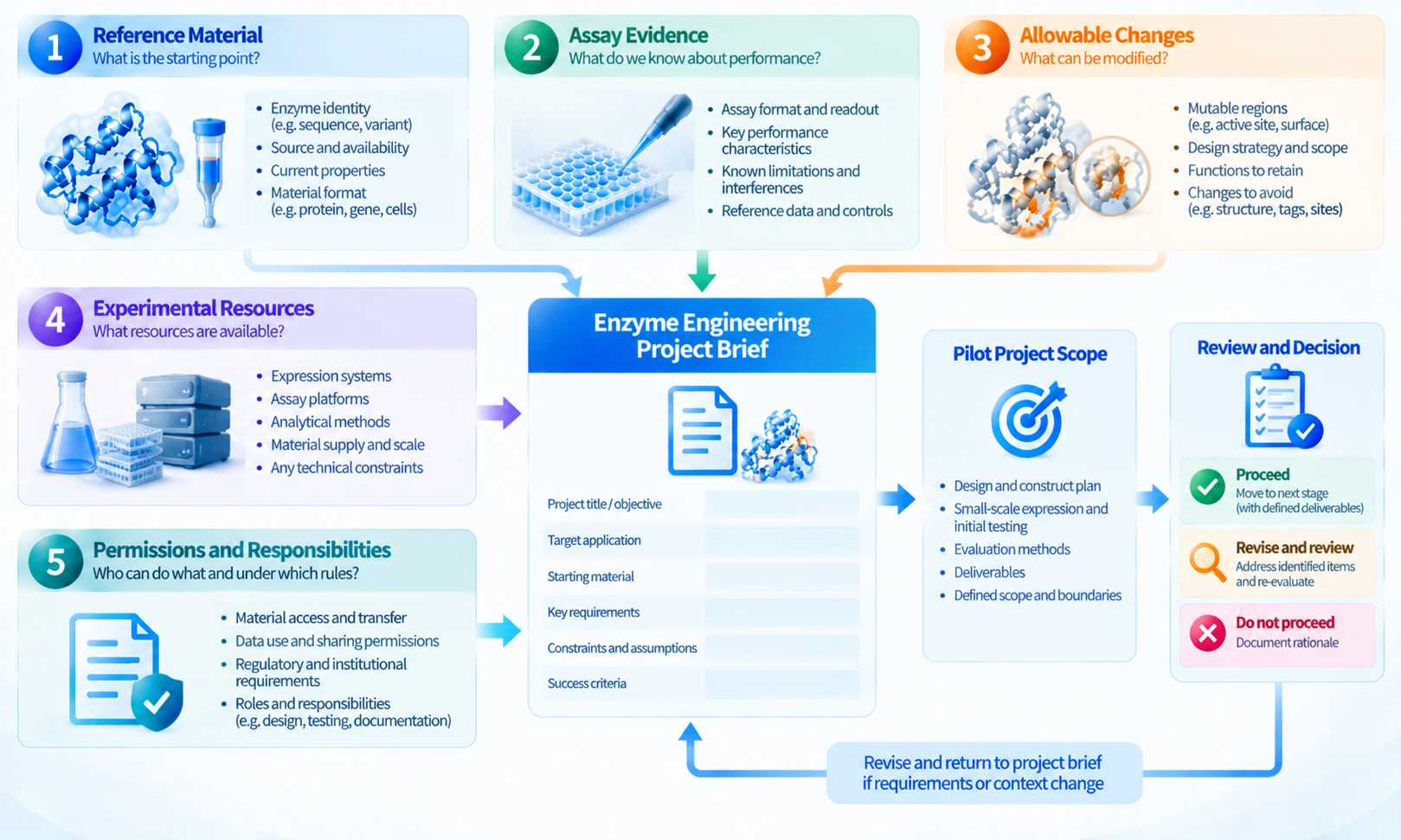
The following outline can be copied into a project document and completed in plain language. Keep the main brief concise enough to review in one sitting. Place detailed sequences, protocols and datasets in controlled attachments, and reference them by stable file or record identifiers.
| Field | What to write |
|---|---|
| Application and current problem | Where the enzyme is used, what fails and the evidence that defines the problem. |
| Reference and material identity | The exact enzyme, construct, preparation and comparison material. |
| Primary objective | The endpoint to improve, operating conditions and proposed acceptance basis. |
| Must-retain properties | Functions, compatibility requirements and production constraints that cannot be traded away. |
| Permitted changes | What may change in the sequence, construct, formulation or assay, and what must stay fixed. |
| Available evidence | Protocols, raw data, prior variants, negative results and known uncertainties. |
| Pilot resources | Experimental capacity, required materials, budget boundaries and scheduling dependencies. |
| Decisions and deliverables | Review milestones, confirmation evidence, report contents and continuation criteria. |
| Responsibilities and permissions | Scientific owner, data rights, sharing arrangements, procurement review and change approval. |
For an illustrative brief, consider a reference enzyme that loses useful signal after a defined handling step. The objective would name that exposure and the assay used to measure retained function. Companion criteria would address acceptable initial activity and performance in the intended reagent. The brief would attach the reference data and mark any unresolved cause of signal loss as a question for the pilot.
That example contains no assumed improvement target or experimental result. Its purpose is to show how a vague stability request becomes a comparison that can be planned. The actual exposure, thresholds and confirmation design belong to the project and should be agreed from its evidence.
State the expected deliverables in concrete terms: an assessed input package, a candidate list with rationale, interpretable screening records, a confirmation report and a recommendation on further work. Include which unsuccessful candidates and limitations will be reported. Avoid using optimized enzyme as the only deliverable when the project is still exploratory.
Resolve the gaps that would change the decision
Review the brief with the people responsible for the assay, material production and computational work. Ask whether they would interpret the primary objective and mandatory constraints in the same way. Differences in meaning should be resolved before they become differences in experimental execution.
If the reference or assay is not ready, scope an initial characterization or measurement task. If the data exist but permissions are unclear, resolve access before transfer. If the desired property conflicts with an essential requirement, agree on the priority or revise the objective. These are scope decisions, not reasons to hide uncertainty in a broad promise.
Finally, record how changes will be approved and how outputs may be used. A project brief supports agreement; it does not replace contractual terms, responsible sequence review or later diagnostic validation. Update the brief when a material assumption changes so that the team continues to work toward the same decision.
Use AI-Ready Experimental Dataset Design for Enzyme Optimization for preparing the supporting data, Responsible AI and Sequence Screening in Protein Engineering for governance questions, and the AI-Driven Enzyme Engineering Resource Center for the technical guides relevant to the selected objective.
Sources and further reading
- STRENDA Commission. STRENDA Guidelines. Beilstein-Institut. Accessed October 9, 2026..
- Wu Z and colleagues. Machine learning-assisted directed protein evolution with combinatorial libraries. PNAS. 2019;116:8852-8858. DOI: 10.1073/pnas.1901979116.
- Biswas S and colleagues. Low-N protein engineering with data-efficient deep learning. Nature Methods. 2021;18:389-396. DOI: 10.1038/s41592-021-01100-y.
- Yang J and colleagues. Active learning-assisted directed evolution. Nature Communications. 2025;16:714. DOI: 10.1038/s41467-025-55987-8.
- Bustin SA and colleagues. MIQE 2.0: Revision of the Minimum Information for Publication of Quantitative Real-Time PCR Experiments Guidelines. Clinical Chemistry. 2025;71:634–651. DOI: 10.1093/clinchem/hvaf043.