

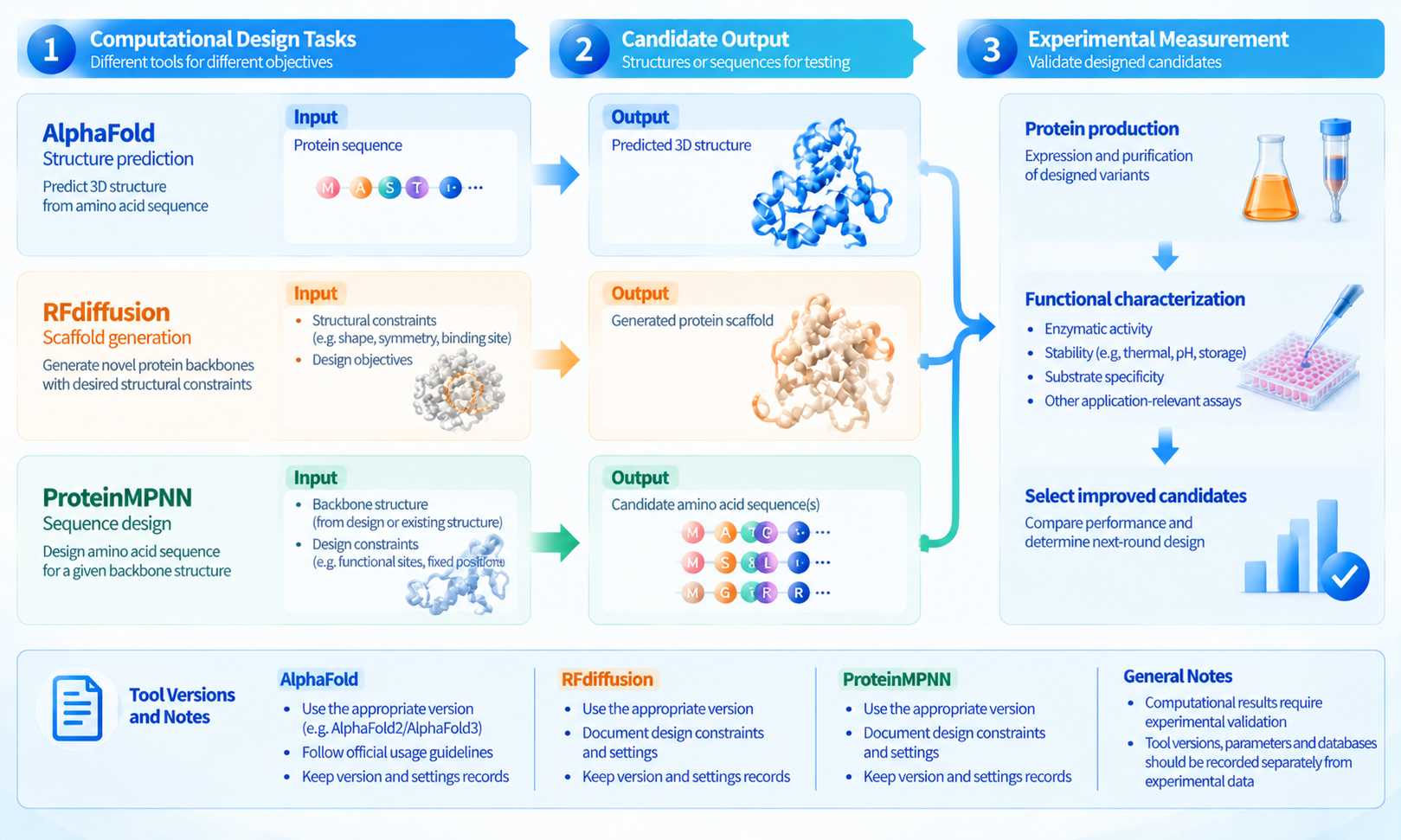
AlphaFold, RFdiffusion and ProteinMPNN address different parts of protein design: predicting a structure, generating a scaffold and proposing sequences for a structure. They can support enzyme engineering, but none of these outputs alone establishes catalytic activity, substrate discrimination or performance in a diagnostic reagent.
The practical question is not which tool is best in general. It is which uncertainty a particular model can reduce, what its score actually represents, and what evidence must come from experiments. Model versions matter because capabilities described for one version do not automatically apply to another.
Start with the missing information
| Tool or task | Useful output | What that output does not establish |
|---|---|---|
| AlphaFold structure prediction | A structural hypothesis for the specified sequence and supported molecular context. | Measured activity, kinetic parameters or storage stability. |
| RFdiffusion scaffold generation | Candidate protein geometries, potentially conditioned on structural requirements. | A complete catalytic mechanism or an experimentally functional enzyme. |
| ProteinMPNN sequence design | Sequences compatible with the supplied backbone representation. | Preservation of every substrate, cofactor or application requirement. |
Jumper and colleagues' AlphaFold2 paper, Watson and colleagues' RFdiffusion study, and Dauparas and colleagues' ProteinMPNN work established these distinct capabilities. Their tasks can be connected in a design workflow, but the outputs are not interchangeable measurements of enzyme quality.
For an existing diagnostic enzyme, the missing information may be a local structural interpretation or a way to propose constrained variants. Generating a completely new fold may add uncertainty without addressing the observed failure. For a new scaffold, structural generation may be central, but production and catalytic confirmation become major parts of the evidence plan.
Write the desired claim before choosing the computational route. A claim about a plausible fold needs different support from a claim about retained activity after heating or reduced response to an alternative substrate. Matching the tool to the claim prevents a visually convincing model from becoming the answer to a question it was never trained to resolve.
Read structural confidence at the scale of the question
AlphaFold2 produces a predicted structure with confidence information. Predicted local distance difference test scores, commonly abbreviated pLDDT, describe local structural confidence. Predicted aligned error, or PAE, helps assess uncertainty in the relative placement of parts of the structure. A confident local domain can coexist with uncertainty about its orientation relative to another domain.
EMBL-EBI's training guidance emphasizes these distinctions and the limits of the modeled context. For an enzyme question, inspect the relevant region and its relationship to other components rather than relying on one protein-wide average. An uncertain loop near the functional site may matter more to the hypothesis than a well-predicted distant domain.
Do not treat a higher confidence score as a predicted increase in melting temperature, catalytic efficiency or soluble yield. Those are different properties. Similarly, a predicted structural change after a substitution is a hypothesis to investigate; a small predicted change does not prove that function is unchanged.
Version differences are consequential. Abramson and colleagues' AlphaFold3 study extends prediction to complexes containing proteins and other molecular types. It would therefore be inaccurate to describe every AlphaFold version as modeling only isolated proteins. Yet a predicted enzyme-ligand complex still does not measure reaction rate or prove that the modeled interaction proceeds through the intended chemical mechanism.
Record the exact model, sequence, partners and input assumptions used. If the application depends on a cofactor, oligomeric state or interacting molecule, state whether and how that context was represented. An omitted component should remain an explicit uncertainty, not disappear behind a confident-looking protein backbone.
Separate scaffold generation from catalytic design
The original RFdiffusion framework generates protein structures and can incorporate structural conditions such as motifs. For enzyme work, the important question is what chemical or geometric information the design actually preserves. A scaffold surrounding a proposed active site is a candidate environment for catalysis, not evidence that the reaction occurs.
Specify the assumptions behind the active-site description. Which groups are considered necessary, what arrangement is intended, and which parts of that arrangement remain uncertain? The generated protein cannot resolve a wrong starting chemical hypothesis merely by enclosing it in a plausible fold. Where the mechanism is uncertain, mechanistic investigation may be the higher-value first step.
Newer methods also change what can be represented. Ahern and colleagues' RFdiffusion2 study uses catalytic functional-group geometries for enzyme active-site scaffolding and reports experimental catalytic activity in tested designs. This is meaningful enzyme-design evidence. It should not be attributed to every version of RFdiffusion or generalized into a guarantee for a different reaction or diagnostic application.
Distinguish candidate generation from the full published design campaign. A study may combine scaffold generation, sequence assignment, structure prediction, additional filters and experimental selection. The performance of that campaign belongs to the combined method and tested systems. Citing only the generator's name can hide the other decisions that contributed to the outcome.
For a development project, retain several chemically plausible alternatives when uncertainty justifies it. Candidate diversity should serve a scientific comparison, such as testing different structural interpretations. Generating many nearly identical structures may consume screening capacity without resolving the central uncertainty.
Ask what the sequence-design objective leaves out
ProteinMPNN is an inverse-folding approach: it proposes amino-acid sequences conditioned on a protein backbone. Its original study demonstrated broad utility through computational and experimental evaluations. The learned relationship is valuable for sequence design, but compatibility with a backbone is not the same objective as optimizing a catalytic rate in a particular buffer.
Identify residues and structural features that must be retained before redesign. A catalytic group, interaction partner or construct feature may be essential even if many other sequences appear compatible with the overall fold. Constraints should follow the scientific hypothesis and be recorded alongside the output, so reviewers know what was fixed and what the model was allowed to change.
Avoid interpreting a favorable model score as a calibrated probability of experimental success. Scores can support ranking within a defined setup, but their meaning depends on the model and configuration. Comparisons across different backbones, constraint sets or sampling procedures need particular care because the underlying tasks may differ.
Consider molecular context explicitly. The original backbone-conditioned formulation is not a general simulator of ligand chemistry. Where a project uses an environment-aware derivative or another method, identify it accurately and evaluate its own evidence rather than crediting all of its capabilities to the original ProteinMPNN.
Finally, review the complete proposed construct. A design intended for a purified-domain experiment may require further work before it can be compared with the full-length production reagent. Changes to tags, domain boundaries or fusion partners can affect interpretation even when the central designed sequence is identical.
Use computational agreement as a filter, then test function
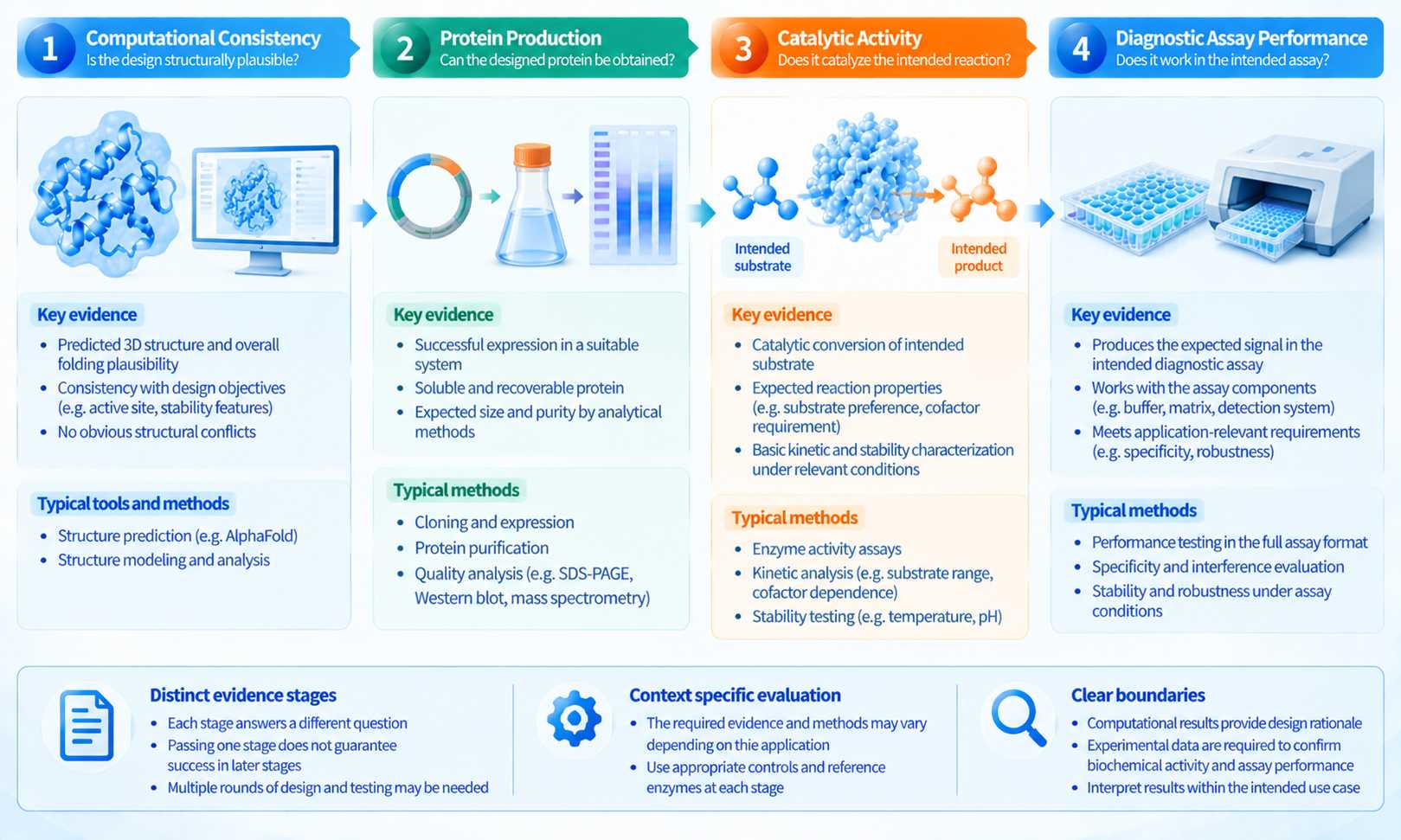
A generated backbone, an assigned sequence and a predicted structure may agree with one another. That agreement supports structural consistency within the workflow. It is not three independent experimental confirmations, and it cannot by itself establish the reaction chemistry or application benefit.
Plan the next experiment around the unresolved claim. If recoverable protein is uncertain, establish material identity and production behavior. If catalysis is uncertain, measure the intended chemical conversion with suitable controls. If the development objective is improved assay performance, compare the candidate with the reference in the relevant reagent system after basic function has been established.
Use measurements that distinguish the proposed explanation from plausible alternatives. A stronger reporter response may arise from more recovered enzyme rather than a better intrinsic catalyst. A lower unwanted signal may reflect loss of all activity rather than improved substrate discrimination. The useful comparison depends on separating these possibilities.
Retain both the computational decision record and the experimental failures. Knowing which candidates were selected, which were tested and which produced interpretable data makes the outcome easier to assess. Reporting only the successful candidate hides whether the computational ranking was informative or whether extensive experimental selection supplied most of the progress.
Choose the smallest design change that addresses the problem
For an established enzyme with a specific application limitation, begin by asking whether constrained changes and a reliable assay can test the desired improvement. For a new catalytic scaffold, define the reaction hypothesis and experimental evidence needed to move beyond structural plausibility. These routes differ in uncertainty, materials requirements and the amount of evidence needed for a useful conclusion.
Before commissioning work, agree on the model versions, retained constraints, candidate-selection rationale and experimental decision criteria. Keep computational deliverables separate from measured outcomes in the project plan. A set of candidate structures can be a valid exploratory deliverable without being described as an optimized enzyme.
Use AI Models for Diagnostic Enzyme Variant Design for the broader model landscape and How to Prepare a Project Brief for AI Enzyme Optimization to turn the chosen scope into a practical brief. The AI-Driven Enzyme Engineering Resource Center connects these limits with stability, specificity and data-design guidance.
Sources and further reading
- Jumper J and colleagues. Highly accurate protein structure prediction with AlphaFold. Nature. 2021;596:583-589. DOI: 10.1038/s41586-021-03819-2.
- Abramson J and colleagues. Accurate structure prediction of biomolecular interactions with AlphaFold 3. Nature. 2024;630:493-500. DOI: 10.1038/s41586-024-07487-w.
- Watson JL and colleagues. De novo design of protein structure and function with RFdiffusion. Nature. 2023;620:1089-1100. DOI: 10.1038/s41586-023-06415-8.
- Dauparas J and colleagues. Robust deep learning-based protein sequence design using ProteinMPNN. Science. 2022;378:49-56. DOI: 10.1126/science.add2187.
- Ahern W and colleagues. Atom-level enzyme active site scaffolding using RFdiffusion2. Nature Methods. 2026;23:96-105. Published online December 3, 2025. DOI: 10.1038/s41592-025-02975-x.
- EMBL-EBI Training. Strengths and limitations of AlphaFold 2. Official training resource. Accessed October 9, 2026..