

A working R&D assay is not yet a reproducible manufacturing process. Transfer problems often appear when unwritten preparation steps, different equipment, longer holds or a new QC method change the product or the way its performance is measured. Increasing batch size can expose these gaps even when the formulation is unchanged.
The central question is whether another team can make and evaluate the intended reagent consistently from controlled instructions. Investigate the observed discrepancy before changing the formulation, and define transfer acceptance in terms of both the production process and the finished assay.
Use the transfer discrepancy to choose the investigation
| Observation | Plausible explanation | Discriminating check |
|---|---|---|
| Production material fails only in the receiving laboratory. | Method execution, calibration or reference materials differ. | Compare shared material under aligned test conditions. |
| Early fills pass but later fills drift. | A hold, mixing or dispensing effect develops during the run. | Link results to fill order and the actual bulk exposure history. |
| Small batches pass while larger batches vary. | Physical processing conditions changed with scale. | Compare temperature, mixing, transfer surfaces and process timing. |
| The original scientist can rescue a failing run. | Critical adjustments or judgment remain undocumented. | Observe and document the intervention, then test an explicit procedure. |
These are hypotheses, not diagnoses. A late-fill effect might arise from the product or from measurement order. Balance the analytical sequence so that production order is not confused with instrument drift. Preserve the failed material and its records before making several corrective changes at once.
Define whether the transfer concerns formulation, manufacturing site, equipment, analytical laboratory or several of these together. Record the version being transferred. Comparing production material against a changing R&D formulation makes the target move during the investigation.
Separate technical acceptance from the calendar milestone. Shipping a protocol or completing a demonstration batch establishes that an activity occurred; it does not establish that the receiving operation can repeatedly meet the intended requirements.
Replace laboratory shorthand with executable production instructions
Document the actual materials and their functional specifications. Enzyme identity, activity-unit definition, stock concentration and formulation all matter. Substituting a stock with the same nominal units can change the volume of glycerol, salts or carrier protein entering the mix. A catalogue name or protein concentration alone may not preserve the development conditions.
Translate phrases such as mix gently, keep cold and use immediately into instructions whose relevance has been evaluated for the process. Define the addition sequence, applicable equipment, timing, hold conditions and permitted adjustments. Specify how completion is recognized rather than relying on the original scientist's visual memory.
Include calculation examples where a concentration basis or activity conversion could be misread. Identify whether a concentration applies to the stock, bulk reagent or final assay reaction. Independent checks should target consequential calculation and identity errors, not simply add signatures to every line.
An observed workaround belongs in the investigation record. If the receiving team changes mixing time or adjusts a component to achieve a pass, determine why that intervention is needed. Either demonstrate and control the revised process or resolve the underlying gap; do not let an undocumented rescue become routine practice.
FDA's design-and-development materials place transfer within controlled development activities. For US device manufacturers, the QMSR became effective on February 2, 2026 and incorporates ISO 13485:2016 by reference. Older discussions of design transfer can explain the concept, but their former regulatory citations should not be treated as the current framework.
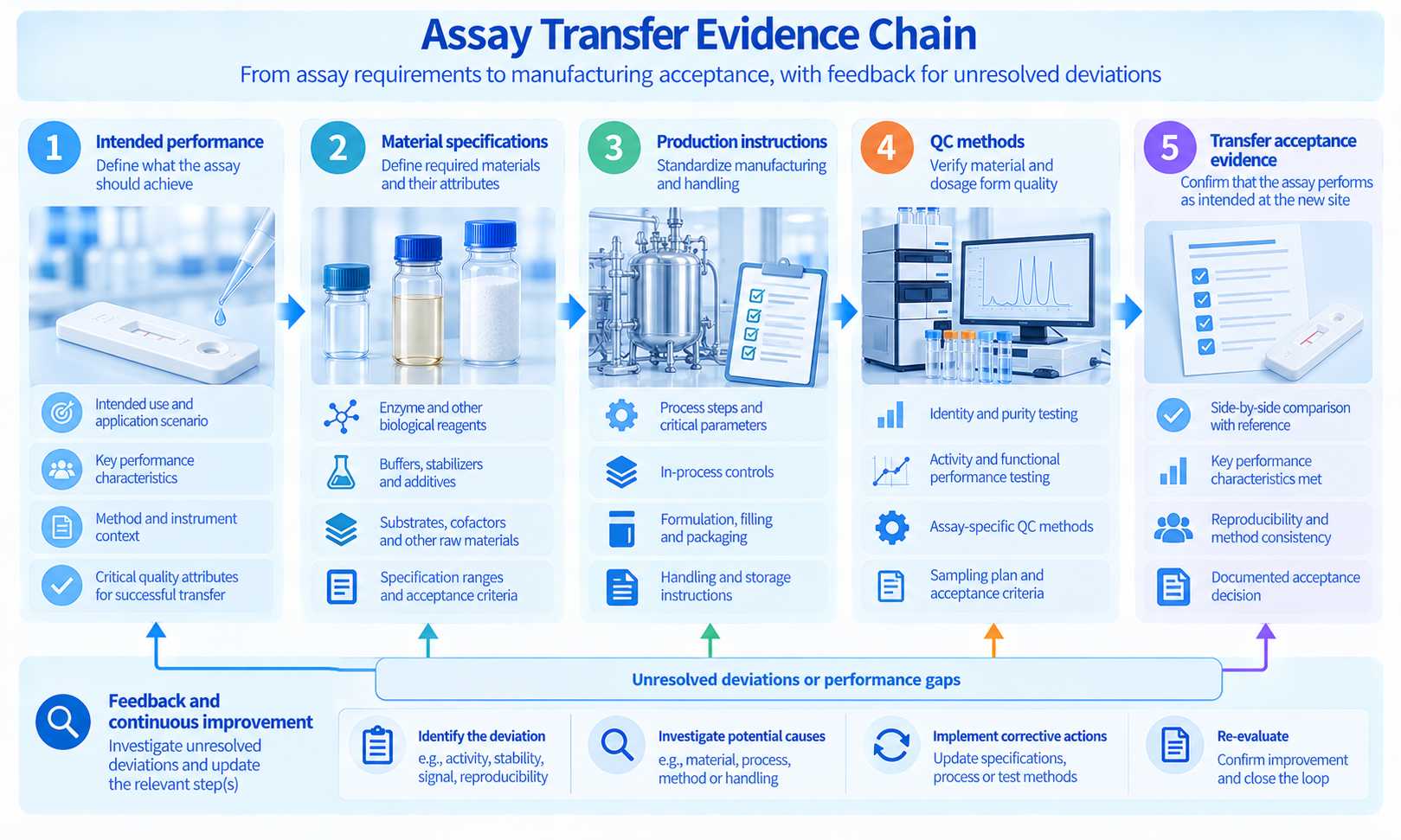
Test what physically changes in production
Scaling the ingredient quantities does not guarantee the same mixing or exposure. Vessel geometry, liquid depth, mixing equipment and addition time can change local concentration and temperature histories. Review the operations that bring concentrated components into contact, especially when the development process used small, rapidly mixed additions.
Map the time from initial preparation to final closure. Larger batches may spend longer in bulk storage, transfer lines or dispensing equipment. Take representative samples at meaningful points, such as after mixing, after a defined hold and across the filling run. Select locations and times based on the suspected mechanism rather than assuming one bulk sample represents every unit.
Account for the intended container and delivery format. Adsorption, dispensing consistency, closure behavior and reconstitution can differ from laboratory tubes. Assess those possibilities when the evidence supports them. A successful liquid bulk measurement does not automatically establish acceptable performance after drying or packaging.
Record material reconciliation and yield in terms useful to the product. Unexpected loss can indicate retention in equipment, filling problems or another process difference, but recovered volume alone does not prove retained function. Link the physical observation to enzyme activity and the complete assay endpoint as appropriate.
Avoid changing supplier, batch scale, equipment and analytical method simultaneously when a staged comparison is feasible. If simultaneous changes are unavoidable, define the additional comparisons needed to interpret a failure. The aim is to preserve the ability to identify causes, not to assume every scale-dependent result requires a new formulation.
Bridge the measurement before judging manufacturing performance
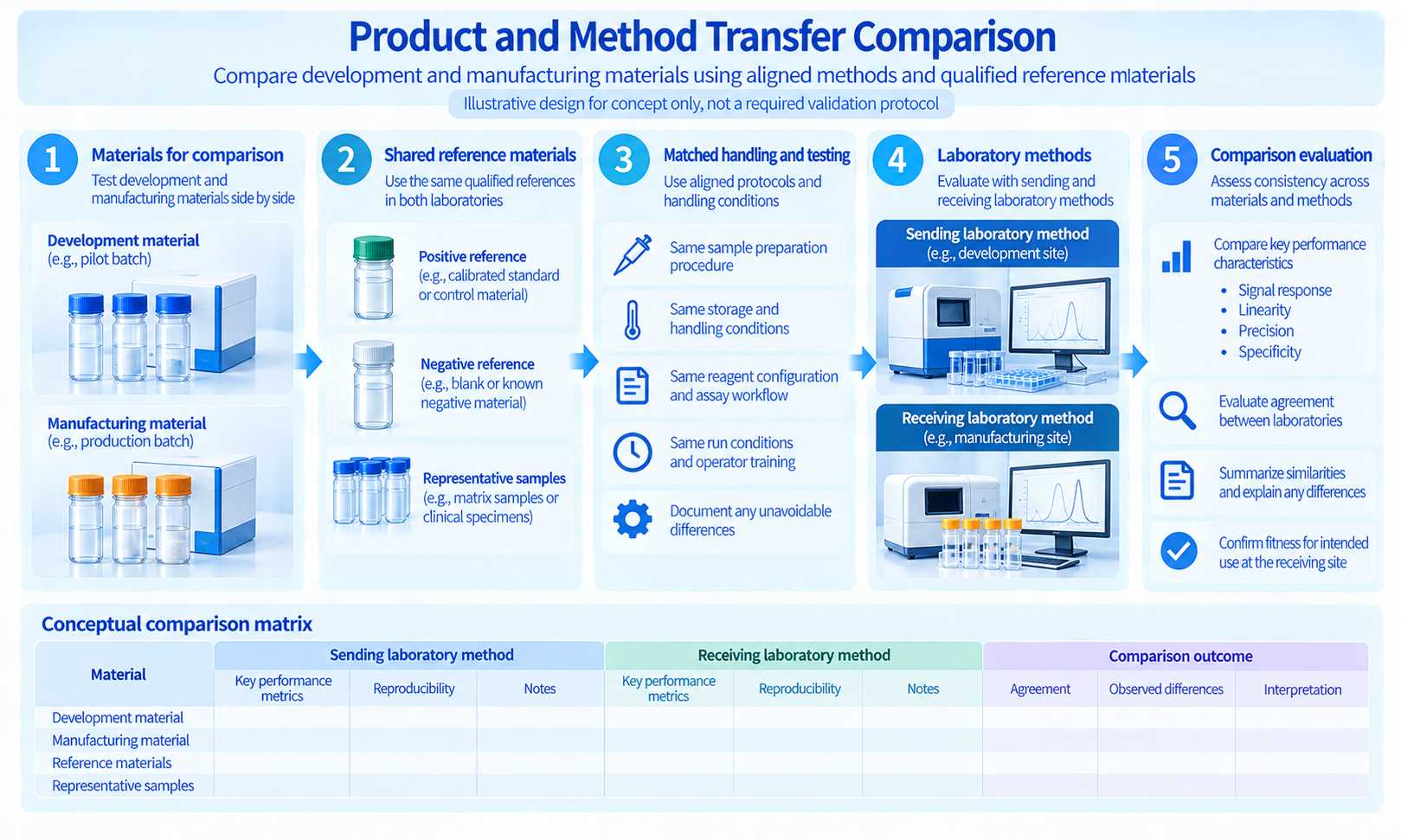
The sending and receiving laboratories need a common basis for declaring the product acceptable. Align method version, calibrator assignment, specimen preparation, instrument settings, timing and calculations. Confirm that the method can detect the performance differences relevant to transfer.
WHO's TGS 4 overview addresses validation of methods used in IVD design, development and manufacture. This matters because a release method that is imprecise or insensitive to the relevant defect can make a process look inconsistent or conceal a real problem. Method suitability and product comparability are separate questions.
Where practical, compare shared development and manufacturing material in both laboratories using qualified references and matched handling. This crossed comparison can help distinguish a material effect from a laboratory effect. It is an investigation design, not a universal regulatory requirement, and it may need adaptation to the assay and available material.
For quantitative methods, examine differences across the relevant measurement range rather than accepting a high correlation alone. CLSI EP09 addresses procedure comparison and bias estimation using patient samples; its public scope does not establish a universal acceptance limit for manufacturing transfer. Define the comparison and decision limits for the actual use of the QC method.
Investigate discrepancies in raw response as well as calculated output. Different calibration or normalization can hide a signal change. If the issue is an enzyme activity method, the Activity Assay Method Validation for Diagnostic Enzymes guide explains why units and reaction conditions must remain interpretable.
Define production evidence before running qualification batches
Agree on the transfer protocol, responsibilities and acceptance criteria before reviewing the results. State the production conditions represented, the measurements to be made and the handling of deviations. A criterion written after seeing the data cannot serve as an independent test of readiness.
Distinguish equipment installation, operating-range investigation and evidence of consistent performance under anticipated production conditions. GHTF's process-validation guidance describes these different purposes. Passing a nominal equipment check does not establish that a reagent process remains acceptable across its relevant operating conditions.
Choose the number of lots, units, operators and runs using process risk, expected variation and the question being tested. There is no single batch count that this article can assign to every diagnostic reagent transfer. Repeated readings from one unit do not represent independent production lots.
Consider failures that routine release testing cannot fully detect. A passing release panel may not establish shelf-life or behavior after transport. Identify how stability, packaging and other relevant evidence will be linked to the transferred presentation, including any justified bridging to existing studies.
Define what stops acceptance: an unexplained trend, a recurring manual adjustment, unresolved method disagreement or a critical process deviation. Distinguish correction of the immediate batch from confirmation that the process is ready. The Diagnostic Enzyme Lot Variation Troubleshooting guide addresses further investigation when production differences persist across lots.
Close the gaps and retain ownership after transfer
Complete the handover with controlled material specifications, manufacturing instructions, analytical methods, training records and the accepted transfer evidence. Assign ownership for deviations, supplier changes, reference-material replacement and future process modifications. An unresolved item needs an owner, a defined impact and a completion decision.
Review the first routine production results against the transfer assumptions. Track meaningful indicators such as in-process behavior, yield, release results and the need for adjustments. A process that passes only with repeated expert intervention has not demonstrated the same independence as one executed within its defined controls.
Use the Change Control for IVD Raw Materials and Diagnostic Enzymes guide when subsequent changes could affect the accepted process. Transfer is complete when the receiving operation has the instructions, measurement capability and evidence to own production, with remaining limitations explicitly resolved or managed.
Sources and further reading
- US Food and Drug Administration. Quality Management System Regulation (QMSR). Official overview. Accessed October 9, 2026..
- US Food and Drug Administration. Quality Management System Regulation: Risk, Design and Development. Official presentation..
- Global Harmonization Task Force, Study Group 3. Quality Management Systems: Process Validation Guidance. GHTF/SG3/N99-10:2004, Edition 2..
- World Health Organization. Technical Guidance Series: TGS 4, Test method validation for in vitro diagnostic medical devices. WHO Prequalification official overview..
- Clinical and Laboratory Standards Institute. EP09: Measurement Procedure Comparison and Bias Estimation Using Patient Samples. Official public overview..