

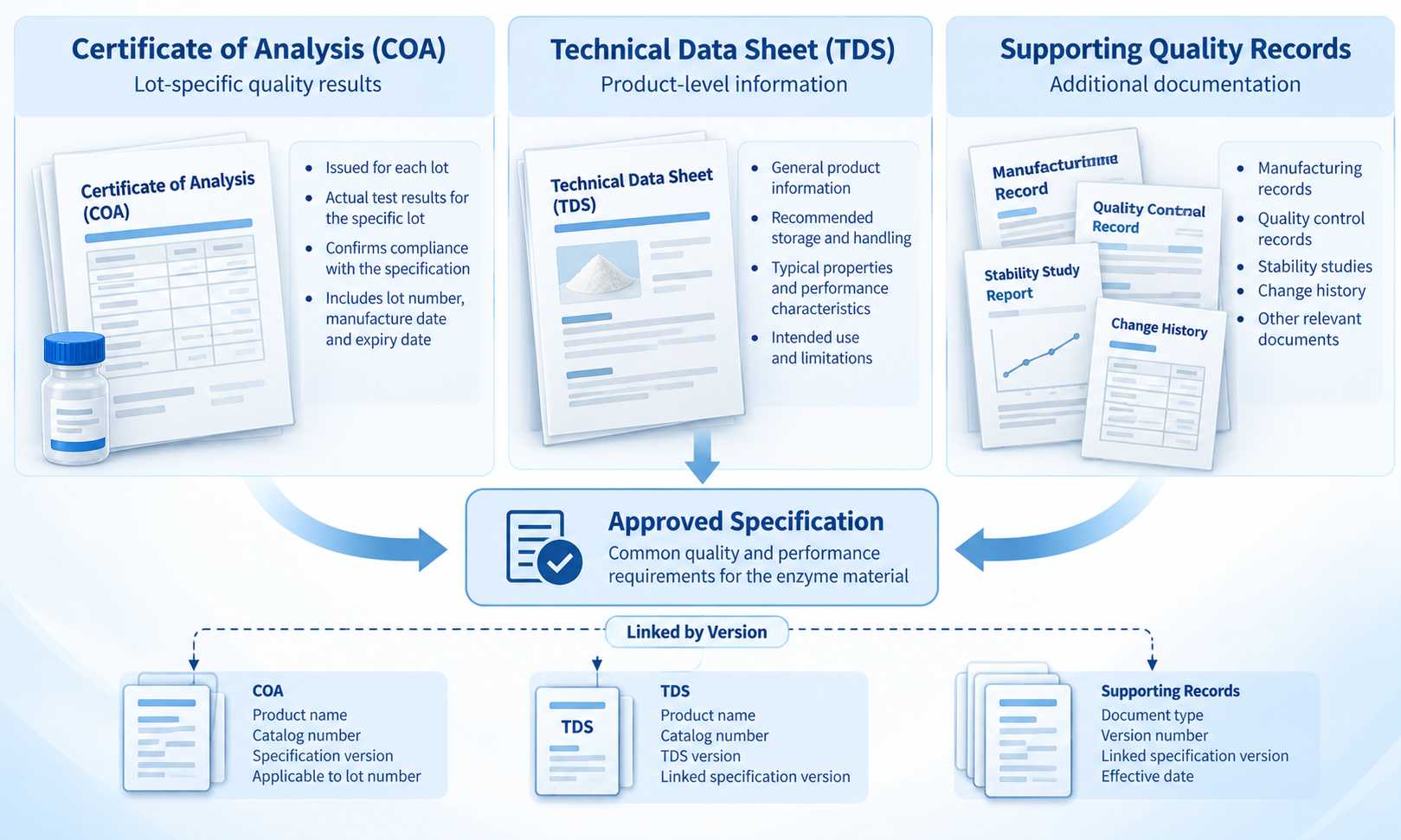
A certificate of analysis (COA) reports evidence for an identified lot or sample. A technical data sheet (TDS) describes the product and its supported handling or use conditions. Supporting quality records explain how those statements were established and controlled. The documents work together, but they should not repeat one another without a clear purpose.
The field sets below are practical starting templates for diagnostic enzyme raw materials. Adapt them to the approved specification and supply agreement, then review them within the organization before issue. Blank fields represent information to establish; they are not permission to invent a value or approval.
Assign the information to the right document
Use the specification as the controlled statement of requirements. It identifies the material attributes, referenced methods and acceptance criteria. The COA reports how the tested material relates to those requirements; the TDS provides the product-level context needed to understand and handle it.
Keep a typical characteristic separate from a release requirement. A development observation can be useful technical information without being measured on every lot. Label its basis and scope so a buyer does not mistake it for a batch result or a guaranteed acceptance limit.
The WHO model certificate of analysis provides a useful example of connecting analytical identity, methods, results and a compliance conclusion. Its pharmaceutical laboratory context is different from a diagnostic enzyme supply arrangement. The templates here use that reporting logic without presenting the WHO model as a mandatory IVD raw-material form.
| Document | Primary content | Completion rule |
|---|---|---|
| Specification | Approved requirements and methods. | Resolve the requirement before assigning a pass/fail conclusion. |
| COA | Identified sample or lot and its reported test findings. | Distinguish tested results from information established elsewhere. |
| TDS | Product description, formulation, handling and supported technical context. | Separate typical data from release limits and qualify application scope. |
| Evidence index | References to methods, studies, agreements and decisions. | Name the current record, owner and any unresolved gap. |
Create a COA that can be reconciled with the shipment
Start with document and material identifiers that connect the report to the received container. Preserve the original lot identity when a distributor or repacker introduces another identifier. If a report applies to a submitted sample rather than an entire lot, keep that scope explicit.
The header should make the issuing organization and authorized report version clear. Use consistent page identification when a certificate spans more than one page. Dates should describe actual events such as testing or issue, rather than being copied forward from a template.
Use one result row per reported attribute. The row needs enough information to locate the method, understand the result and compare it with the applicable criterion. Additional details can sit in a controlled method reference instead of being crowded into every certificate.
| Field | Entry to complete |
|---|---|
| Document identity | Certificate number; revision or issue identifier; page identification. |
| Issuing organization | Responsible organization and relevant laboratory or site. |
| Material identity | Exact product name, product code, enzyme form and formulation identifier. |
| Traceable sample or lot | Original batch identifier; additional sample or repack identifier where applicable. |
| Applicable requirements | Specification identifier and version used for the reported decision. |
| Relevant dates | Test or completion date; issue date; manufacture, expiry or retest date where applicable and supported. |
| Conclusion and authorization | Conclusion limited to the reported scope; responsible approver and approval record. |
| Field | Entry to complete |
|---|---|
| Attribute | Name the characteristic measured or examined. |
| Method | Controlled method identifier and version, with necessary interpretation notes. |
| Requirement | Applicable acceptance criterion and unit or categorical decision rule. |
| Finding | Actual reportable result, units and result basis. |
| Decision | Conformance conclusion under the approved decision rule. |
| Qualification | Relevant sampling limitation, subcontracted test, deviation or supporting-record reference. |
A template should not contain default passing results. Leave the result and conclusion fields unpopulated until evidence is reviewed. If a test was not performed for the lot, say how the attribute is controlled under the agreed program rather than inserting a historical number into a current-lot row.
Make enzyme-specific results interpretable
For activity, provide a method reference that resolves the unit definition, substrate, reaction conditions and calculation. STRENDA emphasizes reporting the experimental conditions needed to interpret catalytic data. The certificate can remain concise if the referenced method is controlled and available through the agreed documentation route.
Differentiate activity concentration from specific activity. The former relates catalytic activity to sample volume; the latter also depends on the protein-mass basis. If carrier protein is present, clarify whether the protein measurement includes it. A result labeled simply activity leaves too much room for inconsistent comparison.
For purity, name the analytical basis. A protein-band proportion and a chromatographic peak-area fraction are different measurements. A purity result should not silently imply that every trace contaminant or unwanted catalytic activity has been excluded.
For a negative contamination finding, state an interpretable reporting limit or controlled detection capability where relevant. Terms such as absent or undetectable can overstate what was established. The test amount, dilution and relevant controls may be needed to judge whether the finding supports the intended application.
Eurachem's analytical guidance supports choosing performance and reporting rules around the measurement task. Apply that principle when setting significant figures, rounding and decision rules. More decimal places do not make an uncertain measurement more informative, and rounding should not be used to turn an unacceptable result into an acceptable one.
Keep the TDS focused on product-level technical information
A TDS should help the reader identify the preparation, interpret its characteristics and use the supplied material within supported conditions. It should remain useful between lots while pointing to the COA for the actual batch findings. Avoid presenting a representative result as though it applies to every container.
Use an explicit document version and a product configuration reference. If a formulation changes, reviewers need to know whether the technical sheet describes the old or new material. The date of a web download is not a substitute for document control.
Handling guidance needs a defined material state. Distinguish unopened storage from conditions after opening, dilution or reconstitution. If evidence for one of those states is unavailable, preserve the limitation instead of extending a storage statement by implication.
| Section | Information to complete |
|---|---|
| Product definition | Enzyme identity, source or construct description where relevant, and supplied physical form. |
| Composition | Formulation components or a controlled formulation reference; concentration basis and relevant carrier information. |
| Technical characteristics | Defined measurements, clearly marked typical information and links to the applicable specification. |
| Activity method context | Unit definition or controlled reference; conditions needed to interpret the stated activity. |
| Handling and storage | Supported conditions for the identified state, preparation instructions and relevant exposure limitations. |
| Use boundary | Accurate intended-use statement and application limitations consistent with the supplied product. |
| Document control | Product configuration, revision, effective date and responsible document owner. |
Do not add certification, diagnostic approval or performance claims merely to make the sheet appear complete. Such statements need their own current evidence and scope. A useful TDS can be technically specific while leaving unsupported claims out.
Index the supporting records and unresolved questions
The package needs a way to locate evidence that is too detailed for the COA or TDS. This may include analytical method support, stability studies, supplier agreements, source-change evaluations or investigation records. An index is often more usable than attaching an uncontrolled collection of documents to every shipment.
For each required record, identify its purpose, controlled reference, owner and availability. A document can exist but still fail to answer the intended question. For example, a stability report for bulk material may not support the filled container described by the current TDS.
The GHTF supplier-control guidance supports agreeing the information and controls exchanged between manufacturer and supplier. Use the index to make that agreement executable: identify what is routinely delivered, what is available on request and what must be reviewed before use.
| Field | Entry to complete |
|---|---|
| Requirement or question | The specific claim, material risk or decision needing support. |
| Evidence reference | Document identifier, version and relevant material configuration. |
| Owner and access | Responsible organization or function and agreed retrieval route. |
| Review outcome | Whether the record supports the intended use, with the reason. |
| Open action | Missing information, responsible owner and agreed next step. |
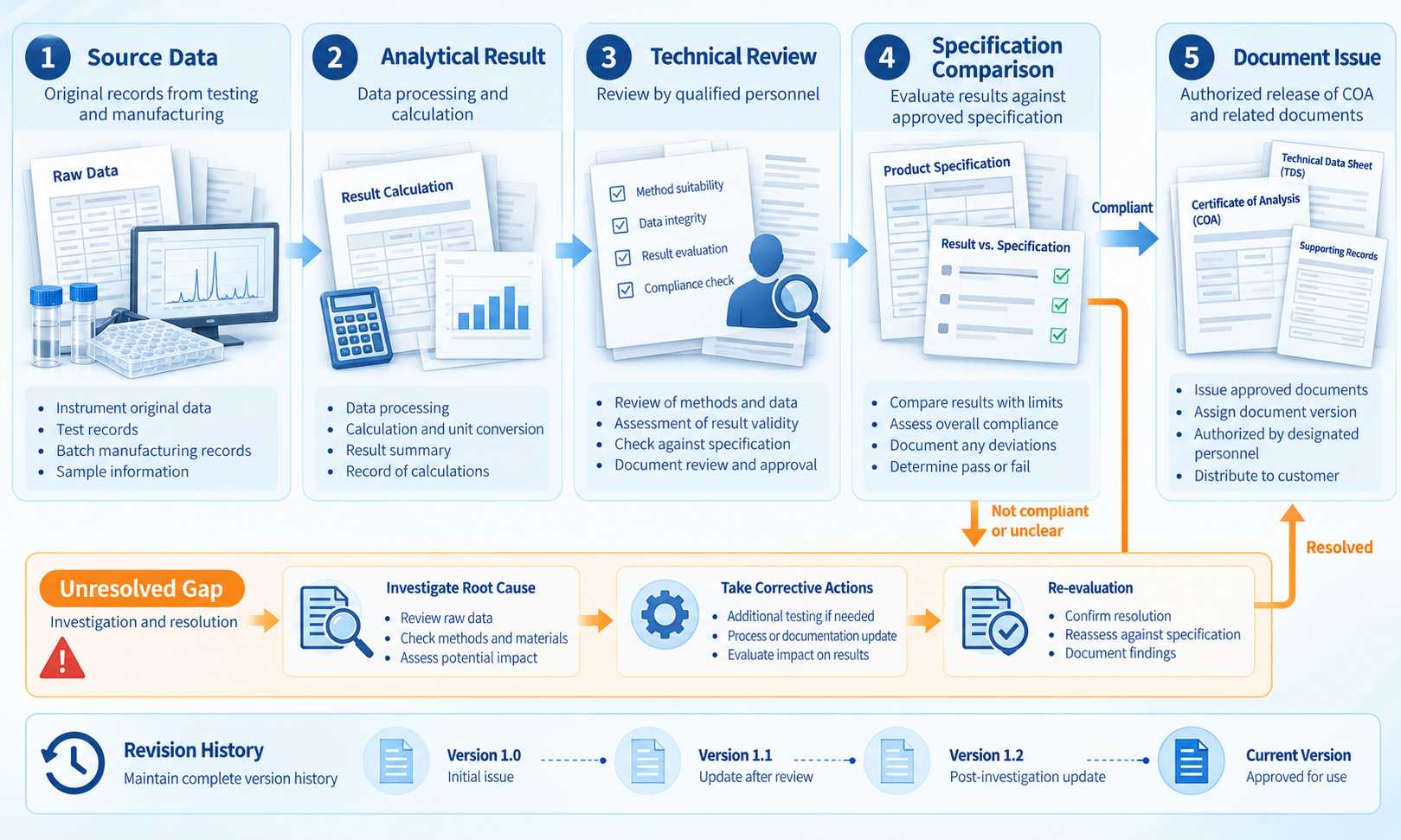
Keep unresolved items visible until they have a documented disposition. Not applicable, not tested and not available are different states. Each should be used deliberately, with enough explanation for a later reviewer to understand why the package was accepted or held.
Review the package as a connected set of records
Before issue, reconcile product codes, lot identifiers, units, formulation versions and storage statements across the documents. Verify that method and specification references resolve to the intended versions. An internally consistent package is easier to assess than several individually polished documents that describe different configurations.
WHO's data-integrity guidance emphasizes preserving the origin, history and availability of records. Apply that principle to calculations, reviews and corrections. A revised COA should remain connected to its predecessor and explain the correction without obscuring the original record.
Separate technical review from the authority to issue a document or accept a material. Define those responsibilities in the organization's process. A signature field in a template does not establish that an authorized person reviewed the results, and a supplier's certificate does not record the customer's acceptance decision.
Test the templates with a real, approved material file before adopting them routinely. Confirm that a reviewer can trace a reported value to its method, find the applicable requirement and locate the supporting evidence. Revise ambiguous fields before copying the format across products.
For the broader supplier relationship, see ISO 13485 and Raw Material Documentation for IVD Enzyme Suppliers. Use Diagnostic Enzyme QC Checklist to organize incoming review and Diagnostic Enzyme QC, Validation and Regulatory Resources for related quality topics.
Source review date: September 24, 2026; review within six months. These original field templates are adaptable documentation aids, not issued certificates, regulatory forms or validated release specifications.
Sources and further reading
- World Health Organization. Model certificate of analysis. WHO Technical Report Series 1010, Annex 4, 2018.
- World Health Organization. Guideline on data integrity. WHO Technical Report Series 1033, Annex 4, 2021.
- STRENDA Commission, Beilstein-Institut. STRENDA Guidelines: Enzyme Kinetics and Assay Conditions. Current public guidelines; accessed September 24, 2026.
- Global Harmonization Task Force, Study Group 3. Guidance on the Control of Products and Services Obtained from Suppliers. GHTF/SG3/N17R9:2008, December 11, 2008.
- Eurachem. The Fitness for Purpose of Analytical Methods: A Laboratory Guide to Method Validation and Related Topics. Third edition, 2025.