

The most useful diagnostic enzyme market signals in 2026 concern the requirements placed on reagents: compatibility with complete assay systems, simplified handling, reliable supply and evidence that supports qualification. Public diagnostic policy and device records help identify these pressures, but they do not establish the size or growth rate of enzyme sales.
This qualitative review considers global testing needs and technology developments, with specific US regulatory examples. Evidence was reviewed through October 9, 2026. It separates documented developments from the practical implications inferred for enzyme developers and technical sourcing teams.
Define what the market estimate would need to include
Diagnostic enzymes are inputs to a range of products, including clinical chemistry reagents, immunoassay signal systems and molecular tests. Revenue from finished instruments, consumables or laboratory services is not the same as revenue from enzyme ingredients. A market figure that mixes those categories cannot answer a raw-material sourcing question reliably.
The boundary also changes when an enzyme is sold as a purified ingredient, an enzyme blend, a liquid master mix or a dried reagent. The invoice may include formulation and manufacturing work as well as catalytic material. Comparing these formats by nominal enzyme units alone can miss differences in the work transferred between supplier and assay developer.
No verified, comprehensive public dataset reviewed for this article establishes total 2026 diagnostic-enzyme revenue by geography and application. Accordingly, the analysis does not assign market size, compound annual growth or supplier shares. Its focus is on observable drivers and the conditions under which they could create demand.
This is a narrative assessment, not a systematic review. Official diagnostic needs assessments, device-format records, current quality-system information and method guidance were selected for their relevance to development and procurement. Their dates and scopes remain distinct from the year in the article title.
Different workflows create different purchasing priorities
| Workflow | Reagent requirement to examine | What prevents a simple volume forecast |
|---|---|---|
| Clinical chemistry | Consistent catalytic response, interference control and compatibility with the reagent system. | Test utilization and reagent efficiency vary by assay and analyzer workflow. |
| Enzyme-linked immunoassays | Useful conjugate performance, low background and matched substrate behavior. | Labeling, purification and assay architecture affect enzyme use per result. |
| Molecular amplification | Performance in the intended specimen, multiplex and preparation conditions. | Reaction volume, extraction and panel architecture change reagent consumption. |
| Integrated or dried formats | Manufacturing compatibility, reconstitution and stability in the final presentation. | Added formulation value does not translate directly into more enzyme mass. |
These segments describe technical purchasing questions rather than measured market shares. The same enzyme family can participate in several formats, and the same diagnostic need may be served by methods with different enzyme requirements.
Established high-throughput testing and newer distributed formats can coexist. A near-patient assay may complement central testing for selected decisions rather than replace it. For a supplier, this means that demand planning should start with the actual product architecture and usage pattern, not with a general claim that all diagnostics are moving to one location.
Distinguish development demand from production demand. Research projects may require many candidate preparations in small quantities. A qualified manufacturing programme may require fewer versions with more demanding continuity and change-control expectations. The number of active projects alone does not show the size of recurring orders.
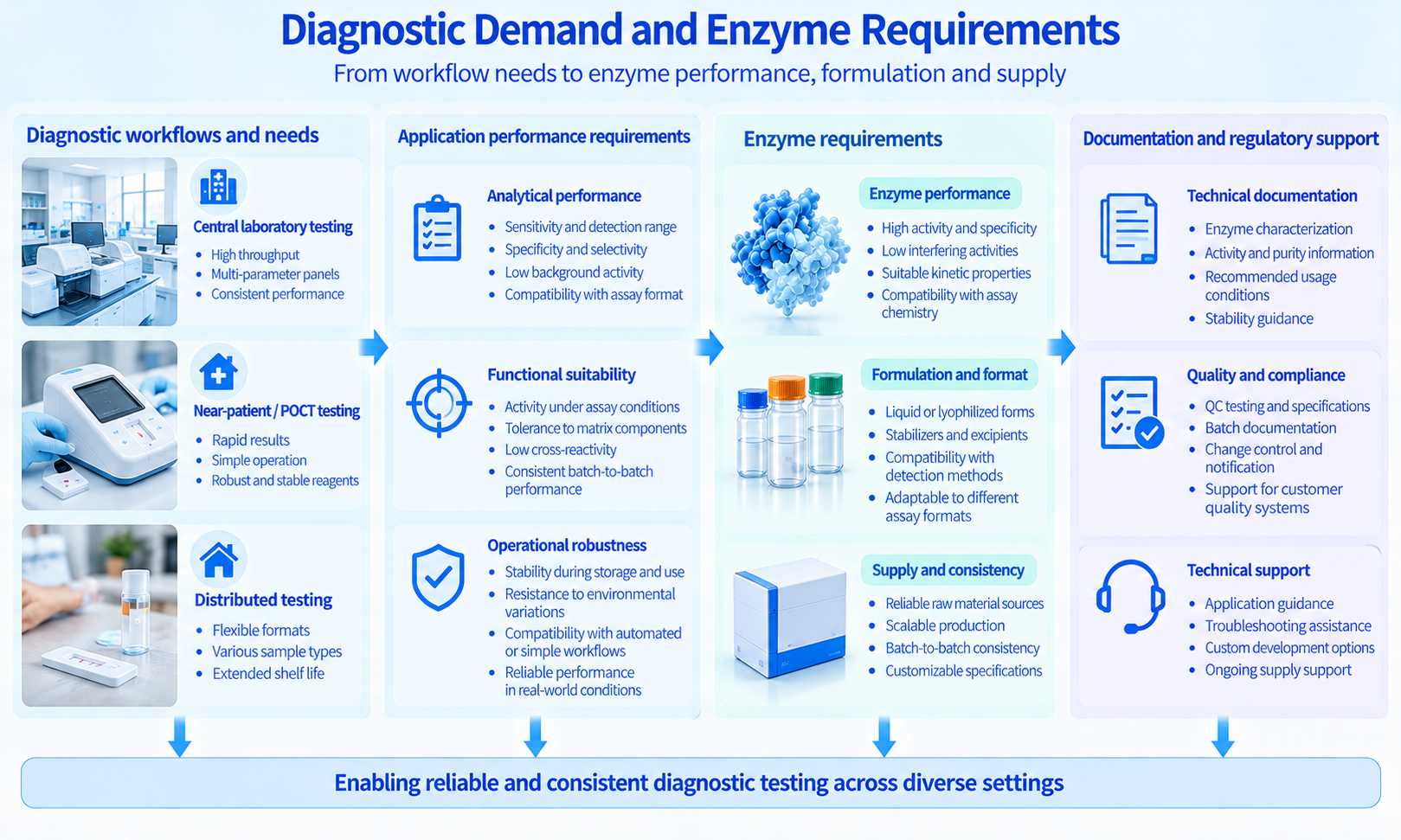
Read access and decentralization as signals, not sales totals
WHO's 2025 bacterial-priority-pathogen landscape maps available and pipeline tests, identifies gaps and sets development priorities. It is evidence of unresolved diagnostic needs and areas for research. It does not identify how much enzyme will be purchased, which technologies will be adopted or when funding will become available.
The inference for enzyme development is conditional: where a new assay can address an important gap and fit the intended service, there may be demand for reagents that enable that workflow. Pathogen identification, resistance-marker detection and phenotypic susceptibility measurements are different tasks. Their enzyme requirements should not be merged into one undifferentiated opportunity.
FDA's molecular EUA table includes home-use and multi-analyte formats. This documents that such formats have reached a regulatory pathway in specific products; it does not measure their utilization, commercial success or adoption outside the United States. An emergency authorization must also be distinguished from authorization through a traditional pathway.
For enzyme teams, simplified workflows raise questions about matrix tolerance, reaction integration and error-resistant reagent delivery. Those are development implications inferred from the format, not evidence that every project needs the same polymerase or stabilizer. The Molecular Point-of-Care Diagnostics Trends article examines the workflow in more detail.
Diagnostic access depends on more than analytical capability. Procurement, staffing, specimen referral and the ability to act on a result can determine whether an available test is used. Treat those conditions as adoption questions rather than assuming that unmet need automatically creates immediate purchasing demand.
Assess differentiation through the complete reagent system
A useful enzyme property is one that changes an assay outcome under relevant conditions. Higher activity in a convenient buffer is not enough if the intended formulation contains inhibitors or must survive drying. Evaluate the property together with specificity, background, usable input range and the conditions of manufacture.
MIQE 2.0's emphasis on transparent quantitative PCR reporting is relevant to technical evaluation. Assay conditions and analysis affect what a performance comparison means. For procurement, the practical implication is to request evidence that makes candidate and reference preparations comparable, rather than relying on a headline sensitivity statement.
Formulation-ready supply can shift development work between organizations. A developer may value a component that fits an existing manufacturing process, but that value depends on compatibility and the scope of the agreement. It should not be inferred from labels such as premium, diagnostic grade or ready to use without specifications.
Ambient storage is another potential differentiator with a precise evidence burden. CLSI EP25 distinguishes shelf-life and in-use evaluation. A dried appearance or a brief heat challenge does not establish the storage claim required by a distributed testing programme. The Decentralized Diagnostics and Ambient-Stable Reagents article addresses that distinction.
Consequently, the useful comparison is cost and risk within the intended workflow. Unit price, qualification effort, waste, storage and troubleshooting all matter. This is a decision framework, not a claim that any one delivery format is always cheaper or commercially dominant.
Account for quality documentation and switching costs
A concrete 2026 change in the United States is the implementation of FDA's QMSR on February 2, incorporating ISO 13485:2016 by reference. Device manufacturers must evaluate their responsibilities under the applicable framework. This should not be simplified into a statement that every enzyme ingredient is FDA-approved or every supplier has identical regulatory obligations.
The sourcing implication is to align supplier information with the manufacturer's actual qualification needs. Identity, activity methods, lot traceability, formulation and change notifications can be relevant to understanding whether an input remains suitable. The appropriate documentation depends on the component's role and the quality agreement.
Switching costs can be substantial even when two materials share an enzyme name. A different formulation, impurity profile or activity assignment may require additional comparison and assay work. A lower purchase price does not by itself establish a lower total cost after qualification.
Second-source planning is therefore best treated as a technical programme with defined comparability evidence. The Second-Source Qualification Guide for Diagnostic Enzymes explains that work. Public information reviewed here does not support ranking suppliers by capacity, reliability or regional market share.
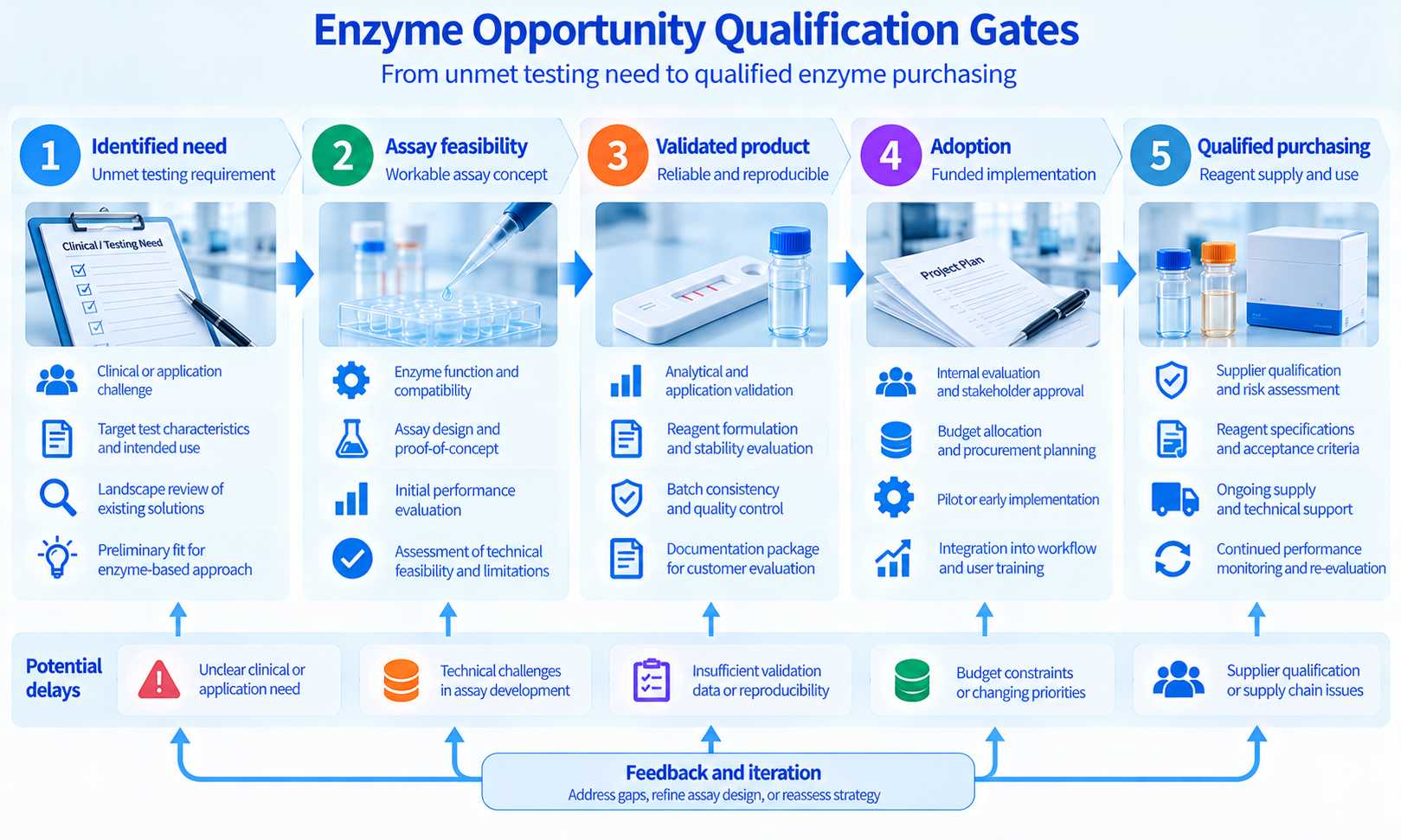
Use an evidence-based watchlist for the remainder of 2026
Track changes that can alter a real development decision: updated diagnostic priorities, new intended-use settings, revised reagent specifications, relevant authorization records and evidence for performance after manufacture or storage. Record what changed and why it matters to the assay rather than collecting announcements without a decision context.
Keep separate indicators for need, technical feasibility, product readiness and adoption. A strong publication can justify a screening experiment. A qualified customer programme can justify manufacturing preparation. Neither alone establishes recurring market-wide demand.
For scenario planning, state the conditions explicitly. Greater decentralized use could favor simpler reagent handling if the complete test remains affordable and supportable. More demanding panels could favor improved reaction compatibility if their clinical purpose and interpretation are justified. These are conditional implications, not numerical forecasts.
Revisit this assessment when official records or project evidence materially change. The Technical Articles, Literature Reviews and Industry Insights centre provides related analyses while preserving the distinction between a promising technology, a usable diagnostic product and a qualified enzyme supply opportunity.
Sources and further reading
- World Health Organization. Landscape analysis of commercially available and pipeline in vitro diagnostics for bacterial priority pathogens. October 2, 2025..
- US Food and Drug Administration. In Vitro Diagnostics EUAs: Molecular Diagnostic Tests for SARS-CoV-2. Official authorization table. Accessed October 9, 2026..
- US Food and Drug Administration. Quality Management System Regulation (QMSR). Official overview. Accessed October 9, 2026..
- Clinical and Laboratory Standards Institute. EP25: Evaluation of Stability of In Vitro Medical Laboratory Test Reagents. Published April 26, 2023..
- Bustin SA and colleagues. MIQE 2.0: Revision of the Minimum Information for Publication of Quantitative Real-Time PCR Experiments Guidelines. Clinical Chemistry. 2025;71:634–651. DOI: 10.1093/clinchem/hvaf043.