

Responsible AI in protein engineering combines scientific accountability with appropriate controls over biological materials, data and downstream use. Sequence screening is one part of that process. A screening result can inform a procurement or review decision, but it does not establish experimental safety, scientific validity or regulatory suitability on its own.
For routine diagnostic enzyme projects, the practical aim is a clear and proportionate review path: know what is being designed, who may use the data, what material will be ordered, and who resolves questions that an automated system cannot answer. Policy examples below were checked on October 9, 2026.
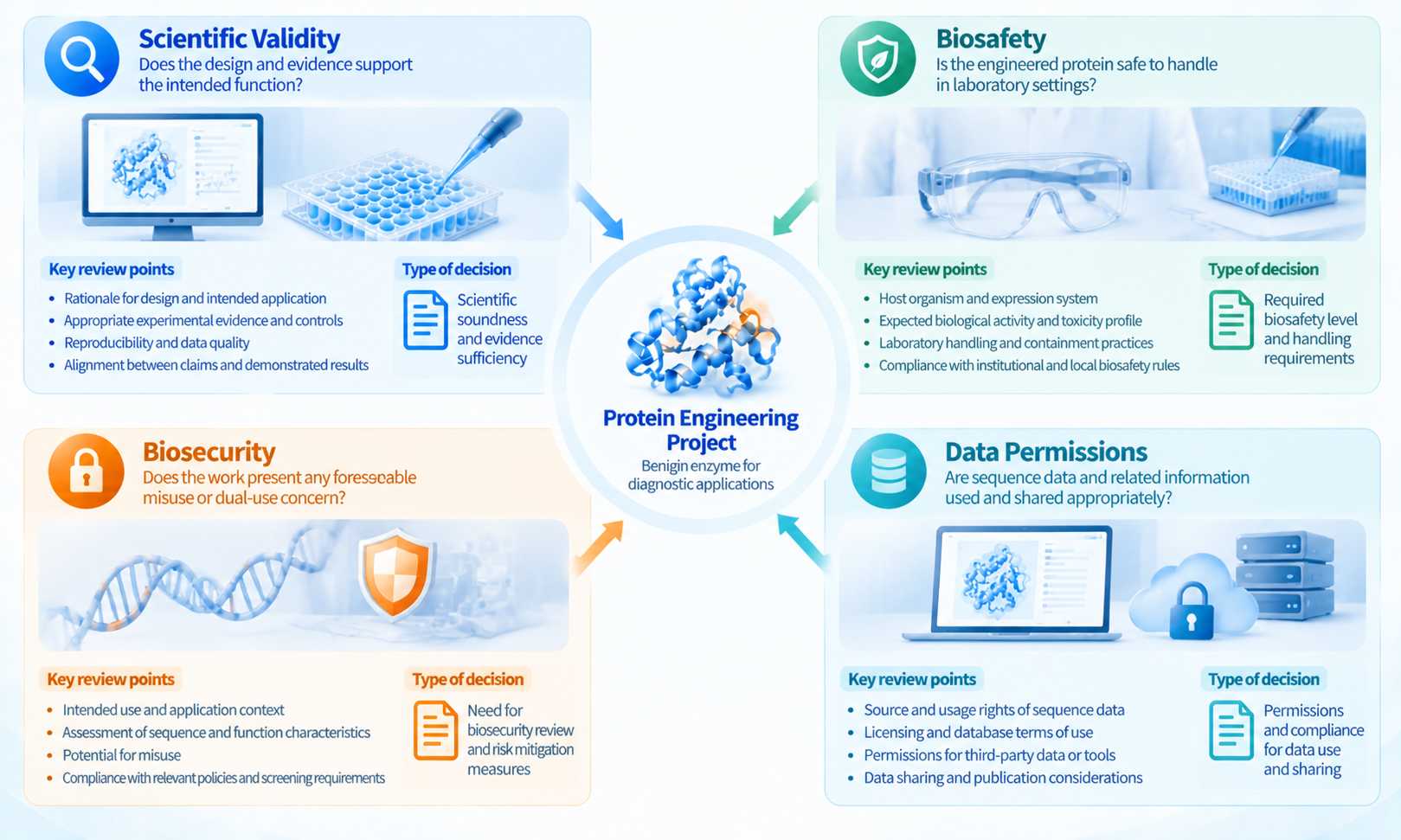
Separate four questions that are often combined
A design can be scientifically uncertain without raising a material biosecurity concern. A familiar enzyme can also involve confidential sequence information or laboratory handling requirements. Treating every issue as a single AI risk makes it harder to assign the right reviewer and choose an appropriate response.
The World Health Organization's life-sciences framework distinguishes biosafety, laboratory biosecurity and oversight of dual-use research. That broad framework supports a useful first step: identify the type of concern before deciding which evidence or institutional process applies. AI assistance does not remove the responsibilities associated with the underlying biological work.
| Review area | Main question | Relevant evidence or owner |
|---|---|---|
| Scientific validity | Does the evidence support the proposed property or application claim? | Scientific lead, measured results and interpretation of model limits. |
| Biosafety | Are the materials and planned activities handled appropriately? | Institutional biosafety process and the actual experimental context. |
| Biosecurity | Are the intended use, access and transfer arrangements appropriate? | Responsible project review, screening context and authorized procurement. |
| Data and permissions | May these sequences, records and outputs be used or shared in this way? | Data owner, applicable agreements and approved computing arrangements. |
These reviews can share information without becoming interchangeable. A favorable model evaluation does not authorize material handling, and a procurement screening outcome does not verify a reported enzyme improvement. Record each conclusion in terms of the question it actually answers.
Give the project a defined purpose and an accountable owner
Describe the intended diagnostic-enzyme application, starting material and property being investigated. State whether the work modifies a known enzyme, explores a new scaffold or compares existing candidates. This context helps reviewers assess the project as it is actually proposed rather than infer purpose from a sequence or a short model prompt.
Name the person responsible for the scientific scope and identify the institutional routes for biosafety, biosecurity, procurement and data questions. A small project may have fewer people than these categories suggest, but the responsibilities should still be explicit. A model-generated recommendation is not the person accountable for accepting it.
NIST's AI Risk Management Framework organizes work under Govern, Map, Measure and Manage. For an enzyme program, these functions can be used as a planning aid: assign ownership, describe the intended context, examine evidence and limitations, and decide how identified issues will be handled. This is an application of general guidance, not a claim that NIST certifies the project.
Agree on the permitted use of input data before uploading sequences or experimental records. Check ownership, confidentiality, storage, access, retention and any reuse for model training. Public availability of a file does not automatically answer every permission question, and removing a customer name may not remove the commercial sensitivity of a sequence or assay dataset.
Use approved computing and sharing arrangements that fit those permissions. Keep a record of the model version and data supplied so that later reviewers can understand the basis of a result. The purpose is traceability, not collecting unnecessary confidential detail in a broadly accessible project log.
Understand what sequence screening contributes
At a high level, sequence screening examines requested biological sequence content for potential concerns, while customer screening examines the identity and context of the requester. The HHS synthetic nucleic acid guidance addresses both dimensions. They answer related but different questions; neither should be inferred solely from a reassuring project title.
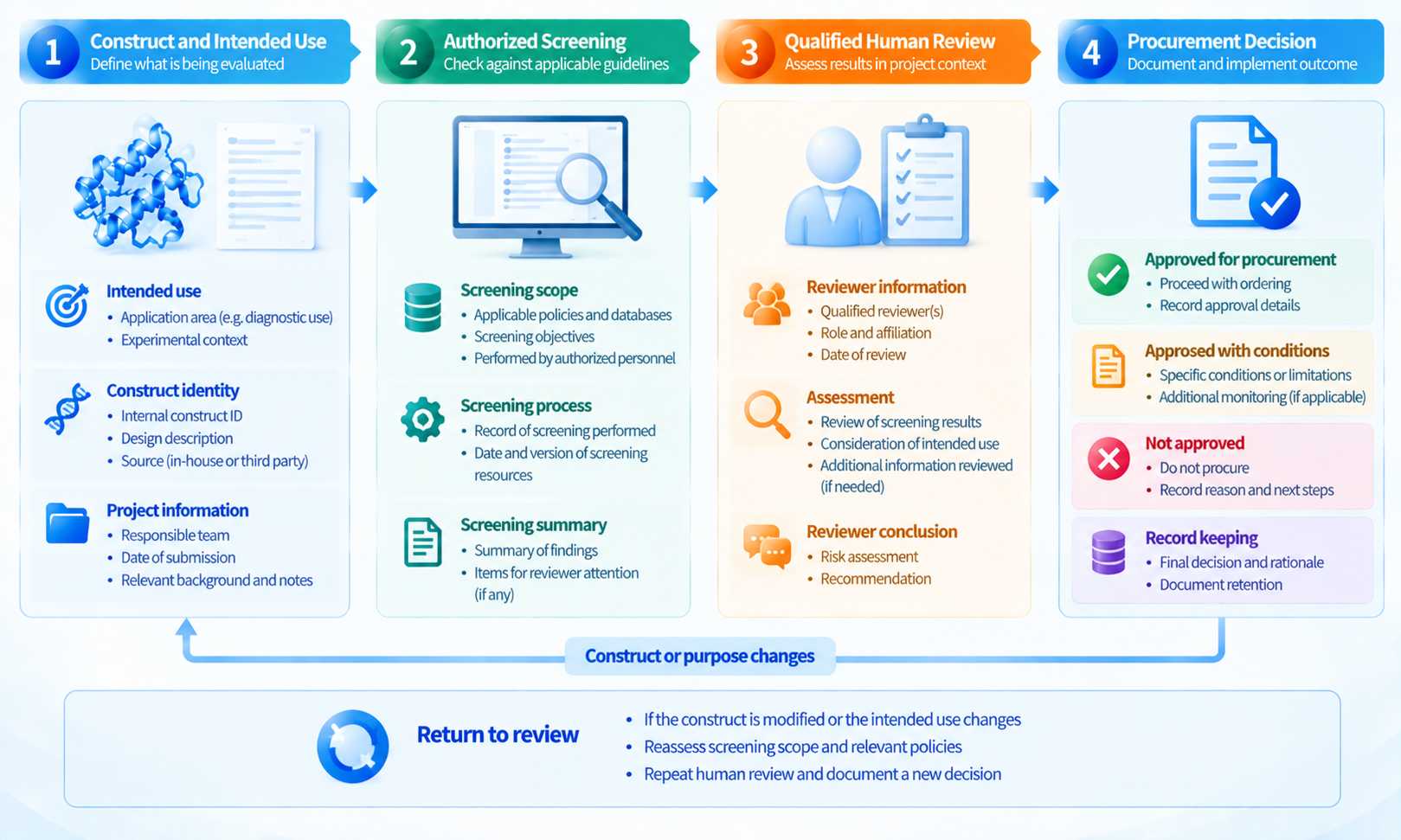
Protein engineering often begins with an amino-acid design and later involves a nucleic acid construct for production. Keep the relationship between the reviewed design and the material submitted for procurement explicit. A review tied to one file should not silently stand in for a different final construct.
An automated flag is a reason for qualified review, not proof of malicious intent. Conversely, absence of a flag is not a universal declaration of safety. A screening method has a defined scope, reference information and known limitations. Its output needs to be interpreted within that scope and alongside the intended use and institutional requirements.
Able and colleagues' 2026 perspective discusses the need to complement sequence similarity with attention to biological function. It is evidence that screening methods continue to develop, not that every service already offers a comprehensive functional assessment. For users, the practical implication is to retain human review and ask what a reported result actually covers.
Use established, authorized screening and procurement processes. If a question remains unresolved, seek clarification through the responsible reviewer or provider. Attempts to alter a submission merely to avoid a screening concern would undermine the review process; the appropriate objective is to resolve the underlying question about the material and its intended use.
Make screening outcomes reviewable and specific
Provide enough context for a legitimate review: project purpose, institutional affiliation, responsible contact and the identity of the requested construct. Share additional sensitive information only through an appropriate channel and only when needed for the review. Routine project records should reference controlled files rather than duplicate them indiscriminately.
Record the date, the scope of screening, the file or construct identifier, and the disposition returned through the authorized process. Preserve requests for clarification and the basis for resolving them. A short status such as reviewed is not sufficient if it is unclear which material was reviewed or whether an outstanding condition remains.
Assign a qualified person to interpret ambiguous results within the relevant institutional process. The decision may be to proceed within the approved scope, obtain additional information, restrict a proposed use or pause the affected activity. A useful record states what was decided, by whom, and what would require renewed review.
Keep the scientific and screening decisions separate in the handoff. A candidate may be acceptable to order yet fail to express or perform as expected. Another candidate may have promising computational properties while procurement review remains unresolved. Combining both dimensions into a single pass label obscures the next action.
The level of documentation should match the project and applicable requirements. An ordinary enzyme comparison does not need to be presented as a high-risk program simply because it uses AI. It does need a reliable way to identify material changes, route genuine concerns and demonstrate that required reviews were completed.
Distinguish guidance from requirements that apply to a specific project
Requirements depend on jurisdiction, funding, institutional policy, materials and activity. International guidance, national recommendations, funding conditions and local procedures do not have identical legal status. Use the relevant original document and confirm its application with the responsible institutional or contracting office.
As a concrete U.S. example, NIH notice NOT-OD-25-012 states procurement and recordkeeping requirements within its defined NIH-funded scope. The notice identifies April 26, 2025 as its effective date. This is a scoped funding-policy example, not a statement that every protein-engineering project worldwide is governed by the same procurement rule.
The May 2025 U.S. presidential action on biological research directed revision or replacement of the 2024 nucleic acid synthesis screening framework. That direction should not be read as evidence that a particular replacement text has been implemented. Before procurement, check current agency instructions and the terms that apply to the actual award or contract.
The sources linked here were checked on October 9, 2026. This article does not provide a universal list of screening thresholds or certify compliance. Its practical recommendation is to document the applicable source, version and scope at the time of the decision, then seek a current determination when policy status is unclear.
Keep oversight connected to changes in the work
Revisit the review when the purpose, construct, experimental activity, recipient or data-sharing arrangement changes materially. A previous conclusion may remain valid, but that should be assessed against the changed context rather than assumed. Keep version links so that the team can identify which decision belongs to which material.
Define a route for reporting unexpected findings, mistaken disclosure or a discrepancy between the approved design and the material ordered. Preserve the relevant records and direct the issue to the responsible institutional function. Resolve the affected decision before treating the project record as complete.
Communicate results with the same care. Describe whether a conclusion is computational, experimental or procedural, and retain its limitations. Responsible communication helps prevent a successful screening result from becoming an unsupported safety claim or a favorable prediction from becoming an asserted diagnostic benefit.
For the scientific record behind model training, see AI-Ready Experimental Dataset Design for Enzyme Optimization. For incorporating responsibilities and review needs into an initial scope, use How to Prepare a Project Brief for AI Enzyme Optimization. The AI-Driven Enzyme Engineering Resource Center connects these governance considerations with the technical design resources.
Sources and further reading
- World Health Organization. Global guidance framework for the responsible use of the life sciences: mitigating biorisks and governing dual-use research. 2022. ISBN: 9789240056107..
- National Institute of Standards and Technology. Artificial Intelligence Risk Management Framework (AI RMF 1.0). 2023. DOI: 10.6028/NIST.AI.100-1..
- U.S. Department of Health and Human Services. Screening Framework Guidance for Providers and Users of Synthetic Nucleic Acids. October 2023..
- National Institutes of Health. Notification of NIH Requirements Regarding Procurement of Synthetic Nucleic Acids and Benchtop Nucleic Acid Synthesis Equipment. NOT-OD-25-012. October 25, 2024..
- The White House. Improving the Safety and Security of Biological Research. Presidential action. May 5, 2025..
- Able G and colleagues. Beyond Sequence Similarity: The Case for Function-Based Screening of Nucleic Acid Synthesis. Frontiers in Bioengineering and Biotechnology. 2026. DOI: 10.3389/fbioe.2026.1832724..