

As of September 24, 2026, FDA reports that its May 2024 laboratory developed test rule was vacated on March 31, 2025. A September 19, 2025 final rule restored the earlier wording of the relevant regulation. Developers should not use the vacated rule's staged phaseout timetable as an active compliance calendar.
That change does not remove the need to establish appropriate test performance or determine the requirements for the actual activity. This U.S.-focused update separates the FDA rule history, continuing CLIA responsibilities, and practical implications for assay and enzyme-material development.
Begin with the current FDA status, not an archived deadline
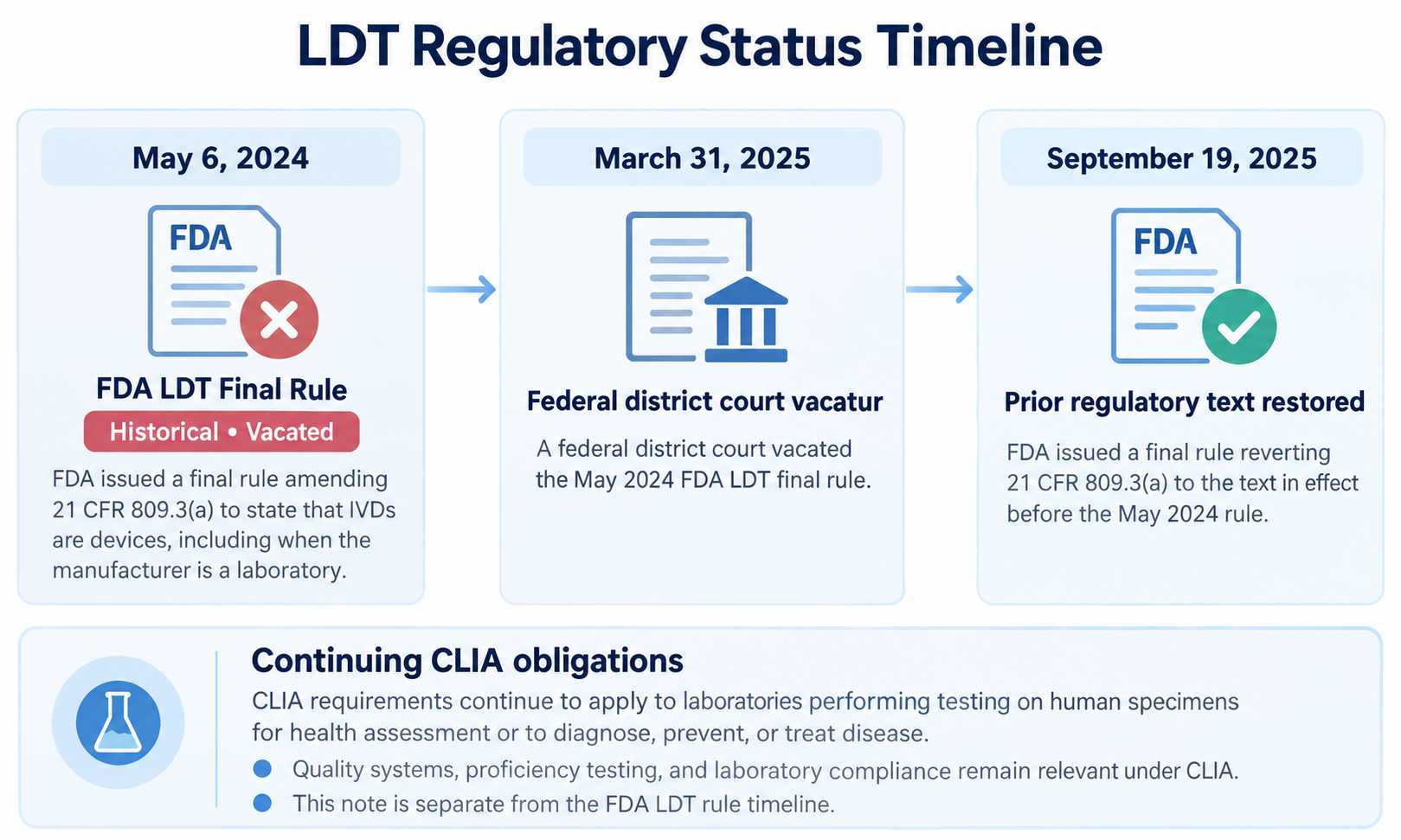
The 2024 rule amended the definition of in vitro diagnostic products in 21 CFR 809.3(a) to expressly include products manufactured by a laboratory. FDA's current LDT page identifies that rule as vacated and places related earlier materials under historical links.
The subsequent 2025 rule restored the regulatory text that preceded the 2024 amendment. This is the relevant published sequence for understanding why older presentations and frequently asked questions can describe requirements and dates that no longer provide a current planning basis.
When reviewing an existing project plan, identify every task whose sole justification was a phaseout milestone from the vacated rule. Reassess those tasks against current sources and the project's actual regulatory position. Some quality activities may remain valuable or necessary for other reasons; their rationale should be corrected rather than assumed.
Do not replace an obsolete deadline with an equally broad statement that every laboratory-associated product is unregulated. The legal and operational assessment still needs to describe what is developed, where testing occurs, what is supplied to others and how the offering is represented. This article does not decide those questions for a particular business model.
| Date | Event | How to use it now |
|---|---|---|
| May 6, 2024 | FDA issued the LDT final rule. | Historical background; do not treat its phased timetable as active. |
| March 31, 2025 | A federal district court vacated the rule, as reported by FDA. | Explains the change in the regulatory sequence. |
| September 19, 2025 | FDA issued the rule restoring the previous regulatory wording. | Read with the current FDA status page and applicable requirements. |
Keep laboratory performance responsibilities in the plan
CLIA, the Clinical Laboratory Improvement Amendments, addresses laboratory testing within its scope. CMS describes the program's certification and quality requirements for testing human specimens to assess health or diagnose, prevent or treat disease. The FDA rule's vacatur does not itself repeal those laboratory requirements.
For applicable test systems, 42 CFR 493.1253 distinguishes two situations. A laboratory introducing an unmodified FDA-cleared or approved system verifies specified manufacturer performance in its setting. A laboratory modifying such a system or introducing an in-house method establishes the applicable performance specifications before reporting patient results.
The establishment provisions cover accuracy, precision, analytical sensitivity, analytical specificity including interference, reportable range, reference intervals and other necessary characteristics, as applicable. The section also addresses calibration and control procedures and documentation. Read its applicability provisions and the wider CLIA framework when determining the laboratory's obligations.
For development planning, translate these categories into questions about the actual system. Define the specimen, analyte, measurement procedure, result interpretation and intended setting. A supplier's isolated enzyme activity result cannot answer all of those questions.
Separate the laboratory's status from a claim about an individual test. CLIA certification should not be described as FDA clearance or approval of the assay. Likewise, establishing analytical performance does not by itself demonstrate every clinical claim that could be made about a result.
Confirm the relevant state and accreditation context with the responsible laboratory team. Use the federal framework as a starting point, while documenting additional applicable requirements and the organization responsible for them. Avoid presenting one checklist as sufficient for every laboratory and jurisdiction.
Describe the activity before assigning responsibilities
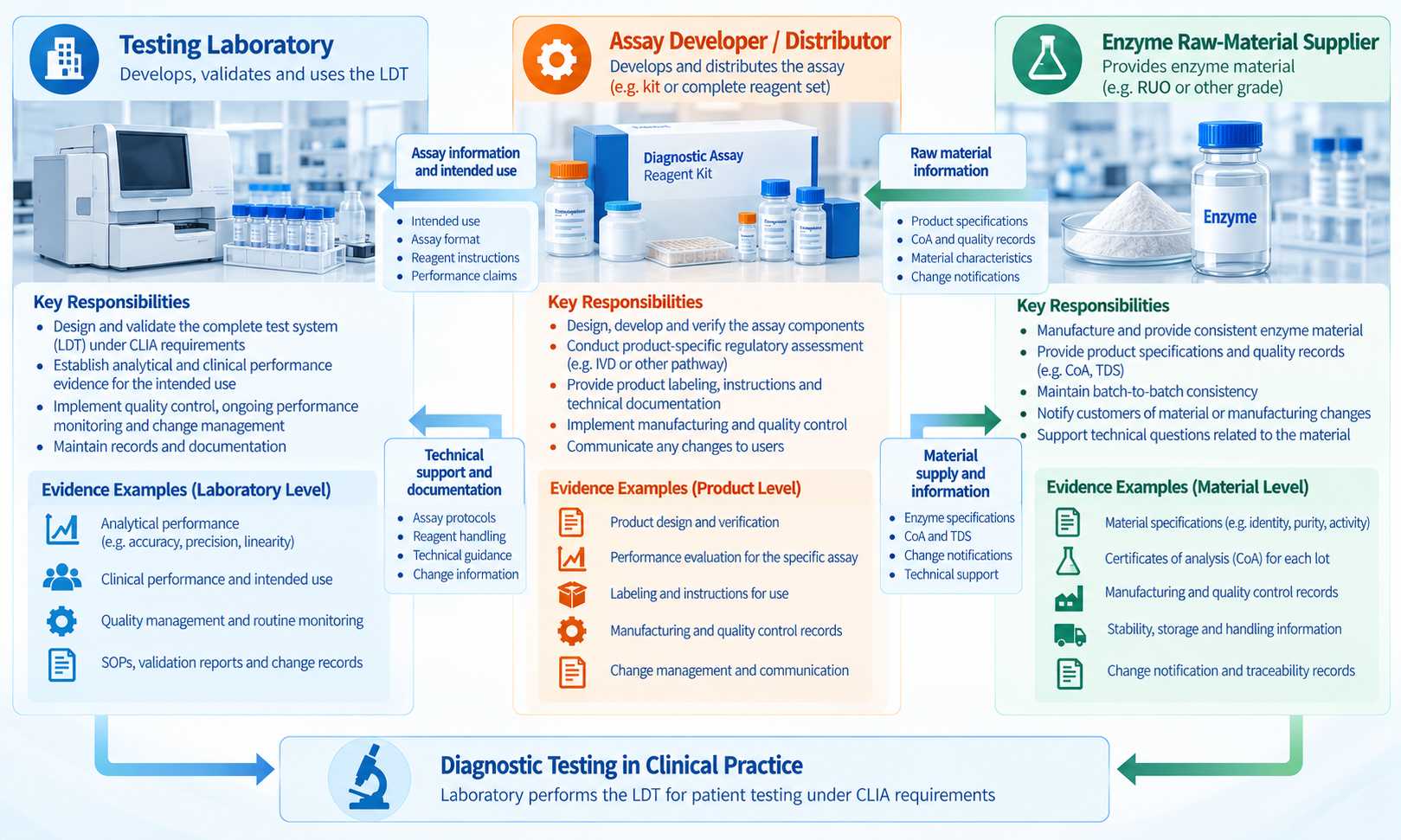
An enzyme supplier, a developer distributing a test product and a laboratory performing a testing service occupy different positions in the development chain. A commercial arrangement can involve more than one of these roles. Identify them explicitly instead of applying the label LDT to every component or transaction.
For a distributed product, assess its intended use, labeling and applicable product requirements on their own facts. The historical FDA LDT rule should not be used as a blanket exemption for a kit, instrument, reagent or other product supplied outside the laboratory's testing activity.
For a raw-material supplier, describe exactly what the supplied preparation and supporting data establish. Identity, activity, contamination controls, storage information and lot traceability can support downstream work. They do not constitute authorization of the customer's complete test or a clinical performance study.
Research use only, or RUO, also requires careful interpretation. FDA's 2013 RUO/IUO guidance concerns the intended use and distribution of the products within its scope. A research designation is not a general assurance that a later diagnostic use is acceptable, and changing terminology alone does not create the missing evidence or resolve product status.
Agree who will maintain the complete test-system file, approve changes and handle questions about claims. These operational responsibilities should remain clear even while policy evolves. Ambiguity between partners can leave critical work unowned without changing the underlying scientific need for it.
Build evidence that remains useful when policy changes
Begin with a written description of the proposed test and use. Record the specimen types, intended population, analyte or target, measurement output and decision the result is intended to support. This gives technical and regulatory reviewers the same starting point.
Preserve the configuration used to generate development evidence. For an enzyme-dependent assay, that includes the relevant enzyme preparation, formulation, use level, handling and complete test procedure. Without this traceability, a strong result can be difficult to connect to the material later used in routine operation.
Plan performance work around the intended claims and plausible failure modes. Near-threshold behavior, matrix effects, specificity and stored-reagent performance may require different studies. State which question each study answers and which claims remain unsupported.
Keep analytical and clinical evidence distinct. Analytical studies describe how the measurement behaves. Evidence connecting the result to the intended clinical use addresses a different question. A regulatory change does not make those scientific questions interchangeable.
Use a gap register with an owner, decision and evidence requirement for each unresolved item. For example, uncertainty about a supplier's activity definition calls for technical clarification, while uncertainty about the distribution model calls for a product-specific regulatory assessment. Combining them under a vague compliance risk makes neither easier to resolve.
Treat component changes as changes to an established configuration. Replacing a polymerase, signal enzyme or substrate may require evaluation even if the nominal biochemical function is unchanged. The scope depends on the assay and change; this update does not prescribe a universal retesting package.
Read the 2026 CLIA request for information as a consultation
CMS and CDC published a CLIA request for information on July 16, 2026, under CMS-3485-NC. It sought input on laboratory practices, including how laboratories establish performance specifications for tests that are not FDA-cleared or approved and for modified systems.
The notice's stated comment deadline was September 14, 2026. It explains that responses may inform possible future notice-and-comment rulemaking. An RFI does not itself replace the current performance requirements or establish a new compliance deadline for the subjects on which it asks questions.
For developers, the practical use is to identify topics to monitor and information worth organizing. Keep evidence of how performance specifications are established and maintained, and distinguish current obligations from possible future policy choices. Do not rewrite a release requirement solely because a consultation question mentions the topic.
When reading updates, check the document's action and status, not just the section of the Federal Register in which it appears. A consultation notice, proposed rule, final rule and effective regulation represent different stages. Headlines that collapse these stages can create an inaccurate project schedule.
Maintain a dated record of the regulatory basis
Create a compact source record for the project: document title, issuing body, publication date, status, section relied on and date checked. Identify whether a source establishes a requirement, explains an agency position or asks for comments. Retain the reasoning linking it to the proposed activity.
Assign a reviewer to revisit the record when the test's intended use, distribution arrangement, laboratory setting or material configuration changes. For this rapidly changing topic, review the official FDA and CMS sources before a consequential project decision, rather than relying solely on a periodic article update.
Keep historical material for context with a visible historical designation. Removing obsolete deadlines from a planning sheet should not erase the explanation for earlier decisions. A short change log can show what was replaced and why.
The useful outcome is a current, bounded plan: the activity is described, the responsible organizations are identified, performance evidence is traceable and open regulatory questions have owners. That plan supports development without predicting that every future policy change will take the same form.
For component transitions, see Change Control for IVD Raw Materials and Diagnostic Enzymes. For intended-use terminology, see RUO vs IVD-Grade Raw Materials: Practical Differences. Further quality topics appear in Diagnostic Enzyme QC, Validation and Regulatory Resources.
Research cutoff: September 24, 2026. U.S. scope only. Recheck official sources before implementation and review this article within six months, or sooner after a material policy development. No prediction of future legislation or product-specific legal conclusion is offered.
Sources and further reading
- U.S. Food and Drug Administration. Laboratory Developed Tests. Current status page; accessed September 24, 2026.
- U.S. Food and Drug Administration; Federal Register. Medical Devices; Laboratory Developed Tests. Final rule, September 19, 2025; document 2025-18239.
- U.S. Department of Health and Human Services; eCFR. 42 CFR 493.1253: Establishment and verification of performance specifications. Current text checked September 24, 2026.
- Centers for Medicare & Medicaid Services. CLIA Regulations & Compliance. Current overview; accessed September 24, 2026.
- Centers for Medicare & Medicaid Services and Centers for Disease Control and Prevention. Request for Information; Clinical Laboratory Improvement Amendments of 1988 Regulations. July 16, 2026; 91 FR 43586–43591; CMS-3485-NC.
- U.S. Food and Drug Administration. Distribution of In Vitro Diagnostic Products Labeled for Research Use Only or Investigational Use Only. Guidance for Industry and FDA Staff, November 2013.