

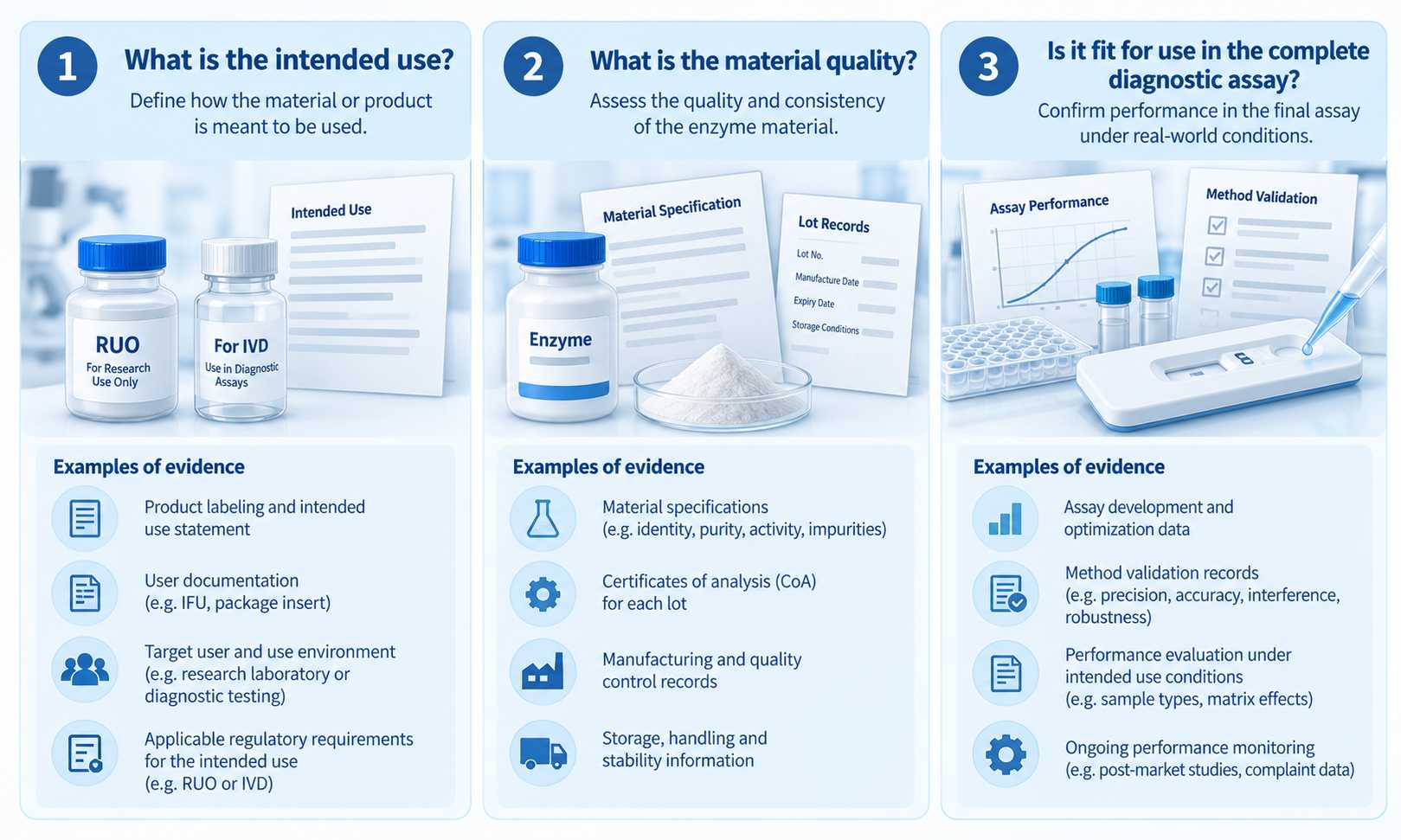
RUO and IVD-grade do not describe opposite ends of one purity scale. Research use only, or RUO, is an intended-use designation in a defined regulatory context. An IVD-grade raw-material description needs to be unpacked into specific quality, documentation and supply commitments. Neither label alone establishes performance in a finished diagnostic assay.
Compare the offering on three separate grounds: the intended use and applicable product status, the evidence supporting the supplied material, and its suitability in the complete reagent system. That approach is more informative than selecting an enzyme by the grade name alone.
Identify what each label actually claims
A raw-material description can combine several kinds of information: the enzyme identity, a technical grade, an intended-use statement and a supplier's service commitments. Read these as separate statements. A product described as suitable for development is not thereby established for every later use of the finished assay.
For an offering described as IVD-grade, ask which specification, controls and documentation distinguish it from another preparation. The answer might concern lot testing, traceability, formulation control or notification arrangements. Those differences must be stated and supported; the phrase by itself does not identify a complete regulatory pathway or authorize a diagnostic use.
RUO also does not quantify catalytic quality. A research preparation can be useful for a particular experiment while lacking the documentation or supply arrangements needed for another project. Its suitability for research does not establish that it may be distributed or used for a different purpose.
Avoid assuming either technical inferiority or automatic equivalence from the label. Two preparations may share an enzyme name yet differ in molecular form, formulation or measurement methods. Conversely, a difference in the commercial description may concern documentation rather than a proven change in catalytic behavior.
| Question | Evidence needed | Inference to avoid |
|---|---|---|
| What is the intended use? | Consistent labeling, product information and the applicable jurisdictional context. | A grade name alone determines product status. |
| What material is supplied? | Identity, formulation, specification and interpretable lot results. | RUO necessarily means low purity or weak activity. |
| How is supply controlled? | Traceability, agreed records and relevant change arrangements. | IVD-grade automatically includes every desired quality commitment. |
| Does it fit the assay? | Application evidence in the intended complete system. | A supplier label replaces assay qualification. |
Interpret intended use within the relevant jurisdiction
In the United States, FDA's 2013 RUO/IUO guidance addresses when IVD products are properly labeled for research or investigational use. The guidance emphasizes consistency between the designation, intended use and distribution practices. A label is not a stand-alone exemption when other evidence indicates a different intended use.
The FDA labeling overview also distinguishes research-phase products from products shipped for investigational testing. Investigational use only, or IUO, is not a synonym for RUO and is not simply a higher technical grade. The applicable conditions depend on the product and its use.
In the European Union, Article 1 of the IVDR excludes general laboratory and research-use-only products unless, considering their characteristics, the manufacturer specifically intends them for in vitro diagnostic examination. This scope rule makes the manufacturer's intended purpose relevant; it should not be reduced to a rule that every laboratory enzyme either requires or never requires an IVD designation.
A general-purpose reagent, a specifically intended IVD reagent and a material supplied into another manufacturer's production process can raise different questions. Establish the role of the actual product and the planned use rather than importing a conclusion from a superficially similar item.
Jurisdictional review and technical qualification should inform one another without being collapsed into one decision. A successful performance study does not rewrite the supplier's labeling. Equally, resolving the intended-use context does not demonstrate that the material meets the assay's technical requirements.
For a particular product, retain the assessment of intended use, responsible organization and relevant requirements with the development file. This guide provides the distinctions needed to ask the question; it does not determine a product's classification or supply a general permission for clinical use of research-labeled products.
Compare documented properties rather than assumed grade differences
Begin with identity and formulation. Confirm the enzyme form, relevant modifications, concentration basis and additives. A buffer component introduced with the stock can affect a downstream reaction even when nominal activity inputs are matched. Record what is known and what still requires clarification.
Compare activity definitions before comparing numerical values. STRENDA's reporting framework highlights the enzyme preparation and experimental conditions needed to interpret activity. The same unit symbol on two data sheets does not establish a common measurement basis.
Ask which attributes are tested for each lot and which are established through characterization or periodic controls. For the intended application, identify relevant contamination and functional risks. A generic purity percentage cannot replace a targeted assay for an impurity whose effect is disproportionate to its mass.
Assess what evidence supports handling and shelf-life statements for the supplied configuration. A research study using freshly prepared material may not reveal problems after shipping, repeated opening or incorporation into a stored reagent. Select comparisons that reflect the actual exposure states the project will require.
ISO 13485 concerns the quality management system and can be used by suppliers as well as medical-device organizations. System evidence can support supplier evaluation, but it does not assign a universal purity level to the product. Likewise, the U.S. QMSR's incorporation of ISO 13485:2016 does not turn a raw-material description into device authorization.
The GHTF supplier-control guidance provides a useful basis for linking controls to the risks of supplied products. In practice, ask for the specific records and arrangements needed for your material: a defined specification, traceable lot evidence, relevant technical support and a workable approach to changes.
| Dimension | Useful comparison question |
|---|---|
| Identity and formulation | Are molecular form, concentration and additives sufficiently defined for the intended reaction? |
| Analytical evidence | Are result methods and reporting limits clear enough to compare the materials? |
| Lot consistency | What evidence describes variation across representative production lots? |
| Handling support | Which storage, shipping and in-use states are supported? |
| Documentation | Which records accompany every lot and which are available through an agreed route? |
| Supply changes | What changes are notified, and what evidence supports their implementation? |
Plan the move from a research result to controlled supply
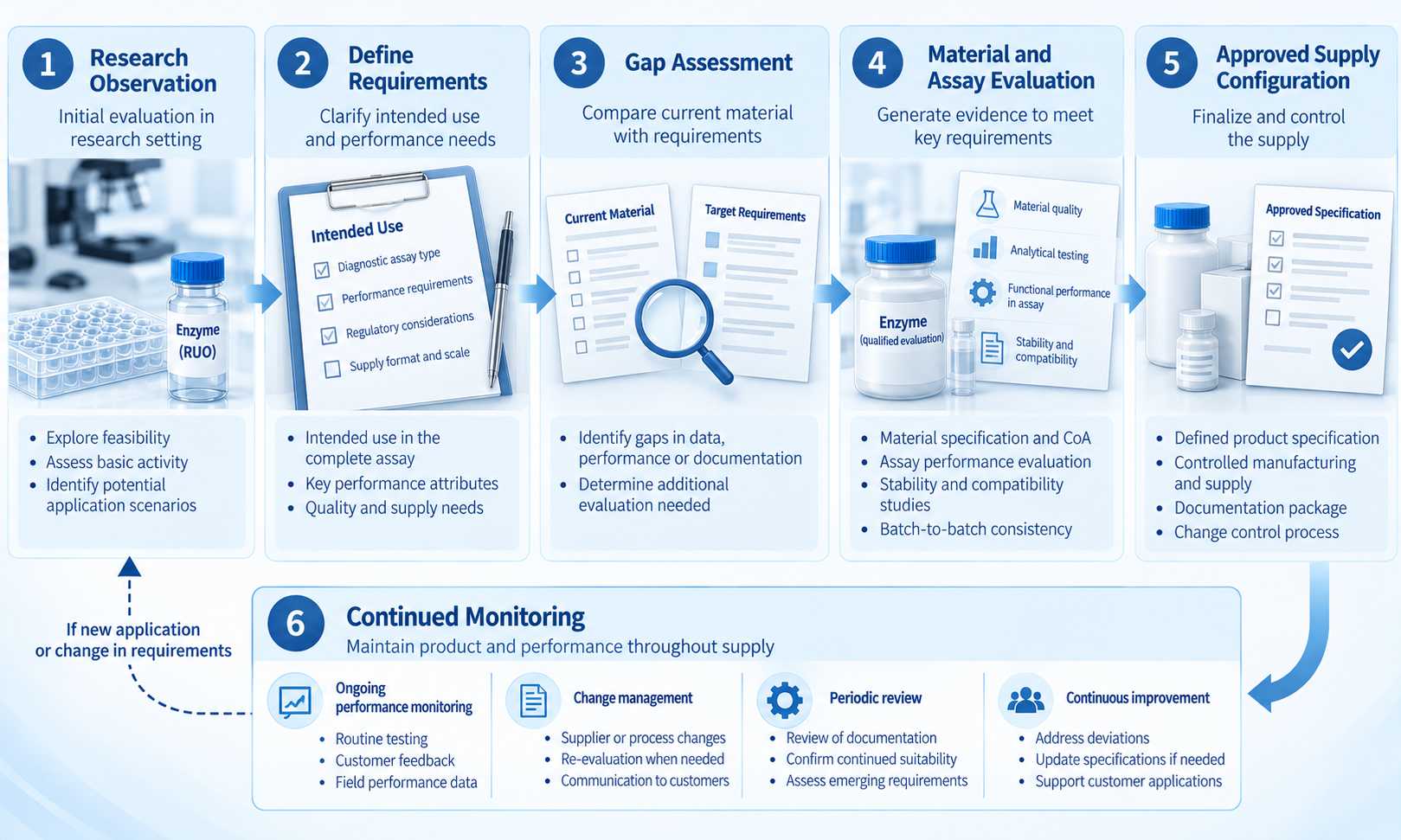
Start with the configuration that generated the research result. Record the exact material and how it was used, including stock volume, reaction conditions and handling. Without that baseline, a later production offering may be compared with an incompletely described experiment.
Translate the intended assay into material requirements. Identify attributes that could affect reaction efficiency, background, matrix tolerance or stored-reagent behavior. Some requirements may be satisfied by existing evidence; others may require additional characterization or application work.
If a supplier offers a different preparation for the next stage, treat the change as a comparison requiring evidence. Determine whether it changes only the documentation arrangement or also the source, formulation, analytical basis or manufacturing configuration. The scope of qualification follows those differences.
Confirm the planned supply and use arrangement with the responsible quality and regulatory functions. Purchasing a material under a new description or applying an internal label does not by itself resolve intended-use or regulatory questions. Preserve the rationale for the selected configuration and the conditions under which it can be used.
Evaluate material and complete-assay performance separately. A change may leave the isolated activity result unchanged while altering behavior in the final mixture or sample matrix. Conversely, a difference in one characterization result may have no demonstrated application consequence. Both observations deserve an evidence-based interpretation.
Record a selection decision that is specific enough to maintain
A useful selection record names the material, supplier configuration, intended project use and evidence reviewed. It identifies the acceptance criteria, outstanding gaps and person or function responsible for the final disposition. This prevents a broad grade description from becoming the only retained justification.
When evidence is incomplete, distinguish a limited research evaluation from acceptance for another stage. Define what the current decision allows and what must be resolved before moving further. A staged decision is useful only when its boundaries remain visible to the teams ordering, receiving and using the material.
Do not assume that all information gaps can be solved through extra incoming tests. Missing change notification, unresolved traceability or unsupported storage claims may require a different supplier arrangement or material configuration. Technical testing and supply controls address different failure modes.
Review the decision when intended use, material configuration or applicable requirements change. Keep claims proportional to the evidence: a qualified raw material supports the development and control of an assay, while the legal manufacturer remains responsible for the finished product's applicable requirements and performance evidence.
For the supplier evidence package, see ISO 13485 and Raw Material Documentation for IVD Enzyme Suppliers. For a replacement material, use Second-Source Qualification Guide for Diagnostic Enzymes. Additional quality resources are organized in Diagnostic Enzyme QC, Validation and Regulatory Resources.
Jurisdictional context reviewed September 24, 2026, using FDA materials and the IVDR consolidated text dated January 10, 2025. Recheck official sources for a specific decision and review this guide within six months. No universal legal status or technical specification is inferred from the phrase IVD-grade.
Sources and further reading
- U.S. Food and Drug Administration. Distribution of In Vitro Diagnostic Products Labeled for Research Use Only or Investigational Use Only. Guidance for Industry and FDA Staff, November 2013.
- U.S. Food and Drug Administration. In Vitro Diagnostic Device Labeling Requirements. Current public guidance; accessed September 24, 2026.
- European Parliament and Council; EUR-Lex. Regulation (EU) 2017/746 on in vitro diagnostic medical devices, Article 1. Consolidated text dated January 10, 2025; checked September 24, 2026.
- International Organization for Standardization. ISO 13485:2016—Medical devices: Quality management systems—Requirements for regulatory purposes. Third edition, 2016; current listing checked September 24, 2026.
- Global Harmonization Task Force, Study Group 3. Guidance on the Control of Products and Services Obtained from Suppliers. GHTF/SG3/N17R9:2008, December 11, 2008.
- STRENDA Commission, Beilstein-Institut. STRENDA Guidelines: Enzyme Kinetics and Assay Conditions. Current public guidelines; accessed September 24, 2026.
- U.S. Food and Drug Administration. Quality Management System Regulation (QMSR). Current official page; accessed September 24, 2026.